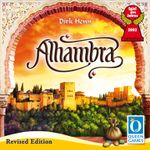
Top 93 · #17 of 60 in Family
Alhambra
A tile-collection game where you buy building tiles with four currencies to construct your own Alhambra palace — winner of the 2003 Spiel des Jahres. Paying the exact price to earn an extra turn keeps every turn tense.
Rules
Buy building tiles in four currencies to construct your own Alhambra palace. Paying the exact price keeps your turn going instead of ending it.
Components
| Component | Count | Notes |
|---|---|---|
| Starting tiles | 6 | Shows the Lion Fountain. Each player places one in front of them as the start of their Alhambra. |
| Building tiles | 54 | 6 kinds: 7 Pavillons, 7 Serails, 9 Arkaden, 9 Gemächer, 11 Gartens, 11 Türme. Each tile has 0–3 wall segments. |
| Money cards | 108 | 4 currencies — denars, dirhams, ducats and florins — each with values 1 to 9. |
| Scoring cards | 2 | Shuffled into the money pile; mark the 1st and 2nd scoring rounds. |
| Building market | 4 spaces | 4 building tiles are displayed on spaces 1–4. Each space has its own currency. |
| Reserve board | 1 per player | Holds tiles not yet added to your Alhambra. Tiles here do not score. |
| Scoring track & pawns | 1 + 12 pawns | Each player gets a scoring pawn and a starting-tile marker. |
For 2–6 players aged 8 and up, playing 45–60 minutes. Across three scoring rounds, points go to whoever holds the most of each building type and to the longest wall around your Alhambra. The player with the most points wins.
Setup
- 1Each player takes a starting tile, placing it in front of them, puts their scoring pawn on space 0 of the scoring track, and places their marker on the starting tile.
- 2Put all 54 building tiles in the bag, draw 4 at random, and display them in order on spaces 1–4 of the building market. Each space has a fixed currency.
- 3Set the 2 scoring cards aside, shuffle the rest of the money cards, and deal cards face up one at a time to each player until their total reaches 20 or more (currency doesn't matter). Do the same for the next player.
- 4Whoever received the fewest cards starts. Ties go to the lowest total money, then to the youngest player.
- 5Reveal 4 more money cards next to the building market. Split the remaining cards into 5 roughly equal piles, insert the 1st scoring card into the 2nd pile and the 2nd scoring card into the 4th pile, then restack and place face down.
Starting money is 20–28
Dealing stops the instant the total passes 20, so no one ever exceeds 28. Currencies can be mixed, and from here on each player's money is kept private.
Your turn — pick one of three
- 1Take money — take one face-up money card, or several that together total no more than 5.
- 2Buy a building tile — pay at least the printed price in the currency assigned to that space. No change is given.
- 3Redesign your Alhambra — move a tile from your reserve board into your Alhambra, move one from your Alhambra to your reserve board, or swap one for the other (a swapped-in tile must go in exactly the same spot).
Paying exactly keeps your turn going
If you pay the exact price, your turn does not end — you choose again from the three actions. Four exact payments in a row plus one final action means a turn can run up to 5 steps.
Your turn ends only once you can no longer pay exactly. Add the tiles you bought to your Alhambra, in any order, or place them on your reserve board. Then refill the building market and money cards back to 4 each. While it's still your turn, nothing is refilled.
Placement rules — walls and access
Building tiles cannot go anywhere you like. All five rules below must be followed.
- Every tile must face the same way as your starting tile (roofs all point the same direction).
- Adjoining sides must match — both walled or both open. A walled side cannot touch an open side.
- A new tile must join your Alhambra along at least one full side. Touching only at a corner is not allowed.
- You must be able to reach the new tile on foot from the starting tile without crossing a wall or leaving the tiles.
- You must never create an enclosed empty space completely surrounded by tiles.
Reserve board is free; the starting tile is fixed
Your reserve board can hold as many tiles as you like with no restriction. Redesigning still has to follow the five rules above, and the starting tile can never be removed or swapped.
Scoring — three rounds
The 1st and 2nd scoring rounds happen when the two scoring cards are drawn; the 3rd and final round happens at the end of the game. Each round awards points for holding the most of each building type and for the longest wall around your Alhambra.
| Building | 1st round, 1st place | 2nd round, 1st · 2nd | 3rd round, 1st · 2nd · 3rd |
|---|---|---|---|
| Pavillon | 1 | 8 · 1 | 16 · 8 · 1 |
| Serail | 2 | 9 · 2 | 17 · 9 · 2 |
| Arkaden | 3 | 10 · 3 | 18 · 10 · 3 |
| Gemächer | 4 | 11 · 4 | 19 · 11 · 4 |
| Garten | 5 | 12 · 5 | 20 · 12 · 5 |
| Turm | 6 | 13 · 6 | 21 · 13 · 6 |
Tile price doesn't matter for scoring
Only the number of tiles counts, not what they cost, and reserve-board tiles don't count at all. Ties share the combined points for those places, divided and rounded down — e.g. tied for 1st/2nd with 4 towers each: (13+6)÷2 = 9.5 → 9 points each.
Wall points are 1 point per walled side along your Alhambra's outer edge. Two tiles whose walls face each other on the inside don't count, and only the single longest unbroken run on the outside is scored.
End of the game
The game ends when, after a player's turn, there aren't enough building tiles left in the bag to refill the market back to 4. Any tiles remaining in the market go to whoever holds the most of that space's currency (by amount of money, not tile price; a tie leaves the tile on the market). These tiles can still be placed according to the placement rules.
The 3rd and final scoring round then happens. Whoever leads on the scoring track wins; a tie is a draw.
Tips
- An exact payment is itself a bonus action, so track your hand's totals ahead of time to chain several tile purchases in one turn.
- Right before a scoring round, focus your buying on a building type you already lead in. Later rounds pay out more per rank, so decide early which type you'll stockpile for the end.
- Internal walls never score, so design your Alhambra so walled sides keep facing outward.
- Holding tiles on your reserve board and redesigning at the right moment lets you fix up your wall shape before a scoring round.
Player-count variant and expansions
2 players — the imaginary third player 'Dirk'
With 2 players, remove one copy of each money card (72 cards total) and add an imaginary player called 'Dirk', who never takes a turn and never builds an Alhambra. Give Dirk 6 random tiles at setup, 6 more right after the 1st scoring round, and a third of the remaining bag (rounded down) after the 2nd scoring round. Either player may give a bought tile to Dirk instead of placing it. Dirk scores building-majority points only — never wall points.
3–6 players use the standard rules with no changes.
⚠️ Unverified: several small expansions (The Vizier's Favor, The City Gates, The Thief's Turn, The Treasure Chamber, The Power of Sultan) and a 2009 Big Box exist, per cross-checked Wikipedia and Namuwiki entries, but the checked official rulebook covers only the base game, so expansion rules are not included here.
Frequently asked questions
Q. If I overpay, do I get change?
No. There's no change — overpaying simply ends your turn.
Q. Can I redesign my Alhambra at any time?
No. On your turn you choose one of take money / buy a tile / redesign, and you can choose again only after an exact payment.
Q. Is there a limit to the reserve board?
No limit — you can stack as many tiles there as you like, but none of them score.
Q. Do internal walls inside my Alhambra score?
No. Only walls facing outward along the longest unbroken outer run score; internal (back-to-back) walls never count.
Q. Does a more expensive building tile score more?
No. Only the count of tiles matters, not price. You need at least 1 of a type to score it at all.
Q. How are ties split?
Add together the points for the tied places and divide by the number of tied players, rounding down.
History and awards
Designed by German designer Dirk Henn and published by Queen Games in 2003, the game won that year's Spiel des Jahres and was also a finalist or runner-up for several other awards, including 2nd place in the Deutscher Spiele Preis, the Swiss Gamers Award, and the Essen Feather.
In Korea, YES24 and 11st listings show the German edition was imported by Korea Boardgames (country of manufacture: Germany) at some point, but as of October 2026 Korea Boardgames' own storefront search returns no results for 'Alhambra', suggesting no localized Korean-language edition ever existed. The building tiles carry their German names as printed.
Several small expansions (The Vizier's Favor, The City Gates, The Thief's Turn, The Treasure Chamber, The Power of Sultan) followed, along with a combined Big Box (cross-checked via Wikipedia and Namuwiki). Exact release years for each expansion and any Korean release were not confirmed.
Sources
Official Queen Games English rulebook (2003, © Queen Games)Distribution check — YES24 product listing: Alhambra (manufactured by Queen Games / imported by Korea Boardgames, country of manufacture Germany)Distribution check — Korea Boardgames storefront search: no results for 'Alhambra'Wikipedia cross-check — Alhambra (board game)Namuwiki cross-check — Alhambra (board game, Korean)Rule summaries are reference content written by us, not quotations from the official rulebook. Always check the official rulebook for exact rules. Diagrams are original schematics, not rulebook illustrations.
Spotted a mistake? Tell us in the comments below →
Last updated 2026-10-10
💡 Master tip
Aim for combos where you pay the exact price to keep your turn going, and try to take the lead in a specific building type right before a scoring round. Since later scoring rounds award more points per building type, it helps to decide in advance which type you'll stockpile until the end.
Ready for something heavier
If this one has gotten too easy, try these — same feel, one step up in weight.
Tools you can request
Not built yet. Let us know if you want one — it goes on the list.
Building Majority Bonus Calculator
Automatically calculates majority points per building type at each interim and final scoring round
Comments
Share your thoughts, report a mistake, or request a tool. No sign-in needed — nicknames are not verified, so anyone can use the same one.
Loading…