Top 119
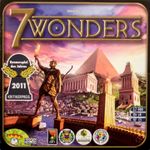
7 Wonders
You take charge of a city built around one of the seven wonders of the ancient world and grow your civilization by drafting cards over three Ages. Everyone plays at the same time, so even a game with 7 people is over in 30 minutes, and it has become the standard for strategy games with a big group.
Rules
Pick one card from your hand and pass the rest to your neighbor — that is the drafting engine. Three Ages of 6 turns each, 18 cards played, and it is over. Scoring runs down seven separate tracks, so it looks complicated at first, but the only decision you ever make is “do I take this card, or let my neighbor have it?”
Components and the 7 card colors
| Component | Count |
|---|---|
| Wonder boards | 7 (double-sided, side A and side B) |
| Age cards | 49 Age I · 49 Age II · 50 Age III |
| Conflict tokens | 42 |
| Coins | 30 value 1 · 20 value 3 |
| Card color | Type | What it does |
|---|---|---|
| Brown | Raw Materials | Produce stone, wood, clay and ore |
| Gray | Manufactured Goods | Produce glass, textile and papyrus |
| Blue | Civilian Structures | Score the victory points printed on the card |
| Green | Scientific Structures | Collect symbols and the points grow as a square |
| Yellow | Commercial Structures | Earn coins and change the trading rules |
| Red | Military Structures | Add shields so you win conflicts |
| Purple | Guilds | Conditional points. They only appear in Age III |
The Age III deck contains no brown or gray cards. Ages I and II are your only chance to add resource production, so lay it down early.
Setup
- 1From each Age deck, return to the box the cards that do not match your player count. The number is printed at the bottom center of the card, as “3+”, “4+” and so on. In a 6-player game you use 3+, 4+, 5+ and 6+, and take out the 7+ cards.
- 2For the Age III deck, additionally: keep only “player count + 2” of the 10 purple Guild cards, chosen at random, and secretly remove the rest. Shuffle the Guilds you kept into the Age III deck.
- 3Shuffle the 7 Wonder cards and deal one to each player. The card and which way up it is decide the Wonder board and the side each player uses.
- 4Each player takes 3 value-1 coins and places them on their board. The rest form the bank.
- 5Put the Conflict tokens in a reserve next to the coins.
Use side A for your first few games — the rulebook recommends it. If everyone agrees, Wonders may be chosen rather than dealt at random. If you removed the right cards, every Age should deal out exactly 7 cards each.
A turn — choose, play, pass
At the start of each Age you receive 7 cards. An Age lasts 6 turns, and every turn all players place one card simultaneously.
- 1Choose 1 card from your hand and place it face down in front of you. Set the rest aside.
- 2Once everyone has chosen, all players act at the same time. There are three options.
- 3Pass the rest of your hand to your neighbor and take a new hand from the other side.
| Action | What it does |
|---|---|
| ① Build the structure | Build the building shown on the card. Pay its cost |
| ② Build a stage of your Wonder | Slide the chosen card face down under your board as a marker. You pay the cost printed on the board |
| ③ Discard the card for 3 coins | Take 3 coins from the bank |
The passing direction changes with each Age
Age I to the left → Age II to the right → Age III to the left. That is why the neighbor you have to watch changes from Age to Age.
The sixth turn — 1 of 2
On the last turn of each Age your hand is 2 cards. Choose one and play it as usual, then discard the other face down. That discarded card does not earn you 3 coins.
You may never build the same structure twice. If a card has the same name and illustration as one you already own, you cannot build it. Use it for a Wonder stage or discard it instead.
Costs and commerce
Resources are not spent
We say you “spend” resources to build, but nothing actually goes away. A brown or gray card you played once gets used again every single turn for the rest of the game. A city's production never goes down.
- If you lack a resource you can buy it from either of your two neighboring cities. You pay the owner 2 coins per resource.
- What you can buy is the neighbor's base production printed on the Wonder board, plus their brown cards and gray cards.
- Resources from yellow cards or from Wonders cannot be bought. They are reserved for their owner.
- Selling does not stop you using the resource yourself that same turn. Nothing is consumed.
- You may buy several resources from both sides in one turn, and no one may refuse to sell.
- If both neighbors produce the resource you want, you choose freely which one to buy from.
- Some yellow cards lower the purchase cost from 2 coins to 1.
Coins earned this turn cannot be spent this turn
To buy resources you must have had the coins at the start of the turn. Coins a neighbor pays you for your resources this turn are only usable from the next turn on. This is the rule new players get wrong most often.
Free Construction (Chains)
If an Age II or Age III card shows the name of an earlier structure to the right of its cost, then if you have already built that structure you build this one for free, with no resources. Build the Scriptorium in Age I, for instance, and the Library is free in Age II.
Building your Wonder
- Use any card from your hand as a marker to build a stage. Whatever that card would have done is lost.
- You pay the cost printed on the Wonder board. The card's own cost is irrelevant.
- Stages must be built in order, left to right.
- Each stage may be built only once per game.
- Building your Wonder is not mandatory. You can win without finishing, or even starting, it.
- Stages are not tied to Ages. You may build several in one Age, or start in Age III.
The standard play is to use a card you do not want your neighbor to have as the marker. It is face down and has no effect anyway, so you make the card they were hoping for disappear.
Conflict — compared with both neighbors each Age
At the end of the sixth turn of each Age you resolve conflicts. Compare the total shields on your red cards with the city on your left and the city on your right, separately.
| Result | Token you take |
|---|---|
| You have more | The Victory token for that Age — Age I +1 · Age II +3 · Age III +5 |
| You have fewer | A Defeat token, −1 |
| Equal | You take nothing |
Defeat tokens stack up. Lose on both sides in all three Ages and that is −6 points. On the other hand an Age III victory is +5 on a single token, so you have to decide: abandon the military entirely, or save it all up and win in Age III.
Final scoring — seven tracks, in order
| Order | Category | How it scores |
|---|---|---|
| 1 | Military conflicts | Victory and Defeat tokens added up. This can be negative |
| 2 | Treasury | 1 point per 3 coins. Leftovers score nothing |
| 3 | Wonder | The points printed on the stages you completed |
| 4 | Civilian Structures (blue) | The points printed on the cards |
| 5 | Scientific Structures (green) | See “science scoring” below |
| 6 | Commercial Structures (yellow) | Some Age III yellow cards give conditional points |
| 7 | Guilds (purple) | Each has its own condition. Some look at the neighboring cities |
Science scores both ways, added together
① Sets of identical symbols score the square of how many you have (1→1, 2→4, 3→9, 4→16). ② Each group of 3 different symbols scores 7 points. You collect both.
- There are 4 green cards per symbol, so one symbol caps out at 16 points.
- The Scientists Guild and the Wonder of Babylon can push past that cap: 5 symbols score 25 and 6 score 36.
- Highest total wins. On a tie, the player with more coins wins. If coins are tied too, the tie stands.
The official 2-player “Expert” variant
- Use the Border card and the Free city card from the box.
- Play with the 3-player card set (3+ only), and put a third board between the two players to serve as the “Free city.”
- Both players and the Free city start with 3 coins. Each player takes a 7-card hand, and the remaining 7 cards form a draw pile to the right of the Border card.
- The player holding the Free city card takes the top card of the draw pile into hand, then chooses one card for themselves and one for the Free city. The opponent just chooses their own card.
- The Free city can buy resources from both sides, and may only discard for 3 coins if it cannot play at all. If a free construction chain is available, it must be used.
- Each turn you take the stack on the other side of the Border card, so control of the Free city alternates.
- Which player holds the Free city card first changes each Age: Age I the player to the left of the Free city, Age II the player to the right, Age III the left again.
The rulebook itself suggests playing a few 3–7 player games before trying the 2-player variant. For two players, “7 Wonders Duel” runs far more smoothly.
Rules people get wrong
Q. Are resources used up when I build?
No. Once played they are reused every turn for the rest of the game. That is why laying down brown and gray cards early matters so much.
Q. Can I spend coins I earned this turn from selling resources?
No. Only coins you held at the start of the turn. Money you earn becomes usable next turn.
Q. If I sell a resource, can I still use it this turn?
Yes. Resources are never consumed, so you sell it and build with it at the same time.
Q. Can I build two copies of the same structure?
No. If a card with the same name is already in your city, you cannot build it. Use it for a Wonder stage or discard it.
Q. Can I skip a Wonder stage?
No. Stages are built strictly left to right.
Q. Do I get 3 coins for the card discarded on the sixth turn?
No. That card is simply discarded. Coins only come from choosing the “discard” action.
Q. What if I cannot do anything with the card I chose?
You are forced to discard it and take 3 coins.
Q. Do I pick either the squares or the sets of three for science?
You get both. Scoring them twice over is the rule.
Q. Can a neighbor buy the resources my yellow card produces?
No. Resources from yellow cards and from Wonders are reserved for their owner.
History and editions
| Item | Detail |
|---|---|
| Designer | Antoine Bauza |
| Published | Repos Production, 2010 |
| Award | The very first winner of the 2011 Kennerspiel des Jahres (German Game of the Year, connoisseur category) |
| Players | 2–7 (2 players uses a dedicated variant) |
| Expansions and spin-offs | Released | Note |
|---|---|---|
| Leaders | 2011 | Adds a draft of leader cards |
| Cities | 2012 | Adds black cards and debt |
| Babel / Armada / Edifice | 2014–2019 | Modular expansions |
| 7 Wonders Duel | 2015 | A standalone 2-player game. The rules differ considerably |
| Second edition | 2020 | Tidied-up art and icons. The rules are essentially unchanged |
Sources
Official Repos Production rulebook (7 Wonders, English)Cross-checked against Wikipedia: 7 WondersCross-checked against Namuwiki: 7 Wonders (Korean)Rule summaries are reference content written by us, not quotations from the official rulebook. Always check the official rulebook for exact rules. Diagrams are original schematics, not rulebook illustrations.
Spotted a mistake? Tell us in the comments below →
Last updated 2026-09-14
💡 Master tip
Science pays off enormously when you commit to it, but it also draws the most blocking. Look at what your two neighbors produce and do not build resources you can simply buy from them — that is the heart of drafting well.
Related games
Similar games
Ready for something heavier
If this one has gotten too easy, try these — same feel, one step up in weight.
Tools you can request
Not built yet. Let us know if you want one — it goes on the list.
Final scoring
Adds up all seven categories, including the squared science score
Comments
Share your thoughts, report a mistake, or request a tool. No sign-in needed — nicknames are not verified, so anyone can use the same one.
Loading…