Top 80 · #15 of 60 in Family
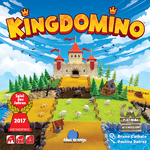
Kingdomino
An entry-level tile-placement game where each round you draft a domino tile showing two kinds of terrain and build your own kingdom within a 5x5 area. The turn-order tension of taking a lower-numbered tile at a loss in exchange for first pick next round creates the game's core tension. The rules are so simple that even someone new to board games can learn it quickly.
Rules
Each round, players draft a two-square domino and attach it to their 5×5 kingdom, scoring big when matching terrain stretches wide and carries crowns. The tension comes from taking a weaker domino on purpose to secure first pick next round.
Components
| Terrain | Plain | 1 crown | 2 crowns | 3 crowns | Total |
|---|---|---|---|---|---|
| Wheat field (yellow) | 21 | 5 | — | — | 26 |
| Lake (blue) | 12 | 6 | — | — | 18 |
| Grassland (light green) | 10 | 2 | 2 | — | 14 |
| Swamp (tan) | 6 | 2 | 2 | — | 10 |
| Forest (dark green) | 16 | 6 | — | — | 22 |
| Mine (black) | 1 | 1 | 3 | 1 | 6 |
| Total | 66 | 22 | 7 | 1 | 96 squares (48 dominoes) |
| Component | Count |
|---|---|
| Starting tiles (single square) | 4 — one per player |
| 3D castles | 4 — one per color (pink, yellow, green, blue) |
| Wooden kings | 8 — two per color |
Terrain names are this guide's translations
Wheat field, lake, grassland, swamp, forest and mine are descriptive names this guide assigned from the English rulebook's artwork; the official printed terms on a Korean box were not cross-checked.
Setup — three player-count variants
- 12 players: each takes 2 kings and a starting tile. Use only 24 randomly selected dominoes out of 48.
- 23 players: each takes 1 king. Randomly set aside 12 dominoes and use only 36.
- 34 players: each takes 1 king. Use all 48 dominoes.
- 4Shuffle the dominoes numbered side up, draw as many as there are players (2–4), line them up in ascending order, and flip them to show the terrain side.
Only the first round assigns kings randomly
On the first turn only, one player gathers all the kings and places them one at a time on dominoes (not necessarily your own color). From the next round on, each player places their own king on their own turn.
Taking a turn — place, then reserve the next tile
- 1The player whose king sits on the lowest-numbered domino goes first.
- 2① Add the domino that held your king to your kingdom, following the connection rules.
- 3② Place your king on a domino of your choice in the newly revealed line. Choose among dominoes with no king yet; the last player has no choice but to take whichever domino remains.
- 4Once every domino in the line has a king, a new line is formed and the next round begins.
- 5In a 2-player game, each player performs these two actions twice, once per king. The game runs 12 turns with 3 or 4 players and 6 turns with 2 players (since each turn covers one action per king, the effective number of actions is similar).
Low numbers cut both ways
Taking a weaker domino on purpose earns you first pick next round. Trading away value for turn order is the heart of the game.
Connection rules — matching terrain and the 5×5 limit
- A kingdom fits inside a 5×5 grid. Each domino covers 2 squares.
- To place a new domino, either ① connect it to the starting tile (a wildcard — it connects to any terrain), or ② connect it to an already-placed domino sharing at least one matching terrain along an edge (diagonal contact does not count).
- If neither condition can be met, the domino must be discarded and scores nothing.
- Even with room elsewhere, a domino is also discarded if placing it would fall outside the 5×5 grid. Leaving space around the castle in advance avoids being forced to discard a strong domino later.
Different from the catalog summary
The catalog summary mentions only "not connected to the castle" as a reason for discarding. The official rules separately specify both mismatched terrain and falling outside the 5×5 grid. This guide reflects both reasons.
Scoring — territory size × crowns
- 1Once placement ends, each player has a 5×5 kingdom in front of them (it may have gaps if any dominoes were discarded).
- 2Squares of the same terrain connected horizontally or vertically form one territory. A kingdom may contain several territories of the same terrain type.
- 3A territory's score = its number of squares × the total crowns within it.
- 4A territory with no crown scores 0, no matter how large it is.
- 5Add up every territory's score for your final total. The highest score wins.
Crownless territory is a wasted investment
Securing terrain that carries crowns matters more than simply growing your total square count.
Ending the game and breaking ties
- 1Once the last line of dominoes has been placed, players take one final turn performing only action ①.
- 2On a tie, whoever has the largest single territory (by square count, regardless of crowns) wins.
- 3If still tied, whoever has the most crowns across their whole kingdom wins.
- 4If still tied, the players share the victory.
Tips for playing together
- Rather than filling in right next to the castle immediately, plan your general direction early and leave room at the edges so a large territory can later connect without a gap.
- Before taking a high-crown mine, swamp or grassland domino, weigh whether it's worth losing your position for next round's pick, since whoever takes it picks later.
- In the last few rounds, check in advance whether anything would be discarded, and when in doubt, secure the spot that definitely fits inside the 5×5 grid.
- Deliberately taking a low-numbered domino to secure first pick next round is also a valid strategy.
Player-count rules and expansions
| Name | Difference | Verification status |
|---|---|---|
| 2-player duel (in the base rulebook) | Each player acts twice per round using 2 kings, still on a 5×5 grid | Confirmed via the official English rules |
| The Mighty Duel (optional 2-player rule) | Uses all 48 dominoes to expand the kingdom to 7×7 | Confirmed via the official English rules |
| Dynasty, Middle Kingdom, Harmony (optional rules) | Play 3 rounds in a row / +10 points if the castle is centered / +5 points if no domino was discarded | Confirmed via the official English rules |
| Queendomino (standalone expansion) | A separate product adding knights, dragons and buildings. Happy Baobab distributes a Korean edition domestically | Existence confirmed only; rule text not cross-checked |
| Kingdomino: Age of Giants (expansion) | A 2–5 player expansion adding giant meeples, footstep dominoes and quest tiles. Happy Baobab distributes a Korean edition of this expansion domestically | Giant/footstep rules confirmed via the official English expansion rules; the Korean edition was not cross-checked |
This guide focuses on the base game for 2–4 players. The full rules for the Queendomino and Age of Giants expansions should be checked against each product's own rulebook.
Frequently confused rules
Q. Must I place the domino that held my king right away?
Yes. The first action of your turn is placing the domino that held your king into your kingdom under the connection rules. If there's no legal spot, that domino is discarded.
Q. Does touching diagonally count as a terrain connection?
No. A connection is only recognized along a horizontal or vertical edge. Diagonal contact does not count.
Q. Can I place a domino partly outside the 5×5 grid and sort it out later?
No. A spot outside the 5×5 grid is never legal to begin with. If poor planning leaves no legal spot, that domino is simply discarded.
Q. Is it better to split crowned terrain into several separate territories?
No. Since scoring is (squares × crowns) per territory, splitting the same terrain into several territories usually loses points by shrinking each territory's square count. Keeping it connected as one territory is usually better.
Q. Why does a 2-player game give each player 2 kings?
Because a 2-player game has each player act twice per round. This keeps the effective number of actions similar to the 12-turn game with 3 or 4 players.
Q. Can I mix Queendomino or Age of Giants into the base game?
Age of Giants is an expansion meant to be added to base-game (or Queendomino) dominoes with its own 12 dominoes and quest tiles, but this guide did not cross-check its full rule set. Check that expansion's own rulebook before mixing it in.
Editions and verification scope
Designed by Bruno Cathala and published by France's Blue Orange Games, released in 2016. It won Germany's Spiel des Jahres (Game of the Year) in 2017.
Happy Baobab distributes the Korean edition of Kingdomino domestically, and several retailers also list Korean editions of Queendomino, Kingdomino: Age of Giants, Kingdomino Origins and Kingdomino Duel. However, this research did not obtain an official Korean rulebook PDF directly, so it remains `ko: unverified`.
English Wikipedia also covers the 2021 children's spin-off Dragomino (winner of Kinderspiel des Jahres), the 2021 prehistoric-themed Kingdomino Origins, and the 2019 dice-based Kingdomino Duel. This guide covers only the 2016 base game's rules.
Sources
Official Blue Orange English rules — base game (PDF pages 2–4) checked in fullOfficial Blue Orange English expansion rules — Age of Giants (PDF pages 2–4), giant and footstep domino rules checkedWiki cross-check — English Wikipedia: Kingdomino (designer, awards, expansion timeline)Wiki cross-check — Namuwiki: Kingdomino (Korean distribution and optional rules)Rule summaries are reference content written by us, not quotations from the official rulebook. Always check the official rulebook for exact rules. Diagrams are original schematics, not rulebook illustrations.
Spotted a mistake? Tell us in the comments below →
Last updated 2026-10-10
💡 Master tip
Taking a high-crown tile early, even at a turn-order disadvantage, to aim for a large territory's multiplied score is the key to a late-game comeback. It's good to place terrain carefully around the castle from the start, leaving room so that a good tile appearing later can still connect without breaking the chain.
Ready for something heavier
If this one has gotten too easy, try these — same feel, one step up in weight.
Tools you can request
Not built yet. Let us know if you want one — it goes on the list.
Terrain multiplication score scanner
Automatically multiplies and sums connected tiles and crown counts per territory
Comments
Share your thoughts, report a mistake, or request a tool. No sign-in needed — nicknames are not verified, so anyone can use the same one.
Loading…