Top 49
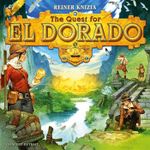
The Quest for El Dorado
A race game where you buy and strengthen your deck while crossing a jungle map to be first to reach the city of gold. This deck-building-and-race hybrid is one of Reiner Knizia's standout later works: you can combine tiles into a different course every game, making it work as both a family game and a strategy game.
Rules
Strengthen your starting deck with cards bought from the market while racing across jungle, river, and village hexes toward the golden city of El Dorado — a deck-building race game. A card's color and power must match the hex's requirement before you can move onto it.
Components and reading the terrain
| Component | Count | Notes |
|---|---|---|
| Starting tile (A/B) | 1 (double-sided) | Double-sided tile with starting spaces 1 through 4 |
| Terrain tiles (C/D–M/N) | 6 (double-sided) | The basic tiles used to build the route |
| Terrain strips (O/P, Q/R) | 2 (double-sided) | Strip-shaped tiles for longer routes |
| Ending tile | 1 (double-sided) | The gate to El Dorado; it has no starting spaces |
| Blockades | 6 (numbered 1–6) | Obstacles placed randomly on connections between tiles |
| Expedition boards | 4 | One per player, holding your hand, draw pile, and discard pile |
| Starting deck | 8 per player (1 Sailor, 3 Explorers, 4 Travelers) | Each card shows its owner's color in the bottom right corner |
| Starting player hat token | 1 | Marks the first player |
| Marketplace cards | 54 (18 types × 3 each) | The full pool of cards available to buy |
| Market board | 1 (2 pieces) | 6 face-up slots plus space above for 12 reserve piles |
| Adventurer playing pieces | 8 (2 per player) | 3–4 players use only 1; 2 players use both |
| Cave tokens | 36 | Caves variant only — not used in the base game |
Each card shows its color, symbol, and power value in the top left, its purchase price in coins at the bottom left, and a small setup symbol at the bottom right. White joker cards let you choose machete, paddle, or coin when played. Purple action cards (Transmitter, Scientist, Cartographer, Travel Log, Compass, Native) may be played anytime during movement or buying to apply their printed effect.
Setup
- 1For a first game, lay out the suggested route (starting tile B plus terrain tiles C, N, I, and K) exactly as shown. For later games, use one of the easy, moderate, or difficult routes, or design your own.
- 2Shuffle the 6 blockades face down and place one randomly on every connection between tiles or strips, then turn them face up. Return the rest to the box.
- 3Place the 6 piles bearing the setup symbol side by side on the market board, and stack the other 12 piles without that symbol above the market board.
- 4Each player takes 1 expedition board and the 8-card starting deck, shuffles it, places it face down as their draw pile, and draws 4 cards into hand.
- 5Whoever sat down first takes the hat token and places a piece on starting space #1; the rest take the next vacant starting space in turn order. In a 2-player game, the starting player occupies #1 and #3, the other player #2 and #4.
Two players use two pieces
In a 2-player game, each player receives 2 playing pieces and must get both into El Dorado to win. With 3 or 4 players, each uses only 1 piece.
Turn structure — 3 phases
- 1① Play cards — play any number of cards from your hand to move your piece and/or buy 1 card. Each card may be used for only one of moving or buying per turn.
- 2② Discard played cards — put all cards played for movement this turn onto your discard pile. Cards played onto a base camp are instead removed from the game entirely. Cards still in hand may be kept or discarded freely.
- 3③ Draw cards — draw from your draw pile until you hold 4 cards. If the pile runs short, shuffle your discard pile into a new draw pile and keep drawing.
Move first, then buy
The rulebook's own example finishes movement before spending the remaining cards' coin value on a purchase. Spending every card on movement first can leave nothing to buy with.
Movement — matching terrain and card symbols
- 1Play a card whose color/symbol matches the space, with a power value equal to or higher than the space's requirement, to move onto it.
- 2If the played card has leftover power (for example, a power-2 card used on a power-1 space), you may continue onto the next matching space with the remaining power. You may stop at any time, and any unspent power is lost immediately.
- 3Rubble takes any cards regardless of color or symbol, as many as the space shows; a base camp works the same way, except those cards are removed from the game entirely.
- 4The black mountain and any space already occupied by another piece cannot be entered by any card.
You cannot combine cards to clear one space
A space with a high power requirement must be met by a single card (or the power left over from it). Adding together the power of several weaker cards is never allowed.
Buying cards at the market
- 1Cards with a coin symbol count for their full power value; every other card counts as ½ coin. Add up the coin value of all the cards you played this turn.
- 2Choose 1 card whose price is at or below your total, from the market board's 6 slots or, if a slot is empty, from the reserve piles above it as well. No change is given.
- 3Put the purchased card on your discard pile. It does not go straight into your hand — you will draw it only after your discard pile is shuffled into a new draw pile.
- 4Whenever a market board slot sells out, refill it from one of the reserve piles above it. Any reserve pile's cards become purchasable as soon as a slot is open.
Thin your deck at the base camp
Removing low-power starting cards at a base camp permanently thins your deck, making your strong cards come up more often.
Breaking through blockades
A blockade sits on the connection between two tiles, or between a tile and a strip. Like a terrain space, it has its own symbol and power requirement, and you overcome it the same way you move.
Whoever breaks through keeps it
The first player to overcome a blockade takes its numbered piece and keeps it. After that, any player may freely pass through that spot, and kept blockades serve as the tiebreaker at the end of the game.
Game end and tiebreakers
- 1As soon as a player reaches one of the ending tile's three finishing spaces, it triggers the final round. That piece is moved onto the gate to El Dorado to free up the finishing space.
- 2Every other player who still has a turn left in that round takes exactly one more turn each.
- 3The game ends once the last player in that round finishes their turn — even if that player reaches El Dorado for the first time on that very turn.
- 4If only one player has reached El Dorado, that player wins. In a 2-player game, you must bring both pieces in to count as arriving.
Tiebreaker order
If multiple players reach El Dorado in the final round, whoever holds the most blockades wins. If still tied, whoever holds the highest-numbered blockade wins. If the tied players hold no blockades at all, whoever arrived first wins.
Strategy tips
- Cards played at a base camp are removed permanently. Thinning out low-power starting cards (Sailors, Explorers) makes your stronger cards appear more often.
- One card's leftover power can be spread across spaces, but several cards' power can never be combined for one space. Plan to buy strong enough cards ahead of any high-cost stretch of route.
- A purchased card does not go straight into your hand — it waits on your discard pile until it is shuffled back into your draw pile. A late-game purchase may not help you that same game.
- Breaking through a blockade yourself lets you keep its number. If a tie looks possible, breaking a high-numbered blockade early is cheap insurance.
- Once one of the market board's 6 slots sells out, all 12 reserve piles above it become purchasable. Watch which slot is likely to empty first to time your purchases.
Player-count rules and expansions
- 2-player variant (an official base-game rule): each player receives 2 pieces and must bring both into El Dorado to win. A single card applies to only one piece and cannot be split between them.
- Caves variant: some mountain spaces get a face-down cave tile; stopping next to one earns a token usable for extra movement, swapping cards, or removing cards. The base game's win condition itself does not change.
- Korean-market expansions: Korea Boardgames has released localized editions of "The Quest for El Dorado: Perils & The Muisca," "Dragons, Treasures, and the Hidden Places," and "The Quest for El Dorado: Legendary Explorers & Curses." This guide covers only the base game and does not include their rules.
New and old editions use different card sizes
The 2023 edition (new artwork, larger cards, and 3 action cards built into the base game) has a different card size than the 2017 edition (model 26720), so their expansions are not compatible. Check which edition you have before buying an expansion.
Frequently confused rules
Q. Can I combine several cards to meet one space's high power requirement?
No. A single space must be satisfied by one card (or the power left over from it). Adding together the power of several cards is not allowed.
Q. How do I cross the black mountain spaces?
You cannot, with any card or action card. The rulebook specifically notes that even the Native card cannot be used to move onto a mountain space or an already-occupied space.
Q. What happens when I break through a blockade?
The first player to break through takes its numbered piece and keeps it. After that, anyone may pass freely, and kept blockades decide ties at the end of the game.
Q. Does a card bought at the market go straight to my hand?
No. A purchased card goes on top of your discard pile, and you only draw it once that discard pile is shuffled back into your draw pile.
Q. What cards can I use on rubble and base camp spaces?
Any cards at all, regardless of color or symbol, as many as the space requires. Cards played on rubble go to your discard pile as usual, but cards played on a base camp are removed from the game entirely.
Q. How many pieces do I use in a 2-player game?
Each player uses 2 pieces and must bring both into El Dorado to win. Starting spaces are also split, #1 and #3 for one player and #2 and #4 for the other.
Editions and history
The Quest for El Dorado (originally Wettlauf nach El Dorado) was designed by Reiner Knizia, with artwork and graphic design by Vincent Dutrait, and first published by Ravensburger in 2017. It was a Spiel des Jahres nominee that year and placed 10th for the Deutscher Spiele Preis.
In 2023, Ravensburger released a new edition with redrawn artwork, larger cards, and 3 action cards newly built into the base game. According to the official service portal's FAQ, the new edition's different card size makes it incompatible with the 2017 edition's (model 26720) expansions. This guide is based on that 2023 edition's official English rulebook.
In Korea, Korea Boardgames has released the Korean edition along with the expansions "Perils & The Muisca," "Dragons, Treasures, and the Hidden Places," and "Legendary Explorers & Curses." Namuwiki has no dedicated article for this game; its name only appears in Korea Boardgames' distribution-list article (searched 2026-10-10).
Korean rulebook verification status
Korea Boardgames' and Boardm's official product pages were checked, but no publicly posted Korean rulebook PDF was found. Numeric rules therefore follow the official English rulebook, and the verification level remains rulebook for one checked edition.
Sources
Official Ravensburger English rulebook (2023 edition, fully checked)Korea Boardgames official product page — confirms Korean retail distributionRavensburger service portal — new (27457) vs. old (26720) edition compatibility FAQWiki cross-check — Wikipedia: Reiner Knizia (awards)Wiki cross-check — Wikipedia: Deutscher Spiele PreisWiki cross-check — Namuwiki: Korea Boardgames distribution list (no dedicated article found, searched 2026-10-10)Rule summaries are reference content written by us, not quotations from the official rulebook. Always check the official rulebook for exact rules. Diagrams are original schematics, not rulebook illustrations.
Spotted a mistake? Tell us in the comments below →
Last updated 2026-10-10
💡 Master tip
This is a deck-building game, but the goal is still purely a race. Decide your card purchases in the mid-to-late game by counting the terrain distribution of the remaining course, and remove early cards that have outlived their usefulness whenever you get the chance.
Similar games
Ready for something heavier
If this one has gotten too easy, try these — same feel, one step up in weight.
Comments
Share your thoughts, report a mistake, or request a tool. No sign-in needed — nicknames are not verified, so anyone can use the same one.
Loading…