Top 69 · #6 of 16 in Card game
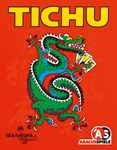
Tichu
A climbing card game in which two teams of two race to empty their hands first. You can stake points by calling Tichu before a hand, and the four special cards — Dragon, Phoenix, Dog, and Mah Jong — can overturn the play. It has remained a card-game classic since its 1991 release.
Rules
Two partners sit opposite each other and race to empty their hands while collecting scoring cards in this four-player climbing game. Players answer with a higher combination of the same type, while special cards, out-of-turn bombs, and ±100/±200 calls can swing a hand.
Contents — 56 cards
| Group | Contents | Count |
|---|---|---|
| Normal cards | 2–10, J, Q, K, A in each of four suits | 13 × 4 suits = 52 |
| Special cards | Mah Jong · Dog · Phoenix · Dragon | 1 each = 4 |
Among normal cards, 2 is lowest and Ace is highest. Each special card follows its own rules and is not treated as an ordinary suited card.
Setup and card exchange
- 1Form two teams and seat partners opposite each other, so the teams alternate around the table.
- 2Shuffle the deck into the center. Going anticlockwise, take one card at a time until everyone has 14 cards. Keep your hand secret, including from your partner.
- 3Choose 3 cards and push 1 face down to the opponent on your left, 1 to your partner, and 1 to the opponent on your right.
- 4Only after choosing and pushing all 3 cards may you pick up the 3 cards sent to you.
- 5After the exchange, the holder of the Mah Jong leads first. They do not have to play the Mah Jong.
Deal used by this guide
Both official rules have players take cards one at a time until they hold 14. This guide does not mix in regional or table variants that split the deal into 8 cards and 6 cards. Grand Tichu is timed by the ninth card, not by separate packets.
Legal combinations
| Combination | Requirement | How it ranks |
|---|---|---|
| Single | 1 card | The card's rank |
| Pair | 2 cards of one rank | That rank |
| Consecutive pairs | 2 or more pairs in adjacent ranks | Same number of pairs; compare the highest rank |
| Trio | 3 cards of one rank | That rank |
| Full house | A trio plus a pair | The trio's rank |
| Straight | 5 or more consecutive ranks | Same length; compare the highest rank |
A response must be a higher combination of the same type and size. A six-card straight cannot be beaten by a five- or seven-card straight, and full houses compare the rank of their trios.
Trick flow and bombs
- 1After the lead, play proceeds to the right, anticlockwise.
- 2On your turn, play a higher combination of the same type or pass.
- 3After three consecutive passes, the player who made the last and highest play takes the trick and leads a new combination.
- 4If that player has already gone out, the lead passes rightward to the next player still holding cards.
| Bomb | Requirement | Comparison |
|---|---|---|
| Four-of-a-kind bomb | All 4 cards of one rank | Higher rank wins |
| Straight-flush bomb | 5 or more consecutive cards in one suit | More cards win; at equal length, higher ranks win |
Bombs may be played out of turn
A bomb beats any single or normal combination and may itself be bombed. The Dog, however, transfers the lead immediately rather than forming a trick combination, so the Dog cannot be bombed.
The four special cards
| Card | Play | Core effect |
|---|---|---|
| Mah Jong | Single or the 1 in a straight | Its player wishes for one normal rank. The next player able to include that rank legally must do so; the wish persists until fulfilled |
| Dog | Only as the lead of a new trick | Creates no trick and transfers the lead to partner. If partner is out, it passes rightward from the partner's seat |
| Phoenix | Wild in a combination or played singly | May represent 2–A but never form a bomb. As a single it is 0.5 above the previous card; when led it is 1.5. Worth −25 |
| Dragon | Single only | Highest single, beaten only by a bomb. Worth +25. If it wins, give the trick to either opponent |
The Mah Jong wish is compulsory when legal
If the wished rank can legally be included in the current combination, it must be played. Otherwise the player may make another legal play or pass, and the wish remains. An out-of-turn bomb does not have to fulfil the wish.
The Dragon's 25 points go with the trick
When the Dragon secures the trick, give that entire trick to either opponent. If a bomb beats the Dragon, the bomber takes the trick normally and the Dragon giveaway does not apply.
Small Tichu and Grand Tichu
| Call | Deadline | Caller goes out first | Caller does not go out first |
|---|---|---|---|
| Small Tichu | Before playing your first card | +100 | −100 |
| Grand Tichu | Before taking your ninth card | +200 | −200 |
- A call is an individual undertaking. If your partner goes out first, your call fails.
- Call points are added to or subtracted from card scoring or a 200-point double victory.
- Small Tichu may be called before the exchange, but it is too late after you play your first card.
- Grand Tichu is decided with no more than 8 cards seen. These official rules do not split the deal into separate packets of 8 and 6.
Hand scoring and game end
- 1End the hand immediately when only one player still has cards.
- 2Give the last player's remaining hand to the opposing team, and give that player's captured tricks to the player who went out first.
- 3Each 5 is 5 points, each 10 and King is 10, the Dragon is +25, and the Phoenix is −25. The deck totals 100 card points.
- 4If one team goes out first and second, skip card scoring and award that team 200 points. Resolve calls separately.
| Scoring card | Points |
|---|---|
| 5 | +5 |
| 10 · King | +10 each |
| Dragon | +25 |
| Phoenix | −25 |
This matches the Tichu score calculator above
Unless there is a double victory, enter one team's card points and the outcome of each call. The calculator fills the other team's share from the 100-point total and applies ±100 or ±200 separately.
End at 1,000 points or more
Check after a hand. If a team has at least 1,000 points, the game ends. If both cross the line together, the higher score wins; if tied, keep playing until the tie is broken.
Edition scope and history
| Item | Verified scope |
|---|---|
| Guide scope | Tichu Nanking for four players in the official Fata Morgana and Rio Grande Games rules |
| Designer · release | Urs Hostettler · 1991 |
| BGG | Listed for 3–10 players; community recommendation and Best at 4 |
| Korean distribution | Namuwiki cross-check records an official Korea Boardgames release |
English Wikipedia describes Tichu as a partnership game influenced by the Chinese climbing-card family. This guide uses that only as historical context; every play rule here is grounded in the two official English rulebooks.
Three-player, six-player, and Grand Seigneur variants are out of scope
The official booklets include other player-count variants, but their exchanges, call deadlines, and sweep bonuses differ. This page covers only the four-player, two-team game used by the catalogue and score calculator. The official Korean rulebook remains unverified.
Frequently asked questions
Q. Must the Mah Jong holder lead the Mah Jong itself?
No. The holder leads the first trick but may lead any other legal combination from their hand.
Q. After passing once, am I out of that trick?
No. If the turn returns before the trick ends, you may play a higher combination of the same type or pass again. Bombs may also be played out of turn.
Q. Can the Phoenix itself satisfy a Mah Jong wish?
The Phoenix is not a card of the wished rank. If you hold the real wished rank and can only include it legally by using the Phoenix elsewhere in that combination, however, you must make that play.
Q. Can I give a Dragon-won trick to my partner?
No. Give it to either opponent. The Dragon's 25 points remain in that trick and therefore move to the opposing team.
Q. Does a team's first-and-second finish absorb its Tichu call scores?
No. The team receives 200 instead of card points, then every Small or Grand Tichu success or failure is added separately.
Q. Can Grand Tichu only be called immediately after receiving eight cards?
The official deadline is before taking the ninth card. Because this edition has players take cards one by one, a player may call while holding 1–8 cards but is too late once the ninth is taken.
Sources
Fata Morgana — official English rulesRio Grande Games — official English rulesBoardGameGeek: Tichu (215)Wiki cross-check — English Wikipedia: TichuWiki cross-check — Namuwiki: Tichu (Korean)Rule summaries are reference content written by us, not quotations from the official rulebook. Always check the official rulebook for exact rules. Diagrams are original schematics, not rulebook illustrations.
Spotted a mistake? Tell us in the comments below →
Last updated 2026-10-09
💡 Master tip
In your first game, hold back on Tichu calls and focus on reading the combinations. The quiet partnership skill of inferring what remains from the cards your partner has played is what decides the game.
Similar games
Ready for something heavier
If this one has gotten too easy, try these — same feel, one step up in weight.
Tools you can request
Not built yet. Let us know if you want one — it goes on the list.
Tichu call score tracker
Automatically applies ±100/±200 for successful or failed Small Tichu and Grand Tichu calls
Comments
Share your thoughts, report a mistake, or request a tool. No sign-in needed — nicknames are not verified, so anyone can use the same one.
Loading…