Top 20 · #5 of 52 in Family
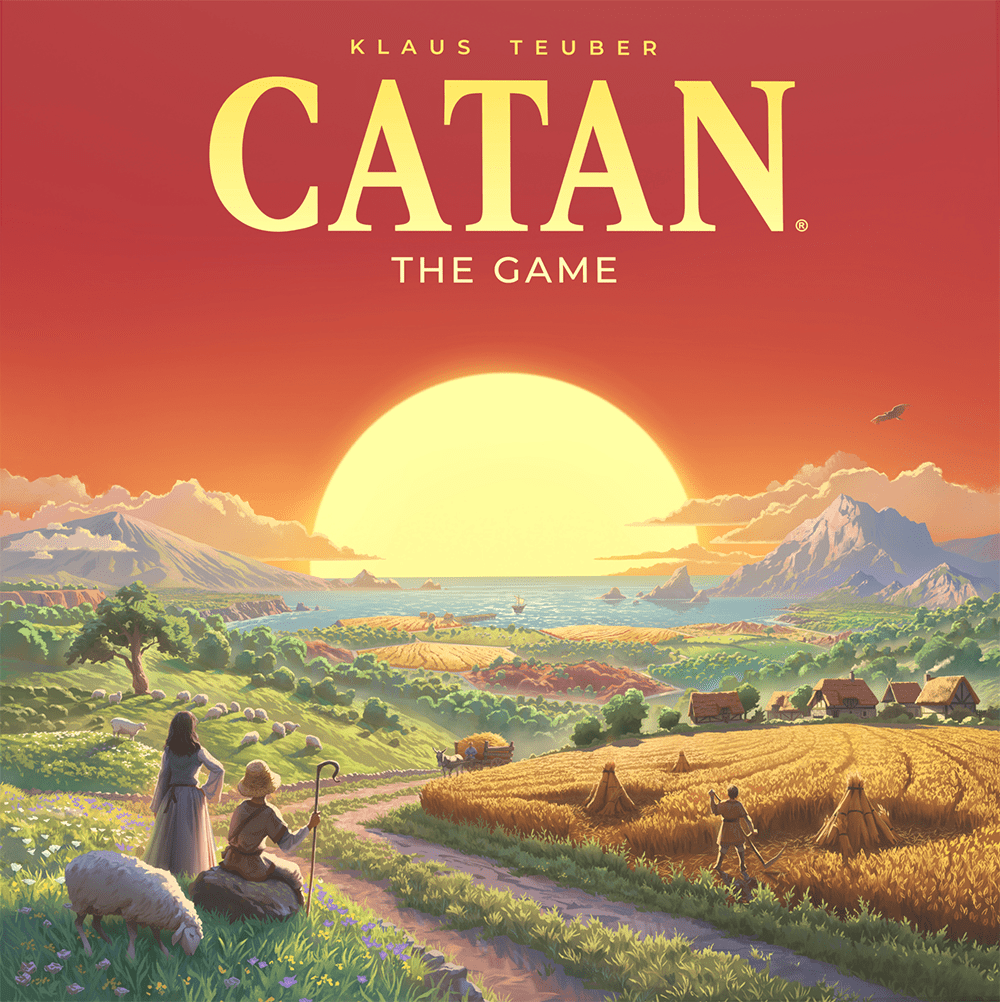
Catan
The classic that marked the start of the modern board game era: you roll dice to produce resources and trade freely with the other players to cover what you lack, developing the island as you go. Production, trade, and building all feed into each other, so every turn gives you a different strategic choice.
Rules
Roll dice for resources, build roads and settlements, and be the first to 10 victory points. This guide uses diagrams to cover the parts that trip up new players: the distance rule, harbor trades, the robber, and Longest Road.
Components
| Component | Count | Note |
|---|---|---|
| Terrain tiles | 19 | Hexagons. The layout is different every game |
| Number tokens | 18 | 2 to 12 (there is no 7) |
| Resource cards | 95 | Brick, lumber, ore, grain and wool |
| Development cards | 25 | 14 knight · 6 progress · 5 victory point |
| Settlements · cities · roads | 5 · 4 · 15 per player | You can never have more than this many on the board |
| Special cards | 2 | Longest Road · Largest Army |
| Other | — | 6 sea frame pieces, 9 harbors, 2 dice, 1 robber, 4 building costs cards |
| Terrain | Resource produced |
|---|---|
| Hills | Brick |
| Forest | Lumber |
| Mountains | Ore |
| Fields | Grain |
| Pasture | Wool |
| Desert | None |
The dots on the number tokens
The number of dots under a token shows how likely that number is. More dots means it comes up more often (6 and 8 are printed in red). 7 is the most likely roll of all, but no token carries a 7 — you get the robber instead.
Setup
- 1Assemble the sea frame by matching the numbers on the pieces, then lay the 19 terrain tiles inside it. For a first game, the beginner layout in the rulebook is the most balanced choice.
- 2Put the number tokens on the tiles as shown. The desert gets no token — it gets the robber.
- 3Each player picks a color and takes 5 settlements, 4 cities and 15 roads, plus one building costs card.
- 4Sort the resource cards into five face-up stacks, shuffle the development cards into a face-down stack, and put the Longest Road and Largest Army cards and the dice to one side.
- 5Each player places 2 settlements and 2 roads on the board, then takes resource cards for the terrain touching their second settlement.
With 3 players
In the beginner layout from the rulebook, nobody takes the red positions. Everything else is the same.
Where things go — intersections and paths
- Settlements and cities only go on the intersections, the corners where hexes meet. Never along an edge.
- Roads only go on the paths along the hex edges, and only one road fits on each path.
- A new road must connect to one of your own roads, settlements or cities.
- A new settlement must connect to one of your own roads.
The distance rule — the one people break most
You may only place a settlement if all three neighboring intersections are empty. That means not next to someone else's settlement and not next to your own, either. This is why the board ends up with intersections that nobody can ever use.
Your turn (always in this order)
- 1Roll both dice. The terrain matching the total produces resources — and everyone collects, not just you.
- 2Trade. Deal with the other players, or trade with the bank.
- 3Build. Put down roads, settlements or cities, or buy a development card.
You may play 1 development card at any point during your turn, in any order. When you are done, pass the dice to the player on your left.
Step 1 — producing resources
- For each of your settlements touching a terrain with the rolled number you get 1 resource card, and for each city 2 cards.
- If you have 2 or 3 settlements touching the same terrain, each of them pays out.
- A terrain with the robber on it produces nothing, even when its number is rolled.
- If the bank does not have enough of a resource for everyone who should get it, nobody gets that resource this turn. The exception: if only one player would receive it, that player still gets it.
Step 2 — trading
- Trading with players: say what you need and what you will give, and haggle. But you may only trade with the player whose turn it is — bystanders cannot swap with each other.
- Trading with the bank: hand in 4 cards of the same resource for 1 resource of your choice. This always works, with or without a harbor.
- Harbors: if you have a settlement or city on a harbor corner you trade 3:1, and at a harbor for a specific resource you trade that resource 2:1.
Step 3 — building
| Build | Cost | Victory points | Note |
|---|---|---|---|
| Road | Brick + lumber | — | Must connect to your own road or settlement, one per edge |
| Settlement | Brick + lumber + wool + grain | 1 point | Must follow the distance rule and connect to your own road |
| City | 3 ore + 2 grain | 2 points | Only by upgrading one of your settlements. The settlement you take back is reused |
| Development card | Ore + wool + grain | Depends on the card | Once the deck runs out, no more can be bought |
As long as you have the resources you can build as much as you like in one turn. The limit is your own supply of pieces — 5 settlements, 4 cities and 15 roads.
When a 7 is rolled — the robber
- 1Nobody produces resources.
- 2Everyone holding more than 7 resource cards discards half of them, rounded down. Exactly 7 cards is safe.
- 3The player who rolled moves the robber to another terrain, or to the desert.
- 4That player picks one opponent with a settlement or city touching that terrain and steals 1 card at random. The opponent holds their hand face down and the robber draws one from it.
The terrain the robber sits on produces nothing until he is moved. Shutting down someone else's 6 or 8 is what the robber is really for.
Development cards
- You may not play a card on the turn you buy it. Victory point cards are the only exception.
- You normally play only 1 card per turn. Until you play it, keep it face down in your hand.
- Knight card (purple) — playing it moves the robber immediately and steals 1 resource card. Leave the played knight face up in front of you.
- Progress card (green) — do what the card says, then remove it from the game (back in the box).
- Victory point card (orange) — keep it hidden. Reveal it when it takes you to 10 points and wins the game. You may play it on the turn you buy it, and you may play any number of them at once.
The two special cards — where games are won
| Card | How you get it | Victory points | How you lose it |
|---|---|---|---|
| Longest Road | Be the first to build an unbroken road of 5 or more segments | 2 points | It passes on the moment someone builds a longer one |
| Largest Army | Be the first to play 3 knight cards | 2 points | It passes on the moment someone plays more |
Losing one costs you 2 points and gives your opponent 2, so 4 points swing at once. In a game to 10, that is enormous.
Road length is counted as a single unbroken line, ignoring branches. You do not add the lengths of two branches together.
Ending the game
- You win the instant you reach 10 or more victory points on your own turn.
- If you reach 10 points outside your turn, the game goes on until someone (you included) reaches 10 on their own turn.
| Source | Victory points |
|---|---|
| Settlement | 1 point |
| City | 2 points |
| Longest Road | 2 points |
| Largest Army | 2 points |
| Victory point development card | 1 point (kept hidden) |
Rules people get wrong
Q. Can I build a second settlement on the intersection right next to my own?
No. The distance rule applies to your own settlements just as much as to other players'. All three neighboring intersections must be empty.
Q. Do I discard if I have exactly 7 resource cards?
No. You only discard with more than 7. Seven is safe.
Q. Do I get resources when it is not my turn?
Yes. No matter who rolled, everyone touching that number's terrain collects. That is why you have to pay attention on other players' turns in Catan.
Q. Can two bystanders trade resources with each other?
No. Trades can only be made with the player whose turn it is.
Q. Can I trade with the bank without a harbor?
Yes. 4:1 is always available without a harbor. A harbor just improves it to 3:1 or 2:1.
Q. Can I buy a development card and play it right away?
No, only from your next turn on. Victory point cards are the exception and may be played on the turn you buy them.
Q. How do I count Longest Road when my roads branch?
Count only one unbroken line and ignore the branches. You do not add the lengths of two branches together.
Q. What if there is nobody to steal from where the robber goes?
You just move him and steal nothing. He still blocks production on that terrain.
History and editions
| Item | Detail |
|---|---|
| Designer | Klaus Teuber |
| First published | 1995, Kosmos (Germany) |
| Awards | Spiel des Jahres 1995 · Deutscher Spiele Preis 1995 |
| Sales | More than 32 million copies in 40 languages as of 2020 |
| Name | Originally The Settlers of Catan, shortened to Catan for the 20th anniversary in 2015 |
| Major expansion | Released |
|---|---|
| Seafarers | 1997 |
| Cities & Knights | 1998 |
| Traders & Barbarians | 2008 |
| Explorers & Pirates | 2013 |
The base game is for 3 to 4 players. Playing with 5 or 6 needs a separate player extension, and each expansion you add needs its own player extension as well.
Sources
Catan Studio official rulebook: Game Rules & AlmanacCross-checked against Wikipedia: CatanCross-checked against Namuwiki: Catan (Korean)Rule summaries are reference content written by us, not quotations from the official rulebook. Always check the official rulebook for exact rules. Diagrams are original schematics, not rulebook illustrations.
Spotted a mistake? Tell us in the comments below →
Last updated 2026-09-08
💡 Master tip
Where you place your first settlements matters most. Aim for intersections where several resources meet, and build up your bargaining power by trading the resources your opponents need. The 2 bonus points from Longest Road or Largest Army also go a long way toward reaching 10.
Related games
Similar games
Ready for something heavier
If this one has gotten too easy, try these — same feel, one step up in weight.
Tools you can request
Not built yet. Let us know if you want one — it goes on the list.
Dice statistics tracker
Probability spread for each number from 2 to 12, plus a counter for how often the robber's 7 has come up
Comments
Share your thoughts, report a mistake, or request a tool. No sign-in needed — nicknames are not verified, so anyone can use the same one.
Loading…