Top 28 · #2 of 60 in Family
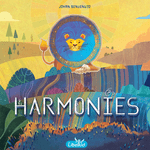
Harmonies
A strategic puzzle game where you stack three-dimensional landscape tokens to build terrain and create a beautiful natural ecosystem where animals can settle.
Rules
Stack six colors of landscape tokens to build mountains, water, trees, fields, and buildings, then complete the habitat shapes shown on Animal cards to settle wildlife in your own hex-tile landscape.
Components
| Component | Count | Role |
|---|---|---|
| Landscape tokens | 120 total (23 gray, 23 blue, 21 brown, 19 green, 19 yellow, 15 red) | Stacked on your Personal board to build terrain |
| Central board | 1 | Double-sided: 5 spaces for 2–4 players, 3 spaces for solo |
| Personal boards | 4 (sides A and B) | Hex-grid board each player stacks tokens on; Side B scores water differently |
| Animal cards | 32 | Show the required Habitat shape and its points; 5 are kept face up |
| Animal cubes | 75 in the English set / 66 in the Korean set | Moved onto a completed Habitat to settle an animal |
| Nature's Spirit cards/cubes | 10 cards / 4 cubes | Optional advanced goals (see Variants) |
| Bag, reminder cards, scorepad | 1 each (4 reminder cards) | Draw tokens blindly; summarize board sides and record scores |
Each color has a fixed role: gray = mountain, blue = water, brown = tree trunk, green = tree leaves, yellow = field, red = building. All terrain scoring comes from just these six colors and their stacked height.
Setup
- 1Place the Central board on the side matching player count (5 spaces for 2–4, 3 spaces for solo).
- 2Put all 120 Landscape tokens in the bag and place it beside the Central board.
- 3Draw tokens randomly to fill each Central board space with 3 tokens.
- 4Each player takes 1 Personal board. Agree together on Side A or Side B, and take a matching reminder card. Side A (river) is recommended for your first games.
- 5Shuffle the Animal cards and reveal 5 beside the Central board. Keep the rest as a face-down draw pile.
- 6The player who most recently saw a beautiful landscape goes first.
Save Nature's Spirit cards for later
The rulebook itself recommends returning Nature's Spirit cards and cubes to the box for your first few games. Add them later from the Variants section once the base rules feel familiar.
Game turn
- 1(Mandatory, once) Take and place tokens — choose one Central board space and take all 3 of its tokens. Place them on your Personal board in any order, and you may interleave the two optional actions below between placements.
- 2(Optional, once per turn) Take 1 Animal card — choose one of the 5 face-up cards and place it above your Personal board (up to 4 at once). Take as many Animal cubes as the card's spaces and set them on it.
- 3(Optional, unlimited) Place 1 Animal cube — whenever a Habitat is complete, move a cube onto your Personal board.
- 4At the end of your turn, refill the emptied Central board space with 3 new tokens from the bag, and refill the Animal card row to 5.
The three actions can be freely ordered
You must take and place tokens exactly once. The optional actions can be performed any number of times, in any order (though taking an Animal card is limited to once per turn).
Stacking tokens — mountains, trees, buildings, fields, water
- A token goes on an empty space, or on top of 1 or 2 existing tokens to create a mountain, tree, or building. No other combination may be stacked.
- Mountain — only gray on gray, up to 3 high. A single gray token already counts as a height-1 mountain.
- Tree — 1 green token on top of 0, 1, or 2 brown tokens. Green with no brown underneath is still a height-1 tree. Brown tokens alone, with no green on top, are not yet a tree.
- Building — 1 red token on top of any red, brown, or gray token. Always exactly 2 tokens tall; a third layer is never allowed.
- Water and field (blue and yellow) can never be stacked on. They always sit flat.
- A new token can never go underneath an existing one, and never on a space already holding an Animal cube.
Animal cards and completing Habitats
Each Animal card shows the exact colors, heights, and shape required, plus the space within that shape where the Animal cube goes. Your Personal board must show this pattern exactly, though it may be rotated in any direction.
- The pattern may be rotated to fit. The rulebook illustrates 6 rotational orientations for a single shape.
- Tree and mountain heights must exactly match the card.
- The space receiving the Animal cube must be empty (no other Animal cube already there).
- A building space works with any of red, brown, or gray as its bottom token.
- A single token can belong to several Habitats at once.
- Once requirements are met, move the bottommost cube from the card. When the last cube is moved, the card is complete, set aside, and no longer counts toward your 4-card limit.
A placed cube stays even if the pattern later breaks
For example, topping a mountain with red to make a building does not remove an already-placed Animal cube. Habitat requirements are only checked at the moment you place the cube.
Scoring each terrain
| Terrain | Condition | Points |
|---|---|---|
| Tree | Height 0, 1, 2, or 3 | 0 / 1 / 3 / 7 (one green token determines the height) |
| Mountain | Height 1, 2, or 3 but isolated from other mountains | Always 0 |
| Mountain | Height 1, 2, or 3 and touching another mountain | 1 / 3 / 7 |
| Field | A single isolated yellow / 2 or more contiguous yellow | 0 / 5 per group (always 5, regardless of group size) |
| Building | Fewer than 3 distinct colors among its 6 neighbors (including red) / 3 or more | 0 / 5 |
| Water — Side A (river) | Only the single longest blue run, length 1–6 | 0 / 2 / 5 / 8 / 11 / 15, then +4 per token beyond the 6th |
| Water — Side B (islands) | Each group of spaces separated by blue tokens | 5 per island (always at least 1 island, even with no blue tokens) |
| Animal cards | The topmost slot whose cube has been removed, whether complete or not | The printed value at that slot (0 if no cube has been removed yet) |
Only your single longest river counts
Splitting blue tokens into several short runs does not help on Side A — only the longest counts. On Side B, the opposite is true: splitting blue tokens increases your island count.
End of game and winning
- 1Either triggers the end — ① the bag is empty when a Central board space needs refilling, or ② any player ends their turn with 2 or fewer empty spaces on their Personal board.
- 2Finish the current round so every player has taken an equal number of turns.
- 3Add your Landscape score (trees, mountains, fields, buildings, water) and your Animal card score.
- 4The highest total wins. Ties go to whoever placed more Animal cubes; if still tied, the players share the victory.
Strategy tips
- A field scores 5 regardless of size, so splitting 4 yellow tokens into two groups of 2 scores more than one group of 4.
- An isolated mountain scores 0 no matter its height. Before stacking gray tokens, check whether they will end up touching another mountain.
- On Side A, only the longest river counts, so scattering blue tokens is wasteful. On Side B, the opposite holds — splitting blue tokens raises your island count.
- A building only scores with 3 or more distinct neighboring colors. Building surrounded by only one or two colors tends to score 0.
- An Animal card scores 0 until at least one cube is removed, so don't just hold 4 cards — prioritize ones where at least the bottom slot is reachable soon.
Nature's Spirit, solo mode, and board sides
- Nature's Spirit cards (for experienced players): each player is dealt 2 face down and keeps 1 face up. Its cube is placed exactly like an Animal cube, and its score is tallied at game end based on your finished Landscape.
- Solo mode: use the 3-space solo side of the Central board and reveal only 3 Animal cards. At the end of each turn, discard the 6 untaken tokens to the box instead of the bag, then refill all 3 spaces with 3 new tokens. On a turn when you did not take an Animal card, you may discard 1 displayed card and replace it from the draw pile. Compare your score against the printed sun-rating scale.
- Personal board Side A (river) vs. Side B (islands): all players must use the same side; Side A is recommended for early games. Only the water scoring differs between sides.
- The game supports 1–4 players; only the Central board's space count changes (3 for solo, 5 for 2–4), while the Personal board and Animal card rules stay the same.
Frequently confused rules
Q. Does a single gray token already count as a mountain?
Yes, a height-1 mountain. But it scores 0 unless it touches another mountain.
Q. Do stacked brown tokens count as a tree without green on top?
No. A tree is only complete once a green token sits on top. Brown alone is an unscored trunk-in-progress.
Q. Can a building be stacked 3 tokens tall?
No. A building is always a fixed 2-tall stack: one base token (red, brown, or gray) plus one red on top.
Q. How many Animal cards can I hold at once?
Up to 4 incomplete cards above your Personal board at the same time. Completed cards are set aside and no longer count toward that limit.
Q. If the tokens under a placed Animal cube change later, must the cube be removed?
No. Cube placement is final the moment it happens, even if later stacking removes the original Habitat pattern.
Q. Can one token count toward more than one Habitat at the same time?
Yes. A single token may satisfy the requirements of multiple Animal cards simultaneously.
Q. Can I take only some of the 3 tokens from a Central board space?
No. You must take all 3 tokens from the chosen space, and you cannot mix tokens from different spaces.
Editions and history
Harmonies was designed by Johan Benvenuto, illustrated by Maëva Da Silva, and published by Libellud in 2024. Libellud's official game page lists a 2024 Swiss Gamers Award win, a 2024 Spiel des Jahres Recommended selection, a 2025 Hungarian Board Game Award win, and a 2025 As d'Or Game of the Year nomination.
Korea Boardgames publishes the official Korean edition. A dedicated English Wikipedia article could not be confirmed by search (checked 2026-10-10); Namuwiki confirmed only the designer, publisher, and release year. The BGG 414317 page returned an automated block (403) on direct access, so player count (1–4), age (10+), and playtime (30–45 min) were cross-checked against the catalog and official rulebooks instead.
Harmonies Pulse and Crescendo are separate expansions
Libellud's official page describes Pulse (10 new Animal cards plus a mirror-symmetry option) and Crescendo (three independent or combinable modules) as separate expansions. This guide covers only the base game and does not include their modules.
Sources
Libellud official English rulebook (PDF)Libellud official Korean rulebook (PDF)Libellud official game page — awards and expansionsBoardGameGeek 414317 — players/age/time cross-check (automated block prevented direct access; cross-checked against the official page instead)Wiki cross-check — Namuwiki: Harmonies (Korean)Wiki cross-check — English Wikipedia search: no dedicated article confirmed (2026-10-10)Rule summaries are reference content written by us, not quotations from the official rulebook. Always check the official rulebook for exact rules. Diagrams are original schematics, not rulebook illustrations.
Spotted a mistake? Tell us in the comments below →
Last updated 2026-10-10
💡 Master tip
A tree is worth just 1 point with a single green token, but stacking it higher pays off fast: 3 points with green on 1 brown token, and 7 points with green on 2 brown tokens. A mountain, on the other hand, scores 0 if it stands alone, so you must always place it touching another mountain. A field earns its full 5 points with just 2 connected tokens, so splitting your yellow tokens into several small groups is more efficient than clustering them into one big field.
Similar games
Ready for something heavier
If this one has gotten too easy, try these — same feel, one step up in weight.
Tools you can request
Not built yet. Let us know if you want one — it goes on the list.
3D habitat terrain score calculator
Automatically tallies points by tree, mountain, and building height
Comments
Share your thoughts, report a mistake, or request a tool. No sign-in needed — nicknames are not verified, so anyone can use the same one.
Loading…