Top 143 · #13 of 16 in Card game
Go-Stop
A Korean folk card game played with a 48-card Hwatu deck: capture cards by matching months, then score the sets you captured — Gwang (Bright), Yeolkkeut (Animal), Tti (Ribbon) and Pi (Junk). Once you reach the target score you choose Stop to end the hand or Go to play on for more. It is played as three-player Go-Stop or two-player Matgo.
Rules
A Korean folk card game played with a 48-card Hwatu deck: capture cards by matching months, then score the sets you captured. Once you reach the target score you choose between Stop, which ends the hand, and Go, which plays on for more; each loser's penalties (bak) are worked out separately. Rules vary by region, so agreeing on house rules before you start is part of the game.
The Hwatu deck — 48 cards
A Hwatu deck has 12 months × 4 cards = 48 cards. The four cards of a month share the same plant, and some of them also show a bright, an animal or a ribbon that makes them more valuable. In Go-Stop you capture cards by matching months, then score by how many of each type you hold and which sets (jokbo) they form.
| Type | Cards | How it scores |
|---|---|---|
| Gwang (Bright) | 5 | From 3 cards — three Gwang 3 points (2 if the rain Gwang is one of them) |
| Yeolkkeut (Animal) | 9 | 1 point from 5 cards · Godori (the birds of months 2, 4, 8) 5 points |
| Tti (Ribbon) | 10 | 1 point from 5 cards · Hongdan, Cheongdan, Chodan 3 points each |
| Pi (Junk) | 24 | 1 point from 10 cards · a Ssangpi counts as 2 Pi |
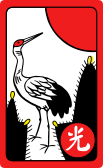
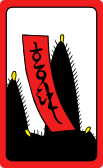
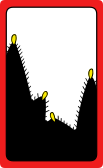
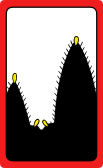
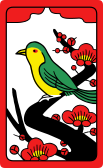
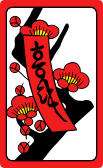
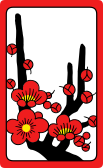
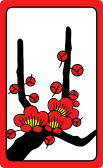
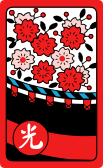
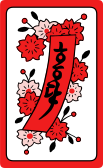
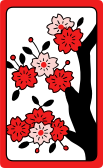
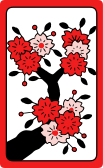
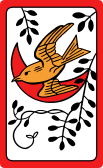
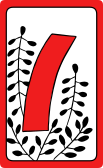
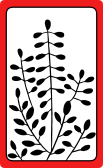
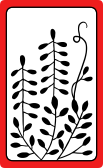
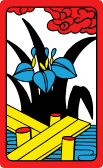
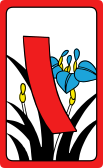
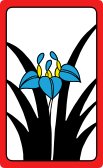
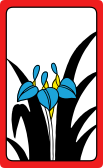
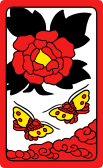
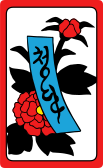
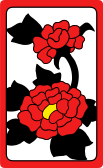
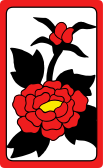
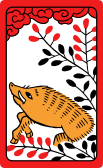
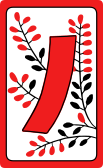
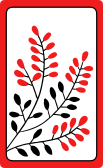
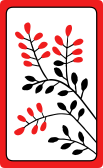
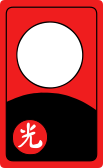
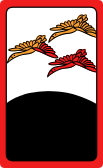
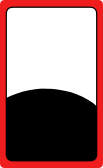

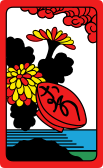
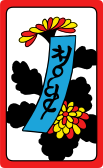
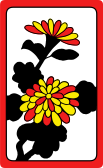
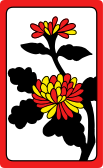
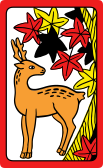
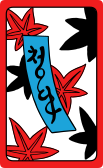
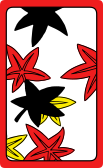
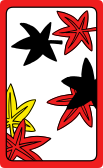
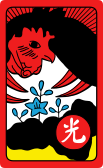
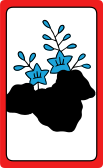
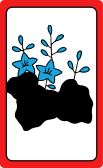
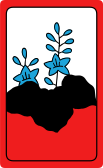
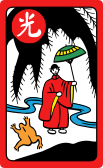
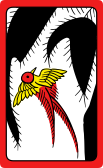

Cards to remember
The December rain Gwang (Bi-gwang) is a Gwang, but it is treated differently when counting three Gwang (2 points if it is included). The September Gukjin (sake cup) can be used as a Yeolkkeut or as a Ssangpi (2 Pi), but never counted in both places at once. The December rain ribbon counts towards your Tti total but belongs to none of Hongdan, Cheongdan or Chodan.
Bonus cards
Retail Hwatu decks include separate bonus cards. They are usually worth a Ssangpi (2 Pi) or a triple Pi (3 Pi), but the number and value differ by product, so settle them before you start.
Setup and the deal
| Players | Hand | Field (face up) | Stock (face down) |
|---|---|---|---|
| 3-player Go-Stop | 7 each (21) | 6 | 21 |
| 2-player Matgo | 10 each (20) | 8 | 20 |
- 1Shuffle the 48 cards. With three players, deal 7 cards to each player and lay 6 cards face up on the field.
- 2Stack the remaining 21 face down as the stock. Keep your hand to yourself; spread the field so everyone can see it.
- 3The lead player (seon) goes first, and a three-player game turns counter-clockwise. The winner leads the next hand; after a Nagari (no winner) the lead stays the same.
A turn — play, flip, capture
- 1Play one card from your hand. If the field has a card of the same month, place it on that card; otherwise put it on the field by itself.
- 2Flip the top card of the stock. It too goes on a same-month card on the field if there is one, or by itself if not.
- 3Take every matched pair (two cards of the same month) and lay them face up in front of you, sorted by type. Captured cards must be visible so everyone can count the score.
- 4If the field has two cards of the month, choose which one to capture. If three of a month are stacked there, the fourth card captures all three at once.
- 5If your score has reached the target at the end of your turn (3 points with three players, 7 in Matgo), you call Go or Stop.
Ppeok, Ttadak, Jjok, Sseul — taking Pi
| Name | When | Result |
|---|---|---|
| Ppeok | You made a pair from your hand, then the stock turned up the third card of that month | You capture nothing and the three cards stay stacked on the field. Whoever later captures them with the last card takes 1 Pi from each opponent |
| Ttadak | The field has two cards of a month, and both your hand card and the stock card are that month | Capture all four and take 1 Pi from each opponent |
| Jjok | Your hand card matched nothing, then the stock turned up the same month and you captured it | Take 1 Pi from each opponent |
| Sseul (sweep) | Your captures leave the field empty | Take 1 Pi from each opponent — counted again if it coincides with another event |
- An opponent with no Pi gives nothing. One who has only a Ssangpi must give the Ssangpi.
- First Ppeok — a Ppeok on your first turn earns the value of 3 points from each opponent on the spot.
- Three Ppeok — making three Ppeok wins the hand immediately. The points it earns vary by region and by online service.
- Sseul, Ttadak and Jjok on the very last turn do not count, because the final cards are bound to match.
Settle Ja-ppeok first
Giving 2 Pi for Ja-ppeok — capturing a Ppeok stack you made yourself — is common in Matgo and online play, but often not used in offline three-player games.
Scoring — the jokbo table
Check your captured cards against every set below and add them all up. One card can count in several sets at once — six Tti that include Hongdan and Cheongdan score 2 for Tti + 3 for Hongdan + 3 for Cheongdan = 8 points.
| Set | Condition | Points |
|---|---|---|
| Three Gwang | 3 Gwang without the rain Gwang | 3 |
| Rain three Gwang | The rain Gwang + 2 other Gwang | 2 |
| Four Gwang | 4 Gwang (with or without the rain Gwang) | 4 |
| Five Gwang | All 5 Gwang | 15 |
| Yeolkkeut | 5 cards | 1 + 1 per card beyond 5 |
| Godori | The 3 birds of months 2, 4, 8 | 5 |
| Tti | 5 cards (rain ribbon included) | 1 + 1 per card beyond 5 |
| Hongdan | Ribbons of months 1, 2, 3 | 3 |
| Cheongdan | Ribbons of months 6, 9, 10 | 3 |
| Chodan | Ribbons of months 4, 5, 7 | 3 |
| Pi | 10 cards (a Ssangpi counts as 2) | 1 + 1 per card beyond 10 |
Going out — Go or Stop
| Players | Target score |
|---|---|
| 3-player Go-Stop | 3 points |
| 2-player Matgo | 7 points (some groups agree on 5) |
- 1When your turn ends with at least the target score, you declare Go or Stop.
- 2Stop ends the hand and everyone settles up at once.
- 3Go continues the hand. Each Go adds points, and from the third Go the multiplier grows.
- 4After a Go, you may call Go or Stop again only once your score is higher than when you last called Go. If losing Pi has lowered your score, you must first win it back.
| Go count | Points added | Multiplier |
|---|---|---|
| 1 Go | +1 | ×1 |
| 2 Go | +2 | ×1 |
| 3 Go | +3 | ×2 |
| 4 Go | +4 | ×4 |
| 5 Go | +5 | ×8 |
| Beyond | +number of Go calls | ×2 again for each Go |
Go carries a risk
If you call Go and another player goes out and stops first, you pay Gobak (see Bak). If nobody goes out, or the player who called Go scores nothing more before the cards run out, the hand is a Nagari — it is void, the next hand's winner scores ×2, and the lead stays the same.
Regional differences
Sources disagree on whether Go points (+3, +4 …) are still added from the third Go on. This guide adds them (following Namuwiki), but many tables — such as online three-player Go-Stop — apply only the multiplier from the third Go. Some count the multiplier after four Go as «number of Go calls − 1».
Bak — multiplied separately for each loser
Bak penalties are judged for each loser separately. In the same hand one loser may have Pibak and the other not. When several bak apply, they multiply (three bak = ×8).
| Bak | Condition | Multiplier |
|---|---|---|
| Gwangbak | The winner scored with Gwang (any three-, four- or five-Gwang set) and the loser has 0 Gwang | ×2 |
| Pibak | The winner scored with Pi (10+ Pi) and the loser's Pi is at or below the threshold | ×2 |
| Meongtta | The winner has 7 or more Yeolkkeut — regardless of the loser's Yeolkkeut | ×2 (on the winner's score) |
| Gobak | The player who called Go loses and someone else stops | 3 players: pays for both · Matgo: ×2 |
| Players | Pibak threshold (Pibak at or below) |
|---|---|
| 3-player Go-Stop | 5 Pi |
| 2-player Matgo | 7 Pi |
+ 10 Pi = 4 points, StopNo Pibak → 400 wonThree-player Gobak — paying for both
In a three-player game, a player who called Go and lost pays both their own share and the other loser's share. That includes the other loser's Pibak or Gwangbak, and the other loser pays nothing.
If you captured no Pi at all
Namuwiki says a loser with 0 Pi is not subject to Pibak (only 1–5 Pi is), but the other sources do not mention this exemption. It rests on a single source, so agree on it before you start. Gwangbak has no such exemption.
Meongtta is not Meongbak
Meongtta is the multiplier for a winner holding 7 or more Yeolkkeut. Meongbak, which also requires the loser to hold 0 Yeolkkeut, is often not allowed together with it, so it is treated as a variant. Ttibak — for a loser with 0 Tti when the winner went out on Tti — is also a variant.
Heundeulgi, Poktan, Chongtong
| Name | Condition | Effect |
|---|---|---|
| Heundeulgi (shaking) | You show three cards of the same month from your hand | If you win, score ×2; repeats stack (twice = ×4) |
| Poktan (bomb) | Three of a month in hand + the fourth on the field | Play all three at once to capture four. Score ×2 (same as shaking) + 1 Pi from each opponent |
| Chongtong | All four of a month in hand | Reveal it to win immediately. The points vary by region and online service |
Reveal them to shake- A bomb leaves you two cards short. To make up for it, you may later take two turns in which you flip the stock without playing from your hand.
- The ×2 for shaking and bombs applies only if you win. Some regions apply it whether you win or lose.
This site's rule — shake then bomb counts ×2 once
If you shake three cards and later bomb with the same cards, apply ×2 only once: the same cards are not counted twice. Some sources count it as ×4, and others forbid bombing with cards you have shaken, so agree on it before you start if you play differently.
Settling up — add first, then multiply
- 1Score = total set points + Go points (1 Go +1, 2 Go +2 …).
- 2Winner's multiplier = Go multiplier (3 Go ×2, 4 Go ×4 …) × shaking and bombs (×2 each) × Meongtta (×2) × the hand after a Nagari (×2).
- 3Each loser's bak = whichever of Gwangbak (×2), Pibak (×2) and Matgo Gobak (×2) apply.
- 4A loser pays score × winner's multiplier × that loser's bak × the stake per point. With three-player Gobak, the player who called Go pays both shares.
| Situation (3 players, 100 won per point) | Calculation | Payment |
|---|---|---|
| A stops with Hongdan + 10 Pi = 4 points. B has 7 Pi, C has 4 Pi | B 4 · C 4 × 2 (Pibak) | B 400 won · C 800 won |
| A calls 1 Go, then B stops with 12 Pi (3) + 5 Yeolkkeut (1) = 4 points. A has 3 Pi, C has 6 Pi | A's share 4 × 2 (Pibak) = 8 + C's share 4 → Gobak: A pays both | A 1,200 won · C 0 won |
| A has three Gwang (3) + 7 Tti (3) = 6 points, stops after 3 Go, shook once. B has 0 Gwang, C has 1 Gwang. A has no Pi points | (6 + 3) × 2 (3 Go) × 2 (shake) = 36 → B also Gwangbak ×2 | B 7,200 won · C 3,600 won |
Mid-hand payments are separate
Money collected during the hand, such as for a first Ppeok, is recorded separately from the final settlement. The sources do not say whether bak or multipliers apply to it.
Matgo — two-player Go-Stop
Go-Stop for two players is called Matgo. Play and scoring are the same; with fewer players you hold more cards and need a higher score to go out.
| Item | 3-player Go-Stop | 2-player Matgo |
|---|---|---|
| Deal (hand / field / stock) | 7 each / 6 / 21 | 10 each / 8 / 20 |
| Target score | 3 points | 7 points |
| Pibak threshold | 5 or fewer | 7 or fewer |
| Gobak | The Go caller pays for both | No paying for both; ×2 |
| Instant points such as first Ppeok or Chongtong | Based on 3 points | Based on 7 points (covered only by Namuwiki's Matgo article) |
House rules — agree before you start
Rules vary by region
Go-Stop has no official rulebook, and Namuwiki itself notes that rules differ subtly from region to region and neighbourhood to neighbourhood, so settle them before playing. This guide does not present «the correct rules»; it uses the most common rules on which several sources agree.
| Item | This guide's default | Common variants |
|---|---|---|
| Go points from the third Go | Added | Multiplier only from 3 Go (e.g. online three-player) |
| Multiplier after 4 Go | ×2 per Go | «Number of Go calls − 1» |
| Four Gwang · five Gwang | 4 · 15 points | Four Gwang without the rain Gwang 5 · five Gwang 15–50 |
| Godori | 5 points | 3 points |
| Pibak threshold | 3 players 5 or fewer · Matgo 7 or fewer | 3 players 4 or 6 or fewer, etc.; Matgo 6 or fewer |
| Pibak exemption at 0 Pi | Exempt (Namuwiki) | No exemption |
| May Yeolkkeut as a Ssangpi | Not used | Used |
| Rain ribbon in the Tti count | Included | Excluded |
| Meongbak · Ttibak | Not used | ×2 |
| Shaking and bomb multiplier | Winner only | Win or lose |
| Shodang · reverse Go · per-hand cap | Not used | Calculated differently by region |
The Go-Stop score calculator starts from «this guide's default» in the table above, and each variant can be switched on or off in its settings. Matching the settings with everyone at the table before the first hand avoids arguments at settlement time.
Frequently confused rules
Q. Is the September Gukjin a Yeolkkeut or a Pi?
You choose one. It counts either as a Yeolkkeut or as a Ssangpi (2 Pi), never as both at once. When you must decide — on capture, once per hand, or at any time — varies by region.
Q. How many points are three Gwang including the rain Gwang?
2 points. Three Gwang without the rain Gwang score 3. Four Gwang score 4 with or without the rain Gwang, and all five score 15.
Q. The December swallow is a bird too — does it count for Godori?
No. Godori is only the three Yeolkkeut of months 2, 4 and 8.
Q. I shook and then lost. Does the ×2 still apply?
Not under the common rules. The ×2 for shaking and bombs applies only when the player who shook wins. Some regions apply it either way, so agree before you start.
Q. I called Go and someone else went out first. How much do I pay?
That is Gobak. In a three-player game you pay your own share plus the other loser's share (including their bak), and the other loser pays nothing. In Matgo your payment is doubled.
Q. I captured no Pi at all. Is that Pibak?
Not according to Namuwiki (Pibak applies only with 1–5 Pi). Only one source covers this exemption, though, so it is best to agree on it before you start.
Sources
Wiki cross-check — Namuwiki: Go-Stop (Korean; primary reference)Wiki cross-check — Namuwiki: Matgo (Korean)Wiki cross-check — Namuwiki: Hwatu cards (Korean)Wiki cross-check — English Wikipedia: Go-Stoppagat.com — Go Stop (John McLeod)Hangame Matgo official help — scoring (Korean)Hangame Matgo official help — combinations (Korean)sloperama.com — Go-Stop rules (Tom Sloper; used only for variants)BoardGameGeek: Go Stop (17530)Card artwork — Wikimedia Commons «SVG Hwatu», 48 cards (extracted by Spenĉjo from Marcus Richert's «Hwatu overview.svg», based on Louie Mantia, Jr.'s graphics) · CC BY-SA 4.0 · file size optimised onlyCard artwork licence — CC BY-SA 4.0Rule summaries are reference content written by us, not quotations from the official rulebook. Always check the official rulebook for exact rules. Diagrams are original schematics, not rulebook illustrations.
Spotted a mistake? Tell us in the comments below →
Last updated 2026-10-09
💡 Master tip
Agree on house rules before the first hand. Settling items that vary by region — Go points from the third Go, the Pibak threshold, the shaking multiplier — in advance avoids arguments at settlement time. Go raises your score, but remember that if someone else goes out first, Gobak can leave you paying for everyone.
Similar games
Ready for something heavier
If this one has gotten too easy, try these — same feel, one step up in weight.
Tools you can request
Not built yet. Let us know if you want one — it goes on the list.
Go-Stop and Matgo score calculator
Enter set points plus Go calls, shaking, Gwangbak, Pibak, Meongtta and Gobak to calculate what each loser pays
Comments
Share your thoughts, report a mistake, or request a tool. No sign-in needed — nicknames are not verified, so anyone can use the same one.
Loading…