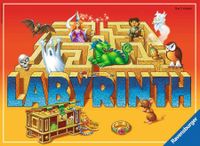
Top 125 · #29 of 60 in Family
Labyrinth
A Ravensburger classic in which you push path tiles to shift the entire maze while hunting for treasures. Since the path you make becomes the next player's path too, it's a family-game standard that has sold for nearly 40 years, letting an eight-year-old and an adult compete on equal footing.
Rules
In this 2–4 player family game, every push of a path tile reshapes the whole maze. Since the row or column you push also changes everyone else's route, reading the whole maze matters as much as reading your own path to the treasure.
Components
| Component | Count | Notes |
|---|---|---|
| Game board | 1 | A 7×7 grid; 16 of the squares are permanently printed path tiles |
| Loose path tiles | 34 | Square tiles. 33 fill the open squares and 1 extra sits beside the board |
| Treasure cards | 24 | Each shows the same picture as one treasure printed on the board |
| Playing pieces | 4 | Red, blue, green, and yellow. Each starts in one corner of the board |
A game for 2–4 players, ages 7 and up, lasting about 20 minutes. Each path tile shows a straight, curved, or T-shaped passage, and pushing a row or column changes every passage shape in it.
Setup
- 1Shuffle the loose path tiles face down and place them face up on the 33 open squares (everything except the 16 fixed squares).
- 2Set the one remaining tile face up beside the board as the extra tile.
- 3Shuffle the 24 treasure cards and divide them evenly among the players, keeping each stack face down in front of its owner.
- 4Each player chooses a playing piece and places it on the board corner matching its color.
Each piece starts only on its own corner. A treasure may be printed on any square, including a corner square.
A turn — push, then move
- 1Secretly look at the top card of your treasure stack. The treasure shown is this turn's goal.
- 2① Insert the extra tile at one of the arrows along the board's edge, pushing that whole row or column over by one square.
- 3② After pushing, move your piece as far as you like along connected passages (you may also choose not to move).
- 4If your piece reaches the goal square, turn that treasure card face up and set it aside, ready to look at the next one.
Pushing always comes first
Even if the path to your goal is already open, you must push a tile before moving your piece. You cannot skip straight to moving.
Whoever most recently went on a treasure hunt in this game goes first, and play continues clockwise. For a first-ever game, choose a starting player any way you like.
Pushing a passage — 12 arrows and no immediate reversal
There are 12 arrows along the board's edge. Each marks a full row or column that can be pushed in that direction. Inserting the extra tile there pushes that whole line over by one square, popping a tile out the opposite end — that popped tile becomes the new extra tile.
You cannot immediately undo the last push
The path tile cannot be inserted back into the board at the same place it was just pushed out. Pushing that same row or column from a different arrow is fine — only an exact reversal of the previous move is forbidden.
Moving your piece — as far as the connected passages allow
- After pushing, move as far as you like along passages that connect without a break from your piece's square.
- A corner or dead-end passage blocks movement in that direction — you may only follow the printed path shapes.
- You do not have to reach your goal treasure. Stopping at a useful square for next turn is fine.
- If the goal square is not connected this turn, you simply wait for a future push to open a route.
One push changes two paths
The row or column you push doesn't only change your own route — it also changes the next player's route. Even when it doesn't reach your own treasure, pushing to block an opponent's path is a valid choice.
Ending the game
- 1Turn over all of your treasure cards, then bring your piece back to your starting corner.
- 2Returning to your starting corner is itself a move — it still requires pushing a tile first.
- 3The first player to find every treasure and return to their starting corner wins.
Strategy tips
- Don't only watch the route to your own treasure — notice how each push opens or closes paths for everyone else too.
- If your goal treasure sits in a row or column you can push, pulling that whole line toward yourself is a valid plan.
- Even when you can't reach the treasure this turn, stopping at a junction that reaches far in many directions pays off later.
- If an opponent is close to winning, consider a push that cuts off their path back to their starting corner.
Editions and variants
The official rulebook includes a variant for younger children: divide the treasure cards as usual, but lay all of them face up so a player may aim for any visible treasure, turning its card over on arrival. Winning still requires turning over every card and returning to the starting square.
Korea Boardgames distributes several official editions beyond the base game, including Labyrinth Junior, a Pokémon-themed edition, and a Disney 100th Anniversary edition. This guide covers the base 2–4 player, 7×7 edition; themed editions are reported to keep the same push-and-move structure with different components and treasure art, but their exact differences were not verified here.
Master and Junior are separate games
Per English Wikipedia, Master Labyrinth (1991, an advanced edition) and Junior Labyrinth (1995, a simplified edition) use different boards and rules from the base game. The push-and-move rules in this guide do not apply to them directly.
Frequently confused rules
Q. Can I move my piece without pushing a tile first?
No. Even if your goal path is already open, you must push one tile before moving every turn.
Q. What exactly does the no-reversal rule forbid?
It forbids inserting a tile back into the exact spot a tile was just pushed out of, undoing the previous move. Pushing that same row or column from a different arrow is allowed.
Q. Does a piece pushed off the board lose its turn?
No. It simply moves to the opposite end of that same row or column, onto the tile that was just inserted, and this does not use up a turn.
Q. How far can a piece move in one turn?
There is no limit. After pushing, you may move any distance along connected passages, even all the way across the board.
Q. What happens if I can't reach my goal treasure this turn?
The card simply stays as your goal for next turn. You don't switch goals or peek at the next card early.
Q. Does returning to my starting corner also require pushing first?
Yes. After finding your last treasure, returning to your starting corner follows the same push-then-move turn structure.
History and verification scope
German psychologist Max J. Kobbert designed the game, first published by Ravensburger in 1986 as Das verrückte Labyrinth — a pun combining the German words for "displaced" and "crazy." It was introduced to English-speaking markets as The aMAZEing Labyrinth.
It won the 1991 Mensa Select award and the 1991 Deutscher Spiele Preis, and received the Spiel des Jahres special award for "most beautiful game" the same year (Wikipedia cross-check, confirmed 2026-10-10; Namuwiki's "Amazing Labyrinth" article covers the same game but does not record Korean distribution or print-status history).
Several variant editions followed, including Master Labyrinth (1991), Junior Labyrinth (1995), Secret Labyrinth (1998), and 3-D Labyrinth (2002). In Korea, Korea Boardgames officially distributes the base game alongside junior and character-collaboration editions.
Sources
Ravensburger official English rulebook — The aMAZEing Labyrinth (2017 print, item 234981)Korea Boardgames product page — confirms the Korean retail edition, player count and ageWikipedia cross-check — Labyrinth (board game)Namuwiki cross-check — "Amazing Labyrinth" (Korean)Rule summaries are reference content written by us, not quotations from the official rulebook. Always check the official rulebook for exact rules. Diagrams are original schematics, not rulebook illustrations.
Spotted a mistake? Tell us in the comments below →
Last updated 2026-10-10
💡 Master tip
Don't just watch the route to your own treasure — notice how a single push opens up paths for your opponents too. If your target treasure sits on a row or column you can push, pulling it toward yourself with that push is a valid idea.
Ready for something heavier
If this one has gotten too easy, try these — same feel, one step up in weight.
Comments
Share your thoughts, report a mistake, or request a tool. No sign-in needed — nicknames are not verified, so anyone can use the same one.
Loading…