Top 81
Hive
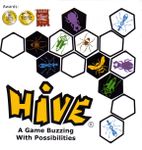
A board-less abstract strategy duel where players link insect tiles -- Queen Bee, Soldier Ant, Grasshopper, Spider, and Beetle -- aiming to completely surround the opponent's Queen Bee on all six sides, chess-like in its depth. Each tile's unique movement rule combines into a careful read-the-opponent puzzle as you close in on their Queen.
Rules
With no board at all, players link hexagonal tiles and win by completely surrounding the opponent's Queen Bee in this two-player-only abstract strategy game. Each bug moves differently, turning the game into a tactical puzzle.
Components
| Tile | Count per color |
|---|---|
| Queen Bee | 1 |
| Beetle | 2 |
| Spider | 2 |
| Grasshopper | 3 |
| Soldier Ant | 3 |
| Total | 11 (22 total for both colors) |
There is no board
There is no separate game board — the connected shape of the tiles themselves is called the Hive. All you need is open space on a table.
Setup
- 1Each player takes all 11 tiles of one color, placed face up in front of them.
- 2One player places a tile from their hand in the centre of the table.
- 3The next player joins one of their own tiles to it, edge to edge.
- 4From then on, each turn either places a new tile or moves one already-placed tile of your own.
Only the very first two tiles (each player's first) are allowed to touch the opponent's color. Every tile placed after that follows the placing rule below.
A turn — place or move
- 1On your turn, either [place a new tile] or [move one of your already-placed tiles] — never both.
- 2Once a tile is placed, it can never be taken back into your hand. It's fine to finish the game with unused tiles in hand.
- 3Until your Queen Bee is placed, you may not move any already-placed tile — only placing new tiles is allowed.
- 4If you can neither move nor place, your turn passes and your opponent plays again.
The Queen Bee must come by your 4th turn
Your Queen Bee can be placed on any of your first four turns, but you must place it on your 4th turn if you have not already.
Placing — only touch your own color
A new tile can be introduced at any time. However, with the exception of each player's very first tile, a newly placed tile must touch only your own color and never the opponent's.
This rule applies only when placing. A tile that moves and ends up touching the opponent's color is never a problem.
How each bug moves
| Bug | Movement |
|---|---|
| Queen Bee | Slides one space per turn into an adjacent empty space. |
| Beetle | Moves one space into an adjacent empty space, or on top of another tile. A stack is treated as the Beetle's own color, and the tile underneath cannot move while covered. |
| Grasshopper | Does not slide. It jumps over an unbroken row of tiles (at least one) and lands in the first empty space beyond them. |
| Spider | Slides exactly three spaces, following a direct path along touching tiles with no backtracking. |
| Soldier Ant | May slide any distance around the Hive, as far as the One Hive and Freedom to Move rules allow. |
Beetle and Grasshopper are the exceptions
Every other bug uses ordinary sliding movement. The Beetle can climb on and off the Hive, and the Grasshopper jumps instead of sliding.
Movement limits — One Hive and Freedom to Move
The tiles in play must always stay linked as one group. If moving a tile would split the Hive in two or strand a tile, that move is illegal (the One Hive rule).
Ordinary moves all slide into a neighboring space. Even if the destination space is empty, you cannot squeeze into it if both sides of the gap leading to it are blocked by tiles (the Freedom to Move rule). Only the Beetle (climbing) and Grasshopper (jumping) ignore this restriction.
Ending the game — surrounding the Queen
- 1The game ends the instant either Queen Bee is completely surrounded on all 6 sides, by tiles of either color.
- 2The player whose Queen Bee is surrounded loses.
- 3If the final move completes the surrounding of both Queen Bees at once, the game is a draw.
- 4Players may also agree to a draw if neither side can do anything but repeat the same two tiles back and forth.
A player who can neither move nor place simply passes that turn automatically. Losing happens only when your own Queen Bee is fully surrounded.
Strategy tips
- Surrounding your own Queen Bee with your own tiles makes it harder to trap, but it also narrows the sliding paths available to those same tiles.
- The Soldier Ant is the most dangerous piece because of its long range, but avoid moving one of your own tiles that acts as a 'joint' holding the Hive together, per the One Hive rule.
- Rather than closing in on the opponent's Queen Bee one space at a time, it is often more effective to first restrict the mobility of their Ant and Beetle.
Expansion bugs and editions
| Expansion bug | Movement and ability |
|---|---|
| Mosquito | Has no movement of its own. When it starts to move, it copies the movement ability of any other bug (either color) it is touching. If it touches only other Mosquitoes, it cannot move that turn; once it climbs atop the Hive like a Beetle, it keeps moving like a Beetle until it climbs back down. |
| Ladybug | Climbs on top of the Hive and moves across exactly two tiles, then descends into an empty space on the third step. It can change direction mid-move, letting it reach spaces other bugs cannot. |
| Pillbug | Normally slides one space, like the Queen Bee. Instead of moving itself, it may move an adjacent, unstacked tile (either color) by lifting it onto the Pillbug and setting it down into another empty space next to the Pillbug. |
Each expansion adds one tile per color, sold separately. The official 2024 Hive Ultimate bundles all three expansion bugs into the base set and formalizes tournament opening rules.
Korean distribution — unconfirmed
According to Namuwiki, the Korean distributor 'Boyak Game' released a Korean-language Compact Edition (13 tiles per color, 26 total — the base 22 plus the Mosquito and Ladybug expansion's 4). This guide was not able to directly verify that Korean rulebook's text.
Frequently confused rules
Q. Can a new tile touch the opponent's color?
Only each player's very first tile is an exception. Every tile placed afterward must touch only your own color. A tile that later moves and ends up touching the opponent's color is fine.
Q. What happens to a tile that a Beetle climbs on top of?
The covered tile cannot move while the Beetle sits on it. For placing purposes, the whole stack counts as the Beetle's color.
Q. Can a Grasshopper jump over an empty row?
No. It must jump over an unbroken row of at least one tile, landing in the first empty space right after that row.
Q. What if I still haven't placed my Queen Bee by my 4th turn?
You cannot delay further. You must place your Queen Bee on your 4th turn if you haven't placed it already.
Q. Who wins if the final move surrounds both Queen Bees at once?
The game is a draw. Otherwise, whoever's Queen Bee is fully surrounded loses.
Q. Does the game end if a player can't move or place anything?
No. That player's turn is simply passed and their opponent plays again. The game only ends when a Queen Bee is completely surrounded.
History and editions
Hive was designed by John Yianni and first published by Gen42 Games in 2001. It won a Mensa Select award and was included in the book 'Family Games: The 100 Best'. Its expansion bugs followed in order: Mosquito (2007), Ladybug (announced 2010, released 2011), and Pillbug (announced January 2013).
The components changed several times over the years. Early (1st-2nd edition) sets used wooden tiles with color stickers; from the 3rd edition on, tiles were made of black and almond-colored bakelite with etched artwork. A monochrome 'Carbon' edition followed in 2011, a smaller 'Pocket' edition in 2012, and the 2024 'Hive Ultimate' bundles all three expansion bugs into the base set.
According to Namuwiki, the Korean distributor was 'Boyak Game', and its Compact Edition is said to contain 26 tiles (the base 22 plus 4 from the Mosquito and Ladybug expansion). No further detail on Korean distribution was confirmed.
Sources
Gen42 Games official English rulebook (2010, by John Yianni)Gen42 Games official expansion rules — PillbugGen42 Games official expansion rules — MosquitoGen42 Games official expansion rules — LadybugWiki cross-check — English Wikipedia: Hive (game)Wiki cross-check — Namuwiki: Hive (board game, Korean)Rule summaries are reference content written by us, not quotations from the official rulebook. Always check the official rulebook for exact rules. Diagrams are original schematics, not rulebook illustrations.
Spotted a mistake? Tell us in the comments below →
Last updated 2026-10-10
💡 Master tip
The Beetle is the strongest piece for shutting an opponent down -- it can climb on top of their tiles and immobilize them. Exposing your Queen Bee too early can get it surrounded quickly, so it's safer to build up a defensive ring of your own tiles around the space before placing her there.
Similar games
Ready for something heavier
If this one has gotten too easy, try these — same feel, one step up in weight.
Tools you can request
Not built yet. Let us know if you want one — it goes on the list.
Per-insect movement rule guide
Summarizes how the Soldier Ant (perimeter sliding), Grasshopper (jumping) and Beetle (climbing on top of tiles) move
Queen Bee siege tracker
Counts remaining open sides around the Queen Bee
Comments
Share your thoughts, report a mistake, or request a tool. No sign-in needed — nicknames are not verified, so anyone can use the same one.
Loading…