Top 19 · #4 of 52 in Family
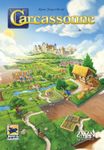
Carcassonne
A classic tile-laying game set in Carcassonne, the walled city in southern France, where you draw and add one tile at a time to complete cities, roads, monasteries, and farms. The heart of the game is deciding, every single turn, whether to place a meeple (follower) on the tile you just laid and where to put it. A completed feature scores at once and gives the meeple back so you can use it again.
👨👧👦 Played with our kids
Played with children aged 7 and 5. We only started playing by the rulebook recently.
Rules
A full walkthrough of Carcassonne with diagrams: lay tiles to build roads, cities, monasteries and fields, place your followers, and score. It also covers the river tiles and the abbot rules that the new edition includes by default.
Components
| Component | Count | Note |
|---|---|---|
| Land tiles | 72 + 1 start tile | The start tile has a darker back, so it is easy to pick out |
| River tiles | 12 | Includes the spring and the lake. Darker backs. They replace the start tile when you play with the river |
| Followers (meeples) | 40 (5 colors × 8) | Red, blue, yellow, green, black |
| Abbots | 5 (1 per color) | For the abbot rules. You can leave them out of your first game |
| Scoreboard | 1 | One follower is used as your score marker |
If this is your first game
The rulebook suggests putting the river tiles and the abbots back in the box, playing two or three games with the basic rules only (roads, cities, monasteries), and then adding farmers, then the river, then the abbot.
Setup
- 1Put the start tile (the one with the darker back) in the middle of the table. If you play with the river, put the spring tile there instead (see 'The River' below).
- 2Shuffle the rest of the tiles and split them into several face-down stacks, so everyone can reach at least one stack.
- 3Put the scoreboard to one side.
- 4Each player picks a color, takes 7 followers, and puts an 8th follower on space 0 of the scoreboard.
- 5If you play with the abbot, also take the abbot of your color.
Your turn (always in this order)
- 1Place 1 tile — draw a tile, turn it face up, and add it to the tiles already on the table. You must place it.
- 2Place 1 follower (optional) — you may put one on the road, city, monastery or field of the tile you just placed.
- 3Score — if your tile completed a feature, score it right away and take the follower back.
The youngest player starts, then play continues clockwise. Placing a follower is optional, but placing a tile and scoring are not.
Step 1 — how to place a tile
- A new tile must share at least one edge with a tile already on the table, and every edge that touches must match: the terrain (road, city, field) has to continue.
- Roads meet roads, cities meet cities, fields meet fields. If even one edge does not match, you cannot place the tile there.
- If you draw a tile that fits nowhere (this is rare), put it back in the box and draw a new one.
Step 2 — how to place a follower
- You may only place a follower on the tile you just placed. Never on a tile that was already on the table.
- Where you put it decides its role: road = thief, city = knight, monastery = monk, field = farmer (laid on its back).
- You cannot place it if that feature (the whole connected road, the whole city, the whole field) already holds a follower of any color — even one of your own.
- If all your followers are out, you simply skip this step. Followers you take back from completed features can be used again.
How to get in anyway
Put a follower on a separate, unconnected piece of road or city, then later place a tile that joins the two pieces. Now one feature holds several followers, and the 'more than one follower' rule below decides who scores.
Step 3 — scoring: roads
A road is complete when both ends are closed. An end is closed when it runs into a village, a city or a monastery, or when the road loops around and closes on itself. A completed road scores 1 point per tile.
It does not matter who completed it. If someone else's tile completes your road, you still score it.
Step 3 — scoring: cities
A city is complete when it is fully closed by its walls with no gap left inside. A completed city scores 2 points per tile, plus 2 more points for each coat of arms inside it.
Step 3 — scoring: monasteries
A monastery is always in the middle of its tile. It is complete once all 8 spaces around it (orthogonal and diagonal) are filled, and it scores the 8 surrounding tiles plus its own tile = 9 points.
When one feature holds several followers
- If a completed feature holds several followers, the player with the most followers on it takes all of the points.
- If two or more players are tied for the most, each of them takes the full score. The points are not split.
- Whether they scored or not, every follower on a completed feature goes back to its owner.
Farmers and fieldsSupplement rules
- The green ground is the field. Fields are cut apart by roads, cities and rivers — a single road splits one field into two.
- A follower laid on its back in a field is a farmer. Laying it down marks that it will not come back for the rest of the game.
- Farmers score nothing during the game. They only count in the final scoring: 3 points for each completed city that touches their field.
- If one field holds several farmers, the same majority rule as roads and cities applies. You cannot add a farmer to a field that already has one.
Farmers never come back
A follower laid in a field stays there until the game ends. How many of your 7 followers you are willing to tie up as farmers is the heart of Carcassonne strategy.
The RiverIn the box in the new edition
The 12 river tiles replace the start tile. If you play with the river, put the start tile back in the box.
- 1Set the spring tile and the lake tile aside.
- 2Shuffle the other 10 river tiles into a face-down stack and slide the lake tile to the bottom of it.
- 3Put the spring tile where the start tile would go.
- 4Until the river tiles run out, draw from the river stack instead of the normal stacks. Once the lake comes up and the river ends, start drawing normal tiles.
- River tiles follow the usual matching rules, and above all the river itself must not be broken.
- You may place followers on the roads, cities and fields of a river tile as usual. You may not place one on the river itself.
- The river may not turn back on itself. If two bends in a row curve the same way so that the river doubles back, the tile cannot be placed.
The AbbotIn the box in the new edition
- Each player takes the abbot of their color. The gardens printed on some tiles are the abbot's own spaces.
- When you place a tile with a monastery or a garden, you may place your abbot instead of a normal follower. The abbot may only go on a monastery or a garden, and a normal follower may never go on a garden.
- A garden scores exactly like a monastery: 9 points once all 8 surrounding spaces are filled.
- Special ability — if you did not place a follower in step 2 of your turn, you may take your abbot back off the board and go straight to step 3 to score that monastery or garden as it stands right now (1 point for its own tile plus 1 for each surrounding space filled so far).
- In the final scoring, an abbot still on the board is scored the same way as a monk.
Pulling the abbot out early from a monastery or garden that will probably never be surrounded gets you the points and frees the abbot for your next turn. The cost is that you place no follower that turn.
End of the game and final scoring
The game ends when the last tile has been placed and there is nothing left to draw. Features that were completed already scored during the game, so the final scoring only covers the unfinished features that still hold a follower.
| Feature | During the game (completed) | End of game (unfinished) |
|---|---|---|
| Road | 1 point per tile | 1 point per tile (the same) |
| City | 2 points per tile + 2 per coat of arms | 1 point per tile + 1 per coat of arms (half) |
| Monastery · garden | 9 points (8 around + its own tile) | 1 point for its own tile + 1 per filled space around it |
| Field (farmer) | — (no points during the game) | 3 points per completed city touching the field |
Add the final scoring on top, and the highest total wins. A tie is a shared win.
Rules people get wrong
Q. Someone else's tile completed my city. Who scores it?
The player whose follower is on it. It does not matter who completed it. Every feature completed that turn is scored in step 3 of that turn.
Q. My road looped around and met its own start. Is it complete?
Yes. A road that closes on itself counts as having both ends closed, so it is complete.
Q. The walls are all joined, but there is one empty space inside the city.
It is not complete. A city must be closed by its walls with no gap inside. It completes the moment that gap is filled.
Q. I placed a tile next to a monastery. Can I put a follower on the monastery?
No. A follower may only go on the tile you just placed, so you can only place a monk on the turn you place the monastery tile itself.
Q. When do farmers come back?
They do not. At the end of the game they score 3 points for each completed city touching their field, and that is that.
Q. Can I place a follower on a road or city that is on a river tile?
Yes, the usual rules apply. Only the river itself is off limits.
Q. Can I place a follower on the same turn I take my abbot back?
No. You may only take the abbot back if you did not place a follower in step 2. It is one or the other.
Q. I have no followers left.
Placing a follower is optional, so just place your tile and move on. Followers come back from completed features and can be used again. The trick is not to tie up too many of them as farmers.
History and editions
| Item | Detail |
|---|---|
| Designer | Klaus-Jürgen Wrede |
| First published | 2000, Hans im Glück (Germany) |
| English editions | Rio Grande Games, now Z-Man Games |
| Awards | Spiel des Jahres 2001 · Deutscher Spiele Preis 2001 |
| Korean release | First brought over in 2001 by Paper Iyagi, later by Korea Boardgames |
There have been two big changes of edition. The artwork was redrawn in 2014, and the 3rd edition (2021) that is sold today folds in the river and the abbot, which used to be bought separately. This guide follows that 3rd edition.
| Major expansion | Released | Korean edition |
|---|---|---|
| The River | 2001 | Included in the 3rd edition box |
| The Abbot | 2016 | Included in the 3rd edition box |
| Inns & Cathedrals | 2002 | Released in Korea in 2016 (hard to find now) |
| Traders & Builders | 2003 | Released in Korea in 2021 |
| The Princess and the Dragon | 2005 | No Korean edition |
| The Tower | 2006 | No Korean edition |
| Abbey and Mayor | 2007 | No Korean edition |
There are many more expansions
There are more than ten big expansions, and counting the mini expansions and spin-offs (Hunters and Gatherers, The Castle, South Seas and others) the total passes twenty. The table above lists only the best known ones and those you can buy in Korea. The Hunters and Gatherers spin-off was published in Korea by Popcorn Games.
Which editions are in print changes over time. Check with the seller before you buy.
Sources
Z-Man Games official rulesheet (Carcassonne, 3rd edition)Z-Man Games supplement rules — farmers, the river, the abbotCross-checked against Wikipedia: Carcassonne (board game)Cross-checked against Namuwiki: Carcassonne (Korean)Rule summaries are reference content written by us, not quotations from the official rulebook. Always check the official rulebook for exact rules. Diagrams are original schematics, not rulebook illustrations.
Spotted a mistake? Tell us in the comments below →
Last updated 2026-09-06
💡 Master tip
A farmer ties up a meeple for the rest of the game, but pays 3 points for every completed city next to it, so claiming a large field early comes back as big points later. You only have 7 meeples, so reaching into too many cities leaves you short — place them where a feature is likely to be completed.
Related games
Similar games
Ready for something heavier
If this one has gotten too easy, try these — same feel, one step up in weight.
Tools you can request
Not built yet. Let us know if you want one — it goes on the list.
Farmer (field) area scoring guide
A visual aid for telling where one farm area ends and the next begins
Comments
Share your thoughts, report a mistake, or request a tool. No sign-in needed — nicknames are not verified, so anyone can use the same one.
Loading…