Top 52 · #32 of 40 in Strategy
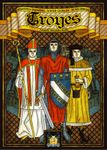
Troyes
As a lord of 13th-century Troyes, France, you roll dice generated by your citizens — civil (yellow), military (red), and religious (white) — and even buy your rivals' dice with money to develop the city. It elegantly blends a cooperative element (defending each round's foreign invasion events together) with a competitive one (buying and selling each other's dice).
Rules
As a noble family of 13th-century Troyes, you grow the city using the workforce rolled by your citizens (yellow for civil, white for religious, red for military). Your own dice are never enough — you must buy your rivals' dice for money — while everyone must also defend the city together against each round's events.
Components
| Component | Count | Notes |
|---|---|---|
| Game board | 1 | The city square (5 player districts), Influence track, Cathedral, Agriculture, and City Hall spaces |
| Dice | 24 (6 each red, white, yellow; 6 black) | Red = military, white = religious, yellow = civil. Black dice represent enemies and belong to no player |
| Citizen meeples | 56 (12 per player color × 4, plus 8 gray neutral) | Placed on the 3 principal buildings (Palace, Bishopric, City Hall) to generate dice each round |
| Cubes | 90 (20 per player color × 4, plus 10 gray neutral) | Used to build the Cathedral, to store delayed Activity-card effects, and to combat events |
| Activity cards | 9 per color (red, white, yellow) | One of each color enters play per round, up to 9 total per color |
| Event cards | 16 (8 red, 4 white, 4 yellow) | 2 enter the queue each round and threaten the city; the red deck's size sets the number of rounds |
| Character cards | 6 | Each player secretly keeps 1 (2 with 2 players) as a hidden end-game scoring condition |
| Deniers & victory point tokens | many | Deniers are the shared currency; VP tokens are stockpiled until the end |
For 1–4 players aged 12 and up; the official rulebook lists 90 minutes. Solo play is supported through an official variant against a virtual opponent, "le Roy" (see the editions section). This guide's main text covers the 2–4 player standard game.
Setup
- 1Choose a color and claim one of the 5 districts of the city square as yours. Place your Influence marker on space 4 of the Influence track.
- 2Take citizens according to player count — 4 with 4 players, 5 with 3 players, 6 with 2 players. Draw 1 Character card at random (2 with 2 players) and keep it secret.
- 3Sort the Activity cards by color and, without looking at the number on the back, place 1 of each color face down for rounds 1, 2, and 3.
- 4Form 3 Event decks: red, white, and yellow. The size of the red deck sets the number of rounds (6 with 4 players, 5 with 3, 4 with 2).
- 5Starting with the start player and going clockwise, then starting with the last player and going counterclockwise, place 1 citizen at a time on the Palace, Bishopric, and City Hall (this initial placement happens only once). Gray neutral citizens fill the remaining empty spaces (with 2 players, place them before the players' placement).
The initial placement happens only once. From then on, citizens move to and from the principal buildings only through actions.
A round — 5 phases
- 1Phase 0 (rounds 1–3 only) — reveal the Activity card for that round number, 1 of each color.
- 2Phase 1 — Income and Salaries: each player gains 10 deniers, then pays 2 deniers per citizen in the Palace and 1 per citizen in the Bishopric (City Hall citizens are free). If you can't pay in full, pay what you can and lose 2 VP.
- 3Phase 2 — Assemble Workforce: roll 1 yellow die per City Hall citizen, 1 white die per Bishopric citizen, and 1 red die per Palace citizen, placing them in your district. The start player rolls the dice for the neutral citizens and places them in the unowned gray district.
- 4Phase 3 — Events: 2 new Event cards enter the queue each round (the red card calls for a second white or yellow card). Military events (marked with a black-die icon) must be countered starting with the start player, who must beat the highest black die with dice from their own district.
- 5Phase 4 — Actions: starting with the start player, each player either activates an Activity card, builds the Cathedral, combats events, places a citizen on a principal building, uses Agriculture, or passes. The round ends once everyone has passed or no dice remain on the city square.
- 6Phase 5 — End of the Round: citizens on buildings return to their owners, unused dice return to the supply, and the start player card passes to the left for the next round.
Red dice count double against black dice
When combating black dice in Phase 3 only, any red die you use counts double. White and yellow dice count at face value.
Buying dice and action costs
Every action uses a group of 1 to 3 same-colored dice. You may draw them from more than one district, but they must share one color. Dice in your own district are free, but using dice in another player's district requires paying that player (who cannot refuse the sale). Dice in the gray neutral district belong to no one, but using them still costs money, paid to the bank.
| Group size (same-colored dice) | Cost per die from another district |
|---|---|
| 1 | 2 deniers |
| 2 | 4 deniers each |
| 3 | 6 deniers each |
Bigger groups cost more per foreign die
A 3-die group is powerful but costs 6 deniers per die bought from another player. Count what's already in your own district before buying only what's missing.
Activating Activity cards
- 1Yellow dice activate civil Activity cards, white dice activate religious cards, and red dice activate military cards.
- 2If you don't already have a tradesman on that card, pay the cost shown in its upper-left corner and place 1 of your citizens there as your tradesman. If you already have one, assemble your dice group with no additional cost.
- 3Divide the total value of your dice group by the number printed at the bottom of the card (rounded down), then apply the card's effect that many times.
- 4A card with an hourglass icon has a delayed effect — instead of an immediate benefit, place that many of your cubes on the card's illustration (one per activation). Later, during a different action, discard 1 cube to substitute for 1 die of that color (2 cubes can never substitute for the same die).
Each card has only 1 tradesman space
You cannot place 2 of your own tradesmen on the same card, and you cannot place one where another player's tradesman already sits. At the end of the game you score the VP printed on your tradesman's space (if every space is filled, some may be worth 0 VP).
Combating events and building the Cathedral
Event cards come in two kinds: military (countered with black dice) and self-effect (countered with cubes). Self-effect cards resolve left to right in the queue; using a dice group matching the card's required color, divide its total value by the printed number (rounded down) and place that many cubes on the card's banner spaces, from left to right.
- 1Once all the banners are filled, the card is immediately countered. Whoever placed the most cubes first gets the larger reward; whoever placed second gets the smaller one. Anyone who places cubes afterward gets nothing (ties split the reward).
- 2When a card is countered, everyone retrieves their own cubes and the card is removed — except Marauding, which is never removed and simply empties out again each time it is countered, remaining a permanent threat.
- 3At the end of the game, any uncountered Event card with at least one of your cubes on it still grants you 1 VP per card (Marauding included).
The Cathedral is built with a group of 1 to 3 dice (colors may be mixed). Each die lets you place 1 cube on the matching-numbered construction space, but you cannot place a cube on a higher-level space until the corresponding lower-level space has a cube. Spaces 1–3 grant 1 VP and 1 Influence point each; spaces 4–6 grant 1 VP and 2 Influence points each, immediately.
An empty level costs points at the end
At final scoring, you lose 2 VP for each Cathedral level with no cube of yours on it (up to 3 levels × 2 = 6 VP).
Sources of victory points
| Source | VP |
|---|---|
| Cathedral spaces 1–3 | 1 VP each (immediate) |
| Cathedral spaces 4–6 | 1 VP each (immediate) |
| Winning/placing second on an event | the card's larger/smaller reward (immediate) |
| Tradesman's space on an Activity card | VP printed on the space (end of game) |
| Uncountered events at game end | 1 VP per card with your cube (Marauding included) |
| Empty Cathedral levels | −2 VP each |
| Character card condition | hidden until revealed — see below |
Character cards stay secret from the moment you receive them, and each sets its own condition. For example, the Chrétien de Troyes card rewards the total number of your citizens placed across the Palace, Bishopric, and City Hall: 1 VP for 4 or more, 3 VP for 5–6, and 6 VP for 7 or more. Guessing your rivals' hidden conditions while hiding your own is a central part of the game.
End of the game
The game ends after the round in which the last card of the red Event deck enters the queue (6 rounds with 4 players, 5 with 3, 4 with 2). At that point, each player settles the Cathedral's empty-level penalty and their Character card's condition; whoever has the most VP wins.
The rulebook recommends keeping VP hidden and stacking them in piles of 10, comparing totals only at the very end. Revealing scores early undercuts the Character cards' bluffing tension.
Tips
- Don't rely only on your own district's dice — buying a rival's best die to disrupt their plan is the heart of the game. Since bigger groups cost more per foreign die, decide the group size first, then calculate the price.
- Check your Character card's condition early and quietly stockpile whatever it rewards (Influence, deniers, tradesmen, Cathedral cubes, and so on).
- Spend Influence points before combating black dice — 1 point rerolls a die, 4 points flips a die to its opposite face (faces always sum to 7), which can turn a weak die into a strong one.
- Cubes stored on delayed-effect cards later substitute for a die of that color, so investing early lets you assemble a big group cheaply exactly when you need it.
- Countering an event only rewards the first and second cube-placers, so if the reward is small, it may be better to skip it and spend your dice elsewhere.
Player-count differences and editions
| Players | Rounds | Citizens | Character cards |
|---|---|---|---|
| 4 | 6 | 4 | 1 |
| 3 | 5 | 5 | 1 |
| 2 | 4 | 6 | 2 |
The 2-player game also changes the initial placement order — the gray neutral citizens fill buildings first, before the two players take turns placing their own.
The rulebook also includes an official 1-player variant designed by Shadi Torbey, The King's Challenge. The virtual opponent, "le Roy," has no money or Influence and acts purely by dice roll; even the initial placement is decided by dice. On le Roy's turn, roll 2 black dice; their sum (2–12) looks up a fixed action table (gain VP, place a worker or tradesman, place Cathedral cubes, resolve an event, and so on), and le Roy always spends his strongest die first. The player's final score is their VP total minus le Roy's.
⚠️ Unverified: the same rulebook also includes 4 Bonus cards — Baker, Banquet, Prior, and Resistance — but within the pages checked, no instructions on when or how to shuffle them into play were found, so this guide does not cover them.
No official Korean-language edition was found in searches of the Korea Boardgames and Board M storefronts, and Namuwiki's board-game article has no mention of a Korean release. That absence, however, is not confirmed by a primary source, so this guide marks the Korean rulebook status as `unverified` rather than `none`.
Frequently confused rules
Q. Must another player sell me the dice in their district?
Yes. You choose whether to buy, but if you do, the owner cannot refuse. The seller has no choice in the matter and simply receives the fixed price.
Q. Are dice in the gray neutral district free?
No. They belong to no one, but using them still costs the price set by your group size, paid to the bank.
Q. What happens if I can't counter a black die?
That die is discarded and you lose 2 VP (no loss if you have 0 VP). Any remaining black dice must then be countered by the next player.
Q. Can I place a Cathedral cube on a higher level first?
No. A cube must already occupy the corresponding lower-level space before you can place one on the level above it.
Q. Does an Activity card's effect apply only once?
No. It applies as many times as your dice group's total value divided by the card's printed divisor (rounded down).
Q. What happens if a tradesman is moved to a different Activity card?
The space on the original card becomes free for another player to place a tradesman there. A citizen already sitting on that space does not automatically move there on its own.
History and editions
Designed by Sébastien Dujardin, Xavier Georges, and Alain Orban, Troyes was first published in 2010 by Belgium's Pearl Games, followed by localized editions from Italy's UPlay.it edizioni and America's Z-Man Games (cross-checked against the board game's mention in English Wikipedia's Troyes city article).
The English rulebook this guide checked is the 2016 edition distributed on Pearl Games' official site, translated by Nathan Morse and edited by co-designer Sébastien Dujardin. The same rulebook includes an official 1-player variant, The King's Challenge, designed by fellow game designer Shadi Torbey.
Namuwiki has an article for Troyes (board game), but it confirms only basic facts (designers, publisher, release year) with no mention of a Korean release or expansions. Searches of the Korea Boardgames and Board M storefronts likewise turned up no listing.
Sources
Pearl Games official English rulebook (Troyes, 2016 edition)Pearl Games official Troyes product page — players, age, time, and rules download confirmedWikipedia cross-check — Troyes (city article mentions the 2010 board game, co-published by Pearl Games, UPlay.it edizioni, and Z-Man Games)Namuwiki cross-check — Troyes (board game): only basic facts confirmed, no Korean-release informationDistribution check — Korea Boardgames storefront search: no listing for 'Troyes'Distribution check — Board M storefront search: no listing for 'Troyes'Rule summaries are reference content written by us, not quotations from the official rulebook. Always check the official rulebook for exact rules. Diagrams are original schematics, not rulebook illustrations.
Spotted a mistake? Tell us in the comments below →
Last updated 2026-10-10
💡 Master tip
Don't try to act using only your own dice. The heart of Troyes is buying away a rival's high roll with money to throw off their turn. Figuring out your hidden noble card's scoring condition early and quietly stockpiling the resources or buildings it rewards also goes a long way toward winning.
Similar games
Ready for something heavier
If this one has gotten too easy, try these — same feel, one step up in weight.
Tools you can request
Not built yet. Let us know if you want one — it goes on the list.
Dice purchase price calculator
Instantly calculates the gold needed to buy 1, 2, or 3 of a rival's dice
Hidden noble card score calculator
Automatically totals each noble's scoring condition at game end
Comments
Share your thoughts, report a mistake, or request a tool. No sign-in needed — nicknames are not verified, so anyone can use the same one.
Loading…