Top 51 · #31 of 40 in Strategy
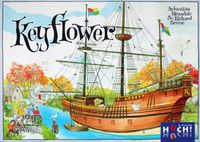
Keyflower
An auction worker-placement game where colored meeples double as both bidding tokens and production workers. Even outside your own turn, you can plant a worker on someone else's village tile to join in producing, so every player's village grows intertwined with the others.
Rules
A four-season auction and worker-placement game where the same colored meeples are used both to bid and to produce. You can plant a worker on another player's village tile even on their turn, so every village grows intertwined with the others.
Components
| Type | Count | Notes |
|---|---|---|
| 64 large hexagonal tiles | 4 turn order · 6 boat · 6 home · 48 village (incl. 4 summer boat tiles) | 12 village tiles per season (spring/summer/autumn/winter) |
| 48 skill tokens | 16 anvils (smithing) · 16 pickaxes (mining) · 16 saws (carpentry) | Used as upgrade costs or scored by certain tiles |
| 120 wooden resource counters | 48 gold · 24 iron · 24 stone · 24 wood | Gold substitutes for any other resource (usually worth 1 point at game end) |
| 141 wooden workers ("keyples") | 40 blue · 40 red · 40 yellow · 20 green · 1 purple (start-player only) | Only same-colored workers may be added to a bid together |
| 6 home screens (with chimney tiles) | — | Stand behind your workers to hide their colors |
A white worker icon on a tile means "any color of the player's choice"; a translucent (?) icon means "random color." The actual physical workers come in only 5 colors: blue, red, yellow, green, and purple.
Setup
- 1Put the blue, red, and yellow workers in the cloth bag; set the green workers, resource counters, and skill tokens face down beside it.
- 2Each player secretly draws 8 workers from the bag and hides them behind their home screen.
- 3Each player takes a random home tile. Whoever draws the lowest-numbered tile takes the purple "start player" worker and begins in spring.
- 4Lay out boat tiles and turn order tiles equal to the player count, and reveal that many spring village tiles in the center.
- 5Each player takes their allotment of winter tiles without looking at them first, holding them in hand for a later choice.
| Players | 2 | 3 | 4 | 5 | 6 |
|---|---|---|---|---|---|
| Home/Boat tiles | 2 | 3 | 4 | 5 | 6 |
| Turn order tiles | 1 | 2 | 3 | 4 | 4 |
| Spring/Summer/Autumn tiles | 6 | 7 | 8 | 9 | 10 |
| Winter tiles (per player) | 3 | 3 | 3 | 2 | 2 |
New tiles arrive each new season
When summer and autumn begin, new boats, new workers, and new skill tokens are added, along with that season's village tiles. No new workers arrive in winter — you finish the game with whatever workers remain.
The four seasons — spring, summer, autumn, winter
The game runs over 4 rounds (seasons). On your turn, place one or more workers in a single location to either ① bid on a village tile (or turn order tile) or ② use a tile for production. The season ends once everyone has passed in succession.
Passing doesn't stop you from acting again
As long as not everyone else has passed, a player who already passed may place workers again. The season ends only once all players have passed in succession.
Bidding — only the same color may be added
- 1Place one or more workers on your side of the village tile (or turn order tile) you want to bid on, drawn from behind your screen or from a losing bid.
- 2You may only add workers of the same color already on or bidding for that tile. A different color cannot bid on it at all.
- 3To outbid an existing bid, you must place more workers than the previous bid. There is no maximum.
- 4Outbid workers do not return behind your screen — they can be moved together to bid elsewhere or to use for production.
Turn order tiles work the same way
Turn order tiles never join your village. Instead they set the order for taking that season's boat contents (except in winter) and determine the next start player.
Production — own village vs. others' villages vs. a tile being bid for
Workers may be placed on tiles in your own village, another player's village, and (except in winter) a tile currently being bid for. The first use of a tile usually costs 1 worker; a second use costs 2 of the same color; a third costs 3 (maximum 6 per tile per season).
Skill tokens and extra workers are outputs too
Some tiles produce skill tokens, white (random-color) workers, or green workers instead of resources. All of these go straight behind your home screen (unlike resources, they never sit on the tile).
Transport and upgrading
Your home tile and the Farrier, Stable, and Wainwright tiles enable transporting resources and upgrading tiles. Placing a worker there moves up to the indicated number of resources along roads, and upgrades (flips) up to the indicated number of village tiles in your own village.
The resources required for an upgrade must already be sitting on that tile. You must transport them there first. Once placed, a tile can never be repositioned.
Resolving the end of a season
- 1Once everyone has passed, workers used in unsuccessful bids return behind their owners' home screens.
- 2Village tiles that received no bids are removed (along with any green workers on them) and go back in the bag.
- 3Tiles successfully bid for are claimed starting with the start player, clockwise, along with any workers placed on them; the workers used then return to the bag.
- 4Workers used for production on your own home tile return behind your screen as usual (including ones used in winter — they still count for final scoring).
- 5Starting with the turn order winners, in spring, summer, and autumn players choose a boat and take its workers and skill tokens; in winter, they take the turn order tile itself instead.
Winter's turn order tiles grant tiles, not boats
Spring/summer/autumn turn order tiles grant a boat's contents (workers and skill tokens), but winter's turn order tile adds the tile itself to the winner's village — winter has no new boats to refill.
Winter tiles — chosen secretly, revealed together
At the start of winter, each player selects one or more of the winter tiles they were dealt during setup (choosing while holding them, unseen), and all players reveal simultaneously. Unselected winter tiles return to the box, and it remains unknown which player chose which.
| Winter tile (selected examples) | Scoring |
|---|---|
| Keythedral | Owner scores a flat 12 points |
| Watermill | Choose one resource type; score 1 point per unit of it you own |
| Village hall | Choose one worker color; score 1 point per worker of that color |
| Scholar | Choose one skill-token type; score 3 points per token of it |
| Key market | 2 points per green worker owned |
Unlike spring/summer/autumn production tiles, most winter tiles only score points at game end rather than producing anything. The key is stockpiling whatever resources, workers, or skills that tile needs before winter arrives.
Final scoring
After winter ends, check each scoring tile in your village and add up the points. Most scoring tiles cannot double-count the same item with another scoring tile (resources parked on a Barn, Blacksmith, Stone yard, or Timber yard belong only to that tile).
| Boat (1 random per game) | Scoring |
|---|---|
| Keyflower | 1 point per point of your own transport capacity |
| Sea Bastion | 1 point per tile connected by a road loop back to the start |
| Sea Breeze | Points per boat (including summer boats) connected to your home tile by river |
| Flipper | Pay an upgrade cost to flip one more tile, and score 2 points |
| Invincible | A flat 5 points, no condition |
Gold can substitute for any resource required by a scoring tile, but doing so forfeits gold's own 1-point value. The purple start-player worker also counts as one resource, skill, or worker of any color for scoring. Ties are broken by playing again.
Strategy tips
- Securing a rare color (especially green) lets you bid with little competition, since few other players hold that color.
- Placing a worker on another player's village tile still routes resources to your own home tile — you can profit from a tile even without winning its auction.
- Securing transport and upgrade tiles before winter makes it much easier to concentrate the resources your scoring tiles will need in the final season.
- Winter tiles are revealed simultaneously, so you can't scout rivals' choices beforehand. It's safer to pick a tile that matches resources, skills, or workers you've already stockpiled.
Player counts and expansions
| Item | Notes |
|---|---|
| Player count (2–6) | Home/boat/turn order/seasonal tile counts scale per the setup table in §2; the rules are identical even at 2 players |
| Keyflower: The Farmers (2013) | Adds wheat, farm animals, and field-based scoring (per English Wikipedia) |
| Keyflower: The Merchants (2014) | Adds contracts, tile extensions, and cabin upgrades (per English Wikipedia) |
Whether either expansion has a Korean release could not be confirmed. This guide covers only the base game, and expansion content is not verified beyond the English Wikipedia summary.
Frequently confused rules
Q. Can I bid with a red worker on a tile that already has a blue worker on it?
No. You may only add workers of the same color already used or bid on that tile.
Q. Who keeps the output when I place a worker on someone else's village tile?
You do — the player who placed the worker. But the resource arrives at your own home tile, not that tile.
Q. Can a player who has passed do nothing else for the rest of the season?
No — as long as someone else hasn't passed yet, a passed player may place workers again. The season ends only once everyone has passed in succession.
Q. Does winning a turn order tile add that tile to my village?
Not in spring, summer, or autumn — you only take that boat's contents (workers and skill tokens). Only winter's turn order tile adds the tile itself to your village.
Q. How many workers do I need to use a tile a third time?
Three of the same color (first use costs 1, second costs 2, third costs 3 — up to 6 total per tile per season).
Q. Is it always worth substituting gold for a specific resource on a scoring tile?
You gain that scoring tile's points, but you give up gold's flat 1-point value at game end. It's usually worth it whenever the scoring multiplier exceeds 1 point per unit.
History and editions
Designed by Sebastian Bleasdale and Richard Breese and published by R&D Games in 2012 (confirmed by both the rulebook's imprint and English Wikipedia). English Wikipedia records wins of the 2012 Meeples' Choice and Jogo do Ano awards, nominations for the 2013 International Gamers Award and 2014 Gouden Ludo, and a one-time ranking of 50th on BoardGameGeek. It is the seventh game in Richard Breese's "Key series," which began with Keydom in 1998.
Namuwiki's entry carries the same basic facts — designers, 2012 release, 2–6 players (4 recommended), 90–120 minutes, ages 12+ — but mentions no Korean edition or domestic distributor. Per English Wikipedia, the expansions "The Farmers" (2013) and "The Merchants" (2014) exist; neither is covered by this guide.
Sources
R&D Games — official Keyflower English rulebook (first printing, October 2012; hosted on the 1jour-1jeu.com CDN)Wiki cross-check — English Wikipedia: Keyflower (board game)Wiki cross-check — Namuwiki: Keyflower (Korean)Rule summaries are reference content written by us, not quotations from the official rulebook. Always check the official rulebook for exact rules. Diagrams are original schematics, not rulebook illustrations.
Spotted a mistake? Tell us in the comments below →
Last updated 2026-10-11
💡 Master tip
Securing a rare worker color (such as green) lets you win auctions with little competition. Stockpiling as many resources and worker counts as possible before the winter tile auctions is also important.
Similar games
Ready for something heavier
If this one has gotten too easy, try these — same feel, one step up in weight.
Tools you can request
Not built yet. Let us know if you want one — it goes on the list.
Per-tile worker color and bid tracker
Visualizes the current bidding state for each displayed tile
Winter bonus tile score calculator
Automatically computes the bonus for holding the most resources/meeples
Comments
Share your thoughts, report a mistake, or request a tool. No sign-in needed — nicknames are not verified, so anyone can use the same one.
Loading…