Top 13 · #10 of 40 in Strategy
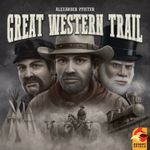
Great Western Trail
Become a 19th-century American rancher, herding cattle along the trail from Texas to Kansas City and shipping them off by train, in this intricate worker-placement deck-building strategy game. The fun centers on engine building: using the varied actions of buildings along the trail and the staff you hire to steadily refine your own cattle card deck into something more powerful.
Rules
Herd cattle from Texas to Kansas City in this worker-placement deck-builder set in the 19th-century American West. Move along the trail to use building actions that improve your cattle deck, then settle your hand's value each time you reach Kansas City and ship it by rail to ever more distant cities.
Components
| Component | Count | Notes |
|---|---|---|
| Game board | 1 | Trail, job market, Kansas City, and railroad track |
| Worker tiles | 54 (18 each of cowboy, craftsman, engineer) | Hired from the job market |
| Hazard tiles | 18 (6 each of flood, drought, rockfall) | Trigger tolls when passed or reached; score at game end |
| Teepee tiles | 22 (11 each of green and blue) | Bought and sold in the Indian trade section |
| Building tiles | 47 (7 neutral + 40 private) | Placed on the trail to create actions |
| Cattle cards | 92 (56 player herd cards + 36 market cattle cards) | Each breed has a different breeding value |
| Objective cards | 24 | Score bonus points if fulfilled at game end, or penalties if not |
| Station master tiles | 5 | Acquired at railroad turnouts — immediate effect plus end-game scoring |
| Player set | Player board, 14 discs, engine, certificate marker, cattleman (1 each) | The certificate marker can raise your effective breeding value |
For 2 to 4 players, each player starts with an identical personal deck built from their own color. Only the 7 neutral building tiles are shared across the table; the other 40 private building tiles belong to each individual player.
Setup
- 1Place the board in the middle, shuffle the 5 station master tiles, and place one face up at each railroad turnout.
- 2Place the 7 neutral building tiles on their marked trail spaces (fixed positions for your first game, shuffled afterward).
- 3Shuffle the worker, hazard, and teepee tiles and reveal them as the rules direct to fill the trail spaces, the Indian trade section, the hazard sections, and the job market.
- 4Shuffle the market cattle cards and display a number based on player count (7 for 2 players, 10 for 3, 13 for 4), and fill the 6 foresight spaces in Kansas City.
- 5Each player takes a player board, 14 discs, an engine (on the starting railroad space), a certificate marker (at space 0), a cattleman (set aside), and a 14-card herd deck, then draws 4 cards into hand.
- 6Each player takes one starting objective card from the objective deck and receives starting capital (6, 7, 8, or 9 dollars, in turn order).
The 10 private building tiles are numbered 1–10 and double-sided (a/b). In your first game, display them all on their a-side and use them as shown.
A turn — 3 phases
- 1Phase A. Move — Advance your cattleman along the trail at least 1 step, up to your current step limit (3 or 4 at the start). You may never move backward, and must choose a path at any fork.
- 2Phase B. Act — If you reached a neutral building or your own private building, use all of its local actions (in any order) or instead take one single auxiliary action. On another player's building, a hazard, or a teepee tile, only the auxiliary action is available. Reaching Kansas City triggers its own 5-step procedure.
- 3Phase C. Draw up — If your hand is below your current hand limit (starts at 4, can rise to 6), draw that many cards from your personal draw stack, reshuffling your discard pile into a new draw stack if it runs out.
Trail movement and building fees
Only spaces holding a building, hazard, or teepee tile count as a trail "location"; empty spaces don't count toward movement. Any location you move to or pass over showing a hand icon (green or black) requires an immediate payment.
| Location type | Hand color | Paid to |
|---|---|---|
| Another player's private building | Green or black | That player |
| Hazard or teepee tile | Green or black | The bank |
Lacking money never blocks movement
If you can't afford a fee, you pay as much as you can and the rest is forfeited. Fees are never paid retroactively for locations you already passed.
Hiring workers — cowboys, craftsmen, engineers
Hiring uses neutral building "A" or one of your own private buildings. Pay the listed hiring cost and place the worker on the leftmost empty space of its row. Workers in the row currently marked by the job market token cannot be hired.
| Worker | Main role |
|---|---|
| Cowboy | Used when buying from the cattle market — more cowboys buy more or pricier cattle in one action |
| Craftsman | Required to place private building tiles on the trail — more craftsmen allow pricier tiles |
| Engineer | Determines how many spaces your engine advances on the railroad track |
Filling a row's 5th and 6th spaces is worth 4 points each at game end. Specializing in one worker type is a valid strategy.
Kansas City — settling income and delivery
- 1Resolve the 3 foresight spaces in order (workers go to the job market; hazards and teepees go to their sections).
- 2Reveal your entire hand and add up breeding values counting each distinct breed only once, no matter how many copies you hold.
- 3Optionally spend certificates (temporary, or permanent from station masters) to raise this total further.
- 4Take that many dollars from the bank, then discard your entire hand to your personal discard pile.
- 5Deliver by placing a disc on a city whose value is equal to or lower than your total, among cities you have not yet delivered to (Kansas City and San Francisco are exceptions and may be used repeatedly).
A lagging engine adds transport costs
If the delivered city is ahead of your engine's nose, pay the bank 1 dollar per space between them. No cost applies if your engine is already ahead of that city.
Moving the engine and appointing station masters
An auxiliary or building action moves your engine forward as many spaces as you have engineers. Except for the starting space, only one engine may occupy a space at a time, so you simply skip over spaces held by other engines.
- 1Stopping on a turnout space lets you choose whether to upgrade that train station (paying its cost, once per station).
- 2If you upgrade, place your disc on the station space and move one of your hired workers from the rightmost space of its row to become the station master.
- 3A station master tile's upper half is an immediate effect (gain money, remove a hazard, etc.); its lower half is an end-game scoring condition.
Final scoring — 11 categories
All scoring happens once, after the game ends. The official rulebook's scoring pad records the following 11 categories in order.
| Category | How it's scored |
|---|---|
| Money | 1 point per 5 dollars |
| Private building tiles | Sum of printed points on tiles placed on the trail |
| City delivery | Points unlocked on city crests via your discs (can be negative) |
| Train stations | Sum of printed points on stations you hold |
| Hazard tiles | Sum of printed points on tiles you hold |
| Cattle cards in deck | Sum of point symbols across your draw stack, hand, and discard pile |
| Objective cards | Fully met tasks score their positive value; unmet tasks score their negative value (your personal objective area must always be scored) |
| Station master tasks | Each tile's own condition — worker counts, objective-card pairs, hazard-tile pairs, teepee pairs, certificate pairs, etc. |
| Worker row 5th/6th spaces | 4 points per filled space |
| Certificate disc space | A one-time +3 if cleared during the game |
| Job market token | +2 for whoever holds it at game end |
Highest total wins, and ties are shared victories.
Game end
The end is triggered the instant a player places a worker tile on the job market's last space, pushing the job market token off the bottom row. That player finishes the rest of their current turn, then every other player takes one final turn.
On a final turn, reaching Kansas City does not allow choosing new worker tiles from the foresight spaces (only remaining hazards/teepees are resolved). Once every final turn is complete, move to final scoring.
Strategy tips
- Kansas City income rewards breed diversity: duplicate cattle only count once, so trimming your deck toward varied breeds pays off more than hoarding copies.
- More craftsmen let you place pricier private buildings, and more engineers move your engine farther to save on transport costs — leaning too hard into one creates a bottleneck in the other.
- Fees you charge opponents are income for you. Claiming a well-placed building space early turns opponents' movement into your revenue.
- When no local action is appealing, taking the auxiliary action for money or cards is a perfectly valid choice instead of forcing a weak local action.
Player count and the 2nd edition
| Item | Detail |
|---|---|
| Player count | 2 to 4, ages 12+. Starting counts for the cattle and job markets scale with player count |
| 1st edition (this guide) | 2016, eggertspiele/Pegasus Spiele. Uses "teepee" tiles in the hazard/trade sections |
| 2nd edition (2021) | Reissued by Plan B Games. Replaces teepee tiles with a bandit theme and redraws the art and icons; adds an official solo mode adapted from fan rules (per English Wikipedia) |
This guide's numbers and terminology follow the 1st-edition English rulebook. If you're playing the 2nd edition, the hazard/trade naming and artwork differ while the core calculations are reported to be the same (per English Wikipedia) — verify any rule changes against the 2nd-edition rulebook directly.
Frequently confused rules
Q. If I can't afford a fee at all, am I stuck and unable to move?
No. You pay as much as you can, the rest is forfeited, and your movement continues as normal.
Q. Can several cattlemen occupy the same trail location at once?
Yes. Cattlemen never interfere with each other, regardless of how many share a location.
Q. After collecting income in Kansas City, what happens to my hand?
Your entire hand goes to your personal discard pile, whether or not you spent certificates to raise its value. You then draw up to your hand limit on your next turn.
Q. Can I deliver to a city I already delivered to?
Not unless it's Kansas City or San Francisco. Any other city crest with your disc on it can never be chosen again.
Q. If my engine is already ahead of the delivered city, do I still pay transport costs?
No. Transport costs only apply when your engine lags behind the delivered city's crest, based on the number of spaces between them.
Q. What if my personal draw stack runs out mid-draw?
Shuffle your discard pile into a new draw stack at that moment and continue drawing.
Designer and history
Designed by Alexander Pfister and first published by eggertspiele in 2016. English Wikipedia reports wins including the Meeples' Choice award, the Gouden Ludo "Best Expert Game," Jogo do Ano, and the UK Games Expo "best board game (European style)."
Namuwiki confirms a domestic community nickname (a shortened romanization, "Gwet") but does not state whether an official Korean edition exists or who distributes it — see the rulebooks.ko note above for the search attempts made.
Sources
eggertspiele/Pegasus Spiele — official English rulebook for Great Western Trail, 1st edition (16 pages)Wiki cross-check — English Wikipedia: Great Western Trail (board game)Wiki cross-check — Namuwiki: Great Western Trail (Korean)Rule summaries are reference content written by us, not quotations from the official rulebook. Always check the official rulebook for exact rules. Diagrams are original schematics, not rulebook illustrations.
Spotted a mistake? Tell us in the comments below →
Last updated 2026-10-11
💡 Master tip
Keeping your hand free of duplicate cattle breeds by regularly trimming (cycling) your deck is the key to high-value deliveries in Kansas City. Early on, use craftsmen to build up your resource-production foundation, then lean on engineers in the mid-to-late game to extend your train's range so you can reach Kansas City more often.
Similar games
Ready for something heavier
If this one has gotten too easy, try these — same feel, one step up in weight.
Tools you can request
Not built yet. Let us know if you want one — it goes on the list.
Kansas City cattle delivery value calculator
Settles cattle breed value with no hand duplicates counted, plus transport cost
Worker/building tech tree tracker
Accumulates your current tech-tree score
Comments
Share your thoughts, report a mistake, or request a tool. No sign-in needed — nicknames are not verified, so anyone can use the same one.
Loading…