Top 8 · #6 of 40 in Strategy
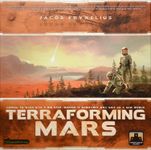
Terraforming Mars
You run a huge corporation, raising the oxygen and the temperature of Mars and placing ocean tiles to turn it into a place people can live. The heart of the game is combining the many projects on the cards to build your own resource production engine.
Rules
You run a corporation raising the oxygen, the temperature and the oceans of Mars. Every step you raise a global parameter, your terraform rating (TR) goes up - and TR is both your income each generation and your score. The game ends in the generation where all three parameters reach their goals.
What the game actually counts
Your goal is to make Mars liveable. Progress is measured by three global parameters - oxygen, temperature and oceans. Every step you raise one of them, your terraform rating (TR) goes up by 1. TR is worth 1 VP at the end and it is also the M€ income you collect every generation, so a point earned early is worth more than the same point earned late.
A parameter at its goal cannot be raised further
Once a parameter reaches its goal it stops, and a card that would raise it simply has that part ignored - no TR either. You may still play the card and take every other effect on it.
- TR starts at 20 (14 in the solo game).
- Your score is TR plus milestones, awards, tiles on the board and VPs printed on your cards.
- On your turn you take 1 or 2 actions and nothing else. The board grows through many short turns.
Components
| Component | Count | Notes |
|---|---|---|
| Game board | 1 | Map of the Tharsis region plus the TR track, oxygen and temperature tracks, standard projects, milestones and awards |
| Player boards | 5 | Each has a production track and a resource box for all six resources |
| Corporation cards | 17 | 10 standard corporations plus 2 Corporate Era ones; the rest are the colorless-backed Beginner Corporation cards |
| Project cards | 208 | Blue (active), green (automated) and red (event) |
| Reference cards | 8 | Standard projects and symbol summary |
| Player markers | 200 | Transparent plastic cubes in 5 colors - used for TR, production, tile ownership and used actions alike |
| Resource markers | 200 | Opaque cubes worth 10 (gold) / 5 (silver) / 1 (copper) - the same cube is any resource |
| Game board markers | 3 | Big white cubes for oxygen, temperature and the generation |
| Ocean tiles | 9 | These tiles are the ocean parameter itself |
| Greenery / city tiles | 60 | 60 for both kinds together |
| Special tiles | 11 | Placed only when a card says so |
| First player marker | 1 | Shifts one seat clockwise each generation |
| Rules booklet | 1 | - |
Resource cubes have no type of their own. What a cube is depends on the box you put it in. If you run out, swap cubes for silver (5) and gold (10) ones.
Setup
- 1Put the board in the middle. Stack the 9 ocean tiles on their reserved space, put the oxygen and temperature markers on 0% and -30 ˚C, and the generation marker on 1 on the TR track.
- 2Put the resource cubes and the remaining tiles where everyone can reach them.
- 3Remove every Corporate Era card (the red and white icon on the lower left edge) from the project deck and from the corporation cards. Shuffle the deck, put it next to the board and leave room for a discard pile.
- 4Whoever won the last game of Terraforming Mars takes the first player marker. Each player picks a color, takes a player board and puts markers on 1 on all six production tracks (standard game only) plus one marker on 20 on the TR track.
- 5Players new to the game take a Beginner Corporation card instead - it gives 42 M€ and 10 project cards straight into hand (no buying). Everyone else shuffles the 10 standard corporations and deals 2 each.
- 6Deal 10 project cards to each remaining player. These are only candidates to buy.
- 7Everyone picks a corporation and which project cards to keep. In player order, reveal your corporation, take its starting resources and production, and pay 3 M€ for each project card you keep. Discarded cards always go face down.
- 8Generation 1 skips the player order and research phases (you just did them in setup). The first player starts the action phase straight away.
The first few generations are poor
Your only starting money is what the corporation gives you, and every card you keep costs 3 M€ - keeping all 10 costs 30 M€. A card in hand is only useful if you can afford to play it, so buying cards you cannot pay for is pure loss.
A generation has four phases
| Phase | What happens |
|---|---|
| 1. Player order | The first player marker shifts one seat clockwise and the generation marker moves up one. Skipped in generation 1 |
| 2. Research | Each player draws 4 cards and buys any number of them for 3 M€ each. The rest are discarded face down. There is no hand limit. Skipped in generation 1 |
| 3. Action | Starting with the first player and going clockwise, take 1 or 2 actions on your turn. Taking no action means you pass and are out for this generation. The phase ends when everyone has passed |
| 4. Production | Everyone at once - all leftover energy becomes heat, you gain M€ equal to your TR plus your M€ production, then all other resources according to your production. Finally, remove the markers from used action cards |
M€ income = TR + M€ production
M€ is the one resource counted differently: your TR is added on top. With TR 24 and M€ production 3 you collect 27 M€. M€ production is the only production that can go negative, and never below -5 - since TR is added, your total income can never be negative.
The seven actions
On your turn you take 1 or 2 of the following, and you may take the same action twice. Taking only one is a real option - it lets you see what your opponents do before committing.
| Action | Details |
|---|---|
| A. Play a card from hand | Check the requirements, pay the cost, resolve the immediate effects, then place the card according to its color |
| B. Use a standard project | The 6 projects printed on the board. Available to anyone, any number of times per generation |
| C. Claim a milestone | If you meet the criteria, pay 8 M€ and put your marker on it |
| D. Fund an award | 8 M€ for the first, 14 M€ for the second, 20 M€ for the third |
| E. Use the action on a blue card | The ones with a red arrow. Once per generation per card |
| F. Convert 8 plants into a greenery tile | Raises the oxygen level 1 step (and your TR) |
| G. Convert 8 heat into a temperature step | Raises your TR as well |
| Standard project | Cost | Effect |
|---|---|---|
| Sell patents | - | Discard any number of cards from hand to gain 1 M€ each |
| Power plant | 11 M€ | Increase your energy production 1 step |
| Asteroid | 14 M€ | Raise the temperature 1 step (+1 TR) |
| Aquifer | 18 M€ | Place an ocean tile (+1 TR, and collect the placement bonus) |
| Greenery | 23 M€ | Place a greenery tile - raises the oxygen 1 step (+1 TR) |
| City | 25 M€ | Place a city tile and increase your M€ production 1 step |
Standard projects are the way out when the cards do not come
With money alone you can still push the parameters. The prices look steep, but Asteroid at 14 M€ buys 1 TR - that is 1 VP plus 1 M€ every remaining generation. The earlier it is, the cheaper it gets.
Cards - cost, requirements, tags
To play a card you must meet its requirement and be able to perform its effects. Requirements vary: oxygen 9% or lower, temperature -6 ˚C or higher, 2 science tags, having plant production, and so on. The cost is printed in the upper left corner, less any discount a card in play gives you.
| Tag | Meaning | Special |
|---|---|---|
| Building | Construction on Mars | You may pay with steel |
| Space | Space technology | You may pay with titanium |
| Power | Energy production or handling | - |
| Science | Scientific knowledge | Many cards require a number of science tags |
| Jovian | Infrastructure in the outer solar system | Some cards have to be scored separately at the end |
| Earth | Activity back on Earth | - |
| Plant | Plant life and photosynthesis | - |
| Microbe | Microbes for a specific purpose | Resource cubes are collected on the card itself |
| Animal | Animals | Usually generates VPs |
| City | Places a city tile | Often requires energy production and produces M€ |
| Event | A one-time event | Red cards, turned face down after being played |
Requirements only matter when you play the card
A card requiring oxygen 9% or lower, played at 5%, stays in play even after the oxygen reaches 14%. The reverse bites too: a card you save can have its window close - play the ones with an upper limit early.
A red border means any player
A red border on a resource, production, tile or tag icon means you may target anyone, including yourself. Removing red-bordered resources is optional - you may do it partly or not at all - but reducing red-bordered production is mandatory: if no opponent has it, you must lower your own or not play the card.
Global parameters and bonus steps
| Parameter | Start | Goal | One step | How to raise it |
|---|---|---|---|---|
| Oxygen | 0% | 14% | 1% | Placing a greenery tile, or cards with the oxygen icon |
| Temperature | -30 ˚C | +8 ˚C | 2 ˚C | Converting 8 heat, the Asteroid standard project, or cards with the temperature icon |
| Oceans | 0 | 9 ocean tiles | 1 tile | The Aquifer standard project, or cards with the ocean icon |
Whoever steps on a bonus keeps it
The bonus goes to the player who raised the parameter to that point. Raising the oxygen to 8% also raises the temperature, so your TR goes up 2 at once; hitting 0 ˚C places an ocean and again gives 2 TR. If someone has stopped one step short, that step is worth taking.
The six resources - production is not the same as stock
Your player board has a production track above and a resource box below for each resource. A resource icon inside a brown box raises your production; the same icon without the brown box just hands you cubes. Mixing the two up wrecks every engine calculation you make.
| Resource | What it does |
|---|---|
| MegaCredits (M€) | The general currency. Income is TR plus M€ production |
| Steel | Pays only for building tag cards, worth 2 M€ each |
| Titanium | Pays only for space tag cards, worth 3 M€ each |
| Plants | 8 of them become one greenery tile |
| Energy | Powers many cards. At the start of the production phase all leftover energy becomes heat |
| Heat | 8 of them raise the temperature 1 step |
There is no change from steel or titanium
Paying a 17 M€ building card with 9 steel (18 M€ worth) simply loses you 1 M€. You may mix in M€, so 8 steel and 1 M€ is the tidy way - though overpaying on purpose is fine when you are short on cash.
Production has no upper limit. Past 10 you leave a marker on 10 and add another one (10 + 2 = 12). Only M€ production can go negative, and never below -5.
Placing tiles - the map is the rule
| Tile | Placement restriction | End-game VPs |
|---|---|---|
| Ocean | Only on the blue ocean-reserved areas, and nothing else may be placed there (12 reserved areas, 9 tiles) | None - ocean tiles have no owner |
| Greenery | Next to another tile you own, if possible. With no tiles of your own, or no free area next to them, place it anywhere | 1 VP, plus 1 VP to each adjacent city |
| City | May not touch another city tile (Noctis City is the exception, on its reserved area) | 1 VP per adjacent greenery |
| Special | As printed on the card | As printed on the card |
- Placing a tile gives you the placement bonus printed on that area (resources or a card draw).
- On top of that you get 2 M€ for each adjacent ocean tile - including when the tile you place is itself an ocean.
- Greenery, city and special tiles take one of your player markers to show ownership. Ocean tiles do not.
- Three areas are reserved for specific cities and take no other tile.
- If placing a greenery cannot raise the oxygen, you get no TR either - the tile is still placed.
Milestones and awards
Both are worth 5 VPs and both are limited to 3 each per game. A milestone is claimed by a player who meets its criteria; an award is funded by anyone and won at the end by whoever leads that category. Funding it does not make it yours.
| Milestone - 8 M€, max 3, 5 VPs each | Criteria |
|---|---|
| Terraformer | A terraform rating of at least 35 |
| Mayor | Owning at least 3 city tiles |
| Gardener | Owning at least 3 greenery tiles |
| Builder | At least 8 building tags in play |
| Planner | At least 16 cards in hand when you claim it |
| Award - 8 / 14 / 20 M€, max 3 | Won by |
|---|---|
| Landlord | Owning the most tiles in play |
| Banker | The highest M€ production |
| Scientist | The most science tags in play |
| Thermalist | The most heat cubes |
| Miner | The most steel and titanium cubes together |
Ties on awards are friendly
First place is 5 VPs, second is 2 VPs. There is no second place in a 2-player game. Players on the same level all get the same placing, and if more than one player takes first, no second place is awarded at all.
The third award costs 20 M€. Open a category you can win while it is cheap - funding late a category an opponent already leads means paying 20 M€ to hand them 5 VPs.
When the game ends
When oxygen 14%, temperature +8 ˚C and all 9 ocean tiles are done, the game ends at the end of that generation. It does not stop immediately - you still play out that generation's production phase.
A final round of plant conversions after the last production phase
After that production phase, players get one last chance to convert plants into greenery tiles, as many times as they can afford, in player order - which can also trigger placement bonuses and other effects. The English rulebook only says "one extra chance", but the Korean edition spells it out: the first player converts as many times as they want, then the next player, and so on. The oxygen is already at 14% so it will not rise, but each tile's own VP and the VPs it gives adjacent cities still count - which is exactly why you want plants banked in the last generation.
Final scoring
- 1TR is your base score. Start from your marker on the TR track and move it up as you add everything below.
- 2Awards - 5 VPs to the leader of each funded award, 2 VPs to the runner-up (no runner-up in a 2-player game).
- 3Milestones - 5 VPs for each one you claimed.
- 4The board - 1 VP per greenery tile you own, and 1 VP per adjacent greenery for each city tile you own. Count these in player order to avoid confusion.
- 5Cards - first count the VPs on cards that collect resources, then gather every other card you have played and count them, including the face-down events.
Ties are broken by the most M€ left over, so there is no reason to burn money you have nothing to spend it on in the last generation.
Strategy that falls straight out of the rules
- 1 TR is 1 VP plus 1 M€ for every remaining generation. A TR gained in generation 3 is worth far more than the same TR in the last one - early parameter raises pay twice.
- A city is worth 0 by itself. Put it where greeneries can reach it or it is a blank space on the scorepad. Conversely, building next to an opponent's greenery is entirely legal.
- Converting 8 plants gives you 1 VP tile + 1 oxygen step + 1 TR + a placement bonus + VPs for adjacent cities in a single action. Nothing else in the game packs that much in.
- Steel and titanium only pay for their own tags. Production you cannot spend is dead weight - raise it to match the cards you actually hold.
- Energy is never wasted, it becomes heat. Power plants built early quietly turn into temperature steps. If you plan to spend energy on a card, though, spend it before the production phase.
- Requirements with an upper limit close for good - play cards needing oxygen 9% or lower before someone pushes the oxygen up.
- Only 3 milestones are ever claimed. If you are close, 8 M€ is cheap, and once someone else takes it those 5 VPs are gone forever.
- Banking plants for the last generation is effectively extra points, thanks to the conversions allowed after the final production phase - 16 plants is two greeneries.
Variants and expansions
| Variant | What changes |
|---|---|
| Corporate Era | Add all the cards with the red and white icon on the lower left edge, including 2 more corporations. In exchange you start with no production at all. It makes the game longer and more complex - not recommended for new players |
| Draft variant | In the research phase you draft instead of simply drawing: take 4 cards, set one aside and pass the rest, repeating until you have 4, then buy from those at 3 M€ each. Cards pass clockwise in even generations and counter-clockwise in odd ones, and there is no drafting in generation 1 since the research phase is skipped |
| Solo (Corporate Era solo) | Start at TR 14 and play exactly 14 generations, with no milestones or awards. Before choosing cards, place 2 neutral cities each with an adjacent greenery, using the cost numbers of revealed cards to find the spaces (these tiles are not yours and do not raise the oxygen). If you have not completed terraforming by the end of generation 14, you lose |
Expansions are separate products. Everything in this guide is the base game; expansions add things like a Venus parameter, colonies and political factions.
- Hellas & Elysium - two alternative maps
- Venus Next - Venus as a fourth global parameter
- Prelude and Prelude 2 - much stronger starting positions
- Colonies and Turmoil - colonies and political factions
- Amazonis & Vastitas, Utopia & Cimmeria, Milestones and Awards - the recent wave
- There is also an Automa expansion for solo play
- Terraforming Mars: Ares Expedition is not an expansion but a separate card game with its own rules
Rules people get wrong
Q. The temperature is already +8 ˚C. May I still play a card that raises it?
Yes. Play the card and simply ignore the temperature part - and you get no TR from it either. Every other effect on the card resolves as normal.
Q. Do I have to keep meeting a card's requirement after playing it?
No. Requirements only need to be met when you play the card. It stays in play afterwards even if the condition no longer holds, and you can keep using a blue card's action.
Q. What if there is no free space next to my own tiles for a greenery?
You may still place it. The rule says 'if possible' - with no tiles of your own, or no free area beside them, you may place the greenery on any available area. Only ocean-reserved and city-reserved areas are off limits.
Q. Does the city adjacency restriction include my opponents' cities?
Yes. No city tile may touch another city tile regardless of owner. The only exception is the Noctis City placed by the card Capital, which always goes on its reserved area.
Q. Is leftover energy simply lost?
No. At the start of the production phase all leftover energy is converted into heat. Conversion comes first and production second, so that heat adds to what your heat production gives you.
Q. A card takes resources from an opponent, but nobody has any. Now what?
Removing red-bordered resources is optional - you may do it partly or not at all and still play the card. Reducing red-bordered production is mandatory, so if no opponent has that production you must lower your own or not play the card.
Q. Event cards go face down. Do they still score?
Their tags only apply while the card is being played, so they do not count for later tag requirements. The VPs printed on them do count, which means you must turn your event pile face up when scoring.
Q. What do I do when a production goes past 10?
Production has no cap. Leave a marker on 10 and add another marker on top of the total (10 + 2 = 12). Only M€ production can go negative, and -5 is the floor.
History and editions
Jacob Fryxelius of Sweden designed the game and FryxGames released it in 2016, with graphic design by his brother Isaac and an English edition co-published by Stronghold Games. The designer took his doctorate in chemistry at Stockholm University and was working as a science teacher at the time.
- The map is the Tharsis region of Mars, including Valles Marineris and three of the four great volcanos - only the area around Olympus Mons is missing.
- The three players in the rulebook examples are named Kim, Stanley and Robinson; the credits thank Kim Stanley Robinson for the inspiration of his Red Mars trilogy.
- It won the Deutscher Spiele Preis in 2017 and was nominated for the Kennerspiel des Jahres the same year.
- It climbed as high as 3rd in the overall BoardGameGeek ranking in 2019 and 2020.
- Expansion timeline (cross-checked against Wikipedia): Hellas & Elysium and Venus Next (2017), Prelude and Colonies (2018), Turmoil (2019), then Prelude 2, Milestones and Awards, Automa, Amazonis & Vastitas and Utopia & Cimmeria (2024).
- A Korean edition was published by Korea Boardgames; it sold out on release and reprints went quickly too (cross-checked against Namuwiki).
Do not confuse it with Ares Expedition
Terraforming Mars: Ares Expedition (2021) is a different game in the same setting - cards only, no board, and much shorter. None of the rules in this guide apply to it.
Sources
Official Korea Boardgames rulebook (Terraforming Mars, Korean edition, 16 pages)Official FryxGames rulebook (Terraforming Mars, English)FryxGames product page (Terraforming Mars)Cross-checked against Wikipedia: Terraforming MarsCross-checked against Namuwiki: Terraforming Mars (Korean)Rule summaries are reference content written by us, not quotations from the official rulebook. Always check the official rulebook for exact rules. Diagrams are original schematics, not rulebook illustrations.
Spotted a mistake? Tell us in the comments below →
Last updated 2026-09-14
💡 Master tip
Early on, secure cards that raise your production (energy and plants especially) so your engine runs later, and time the rises in the global parameters to match the requirements on your cards. Lining cards up in advance for tag synergy makes your late-game combos far more efficient.
Similar games
Ready for something heavier
If this one has gotten too easy, try these — same feel, one step up in weight.
Tools you can request
Not built yet. Let us know if you want one — it goes on the list.
Counts include public tool requests only, excluding repeats from the same browser. These are not signed-in people counts: other devices or cleared cookies can be counted again.
Resource production timer and calculator
Adds up the resource production actions for each generation automatically and shows the current generation.
Comments
Share your thoughts, report a mistake, or request a tool. No sign-in needed — nicknames are not verified, so anyone can use the same one.
Loading…