Top 39 · #28 of 40 in Strategy
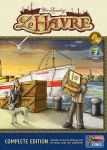
Le Havre
Become a ship owner in the French port city of Le Havre, converting raw materials into processed goods, building buildings, and constructing ships to amass a great fortune in this challenging Euro game. The key is designing a resource-processing chain while under the pressure of feeding your workers every round.
Rules
In the French port city of Le Havre, players convert raw materials into processed goods and build or buy buildings and ships to amass the greatest fortune. New goods arrive every turn via Supply tiles, and the pressure to feed workers every seven turns is what shapes every decision about what to process and what to build.
Components
| Component | Count | Notes |
|---|---|---|
| Game board | 3 connecting parts | Supply tile spaces, Building Proposals spaces, ship pile spaces |
| Person discs · ship markers | 5 each (player colors) | Mark building occupancy · track Supply tile progress |
| Supply tiles | 7 | One revealed per turn, supplying 2 kinds of goods/Francs to the offer spaces |
| Game turn overview cards | 5 (reverse = Buttery) | A Buttery is a food storeroom for the end of the round |
| Standard Building cards | 33 (incl. 3 starting buildings) | 1 Construction Firm + 2 Building Firms start owned by the town |
| Special Building cards | 82 (+ 4 blank) | Includes the Le Grand Hameau expansion and bonus cards; only 6 are used per game, chosen at random |
| Round cards | 20 (reverse = ship) | 7 Wooden Ships, 6 Iron Ships, 4 Steel Ships, 3 Luxury Liners |
| Loan cards | 11 | Only taken when food or interest cannot otherwise be paid |
| Round overview cards | 5 (one per player count) | One side for the full version, the other for the shortened version |
| Goods and money tokens | 420 total, all double-sided | 78 Francs and fish/wood/coal/cattle/grain/iron/clay/hides, etc.; the reverse side is the upgraded good |
| Food production tokens | 16 | Show the food reduction a ship provides (2/5, 3/4, 5/6, 7/8, 9/10, 11/12, 13/14) |
Every goods token has two sides
Wood, clay, iron, coal, fish, grain, cattle, and hides only enter the game in their standard form, and flipping them via a building action turns them into their upgraded form (charcoal, brick, steel, coke, smoked fish, bread, meat, leather). When building, brick may always substitute for clay, and steel for iron.
Setup (full version)
- 1Lay out the 3-part game board in the middle of the table.
- 2Each player takes 1 person disc, 1 ship marker, and 1 game turn overview card in their color.
- 3Shuffle the 7 Supply tiles and place them face down on the round spaces; set the ship markers beside the first tile.
- 4For the full version, place 2 Francs, 2 fish, 2 wood, and 1 clay on the starting offer spaces.
- 5Each player takes 5 starting Francs and 1 coal.
- 6Shuffle the Special Building cards and place only 6 face down on the 'Special Buildings' space; return the rest to the box.
- 7Set aside the green Construction Firm and the 2 Building Firms as the town's starting buildings.
- 8Remove any Standard Building cards not marked for this player count, then shuffle the rest into 3 equal piles and fan each out by ascending sort order number onto the Building Proposals spaces.
- 9Choose Round cards for this player count, show the harvest/no-harvest side, and stack them with round 1 on top.
- 10Whoever lives closest to the sea becomes the starting player; play proceeds clockwise.
The shortened version is an official rule, not a house rule
The full version runs from 7 rounds (solo) to 20 rounds (4 players) and can be quite long. The rulebook also provides an official shortened version (more starting resources, no Special Buildings, and nearly half the rounds). See 'Editions and expansions' for details.
A turn — Supply action, then a main action
- 1Supply action (mandatory): Move your ship marker to the next Supply tile in the direction of the arrow (flip it face up if this is the first time it is occupied). Place 1 token of each of its 2 kinds of goods/Francs, standard side up, on the offer spaces.
- 2If the tile reads 'Interest', every player holding at least 1 loan must immediately pay exactly 1 Franc in interest, regardless of how many loans they hold.
- 3Main action (mandatory, choose one): (A) take everything from one offer space, or (B) move your person disc into an empty building and carry out that building's action.
- 4Additional actions (optional, any time on your own turn, repeatable): buy a building or ship with money, or sell one of your own buildings or ships to the town for half its value.
- 5The turn in which your ship marker lands on the 7th Supply tile is the last turn of that round. After finishing that turn's main action, resolve the Round card.
There is no limit on the offer spaces
There is no limit to a player's personal supply either, and all goods are open information, kept face up. Francs are not counted as goods but can be taken from an offer space. Note, however, that coal and hides never appear on the offer spaces — they are only obtained through building actions.
Processing resources — from raw materials to goods
Everything arriving via the offer spaces is a raw material (standard side). Entering the right building and flipping the tokens turns them into more valuable processed goods (upgraded side), sometimes at an energy cost, sometimes earning a Franc subsidy.
| Raw material | Processed good | Building | Cost | Notes |
|---|---|---|---|---|
| Wood (1 energy) | Charcoal (3 energy) | Charcoal Kiln | No energy needed | The process generates its own energy |
| Clay | Brick | Brickworks | ½ energy per 1–2 brick (rounded up) | Subsidy of 1 Franc per 2 brick; brick can substitute for clay when building |
| Iron | Steel | Steel Mill | 5 energy per steel | Steel can substitute for iron when building; required to build the Bank |
| Coal (3 energy) | Coke (10 energy) | Cokery | No energy needed | Subsidy of 1 Franc per coke produced |
| Fish (1 food) | Smoked fish (2 food) | Smokehouse | 1 energy regardless of quantity | Subsidy of 1 Franc per 2 fish smoked |
| Grain (0 food) | Bread (2 food) | Bakehouse | ½ energy per 1–2 bread (rounded up) | Subsidy of 1 Franc per 2 bread baked |
| Cattle (0 food) | Meat (3 food) | Abattoir | 2 Franc entry fee | Yields 1 hide as a byproduct per 2 cattle slaughtered (rounded down) |
| Hide | Leather | Tannery | No entry fee | Subsidy of 1 Franc per leather tanned |
Grain and cattle provide no food until processed
In their standard form, grain and cattle are worth 0 food. They must first be processed into bread or meat before they count toward a food payment. Fish, by contrast, already counts as 1 food even before being smoked.
Buildings — construction, buying, and entry fees
- Construction (main action B): Enter the Construction Firm, a Building Firm (buildings only), or a Wharf (ships only), pay the listed materials, and build the top card of a Building Proposals pile. The Construction Firm may build up to 2 buildings per visit.
- Buying (additional action, any time): Buy any town-owned building, or the top card of any of the 3 Building Proposal piles, with money. Ships may be bought the same way, but a ship's purchase price is always higher than its printed value.
- Entry fee: Entering another player's building (or a town-owned one) costs food or Francs, as listed. If the cost is split by a '/', only one of the two is required. Food can always be paid with Francs instead, but Francs can never be paid with food.
- Selling: Your own buildings and ships can be sold to the town at any time for half their value. A building sold this turn cannot be bought back the same turn. Selling or buying a building sends any person disc on it back to its owner.
| Building type | Icon | Notes |
|---|---|---|
| Craftsman's | C | First-stage processing like fish and wood; often carries a Hammer or Fisherman icon |
| Economic | E | Mostly exchange and selling buildings |
| Industrial | I | Processing and steelmaking — the core of the mid-to-late game |
| Public | P | Conditional bonus buildings like the Town Hall and Church |
| Non-building | N | Buildings with no type, such as the Marketplace, Clay Mound, and Black Market |
Padlocked buildings offer no action
Buildings like the Bank, Town Hall, Storehouse, Guildhouse, and Business Park carry a padlock icon: visiting them does nothing, but they grant their owner extra end-game value(the '+' symbol) based on the other buildings that owner holds.
End of a round — harvest, feeding, construction, new ship
- 1Once the main action of the turn that revealed the 7th Supply tile is finished, resolve that round's card for the row matching the player count.
- 2① Harvest: anyone with at least 1 grain gets 1 more grain, and anyone with at least 2 cattle gets 1 more cattle (at most +1 each per harvest). 'No harvest' rounds skip this entirely.
- 3② Feeding: each player pays the amount of food shown on the card. Each ship owned reduces that amount by a fixed value. A player short on food must sell buildings or take a Loan card.
- 4③ Town construction: if indicated, add 1 Standard (lowest sort order from the Proposals) or Special (top of the face-down pile) building to the town's holdings.
- 5④ New ship revealed: flip the Round card over; its reverse becomes a new Ship card added to the matching pile (Wooden, Iron, Steel, or Luxury Liner).
- 6The next round begins with the player whose number is printed on the card.
Loans are a last resort
You may only take a loan when you genuinely cannot pay food or interest (you receive 4 Francs immediately). It can be repaid at any time for 5 Francs, but each unpaid loan at game end costs 7 Francs off your final fortune.
The food requirement differs from round to round
The food amount printed on each Round card varies by player count and generally trends upward over the course of the game, but the exact numeric table is printed on the physical cards themselves, not listed as numbers in the rules text. This guide describes the mechanism, not the full per-round table.
Calculating final wealth
- 1Add the printed value of every building and ship you own (they score even if empty or never visited).
- 2Buildings with a '+' symbol (Bank, Town Hall, Guildhouse, etc.) add bonus value based on the other buildings you own at game end.
- 3Add the cash (Francs) in hand.
- 4Subtract 7 Francs for every unpaid loan.
- 5Goods remaining in your personal supply (wood, iron, etc.) are worth nothing (exception: the Storehouse's own value rises with the number of goods tokens its owner holds).
- 6The player with the greatest fortune wins. Ties share the victory.
The final stage and game end
Once the last Round card has been resolved, the 'final stage' begins. Starting with the starting player and going clockwise, each player takes exactly one more main action. No Supply or Buying actions are taken in this stage, and interest is no longer paid.
Only during the final stage may a player move into a building already occupied by another person disc (the one exception: you still cannot re-enter a building already holding your own disc). Repaying loans and selling buildings or ships remain possible during this stage.
Once every player has taken their final action, the game ends immediately and wealth is calculated. Unless the rare situation arises where the order actually matters (paying an entry fee, buying a Luxury Liner), the order of final actions generally does not matter.
Strategy that follows directly from the rules
- The earlier you secure ships, the less food pressure you face each round. The official rulebook itself states the game is 'essentially impossible to win without ships.'
- Owning a Hammer-icon building (like the Construction Firm or a Building Firm) early makes it easier to gather extra coal at the Colliery and similar buildings, easing your energy supply.
- Loans are a legitimate strategy — a player holding the Local Court special building can win even while carrying several loans.
- Late in the game, players often use the Bridge over the Seine to cash in leftover goods, or the Steelworks to produce steel for expensive steel-requiring goals like the Bank or a Steel Ship.
Editions and expansions
| Item | Details |
|---|---|
| Full version / shortened version | Both official lengths ship in the same box. The shortened version grants more starting resources, skips Special Buildings, and runs for nearly half the rounds. |
| 2008 first printing / 2012 full version / 2016 combined printing | The English rules are identical across all three. The 2016 printing (this guide's baseline) bundles the Le Grand Hameau expansion and extra bonus cards into the Special Buildings deck by default. |
| Le Havre: Le Grand Hameau | An expansion co-designed with Grzegorz Kobiela that adds more Special Building cards. Printings from 2016 onward already include it. |
| Le Havre: The Inland Port (2012) | A standalone two-player spin-off using an action-point system, distinct from the base game. It won the 2013 International Gamers Award for 2-player strategy games (per Namuwiki). |
| Digital edition | Codito Development released an iOS app in June 2012 (Metacritic score of 82% from 6 reviews). |
| Korean release | Price-comparison sites and the official storefront listing confirm that Korea Boardgames distributes 《Le Havre Complete Edition》(ages 14+, 1-5 players, 100-200 minutes). No Korean rulebook text was obtained, so Korean-specific terminology is not reflected in this guide. |
Frequently confused rules
Q. What's the difference between construction and buying?
Construction is a main action, paid for with materials, and can only be done at the Construction Firm, a Building Firm, or a Wharf. Buying is an additional action, paid for with money, and can be done any time during your turn.
Q. Do I pay an entry fee to enter my own building?
No. Your own buildings never require an entry fee. You only pay food or Francs when entering another player's building or a town-owned one.
Q. What happens if I don't have enough food?
You may pay with Francs instead. If that is still not enough, you must sell buildings or take a Loan card. A loan grants 4 Francs immediately, but each one left unpaid at game end costs 7 Francs off your final fortune.
Q. Do I have to build ships?
It isn't mandatory by the rules, but ships reduce your food burden every round. The official rulebook itself says the game is essentially impossible to win without them.
Q. Can Luxury Liners carry goods?
No. Only Wooden, Iron, and Steel Ships can be used with the Shipping Line building. Luxury Liners are never used for shipping, though they still count fully toward your final fortune and toward the Dock's bonus value.
Q. Does an empty building still score points?
Yes. A building's printed value counts even if no one ever visits it. However, the bonus value on '+' buildings is calculated from the owner's building holdings at game end, independent of occupancy.
History and reception
Uwe Rosenberg edited the game together with Hanno Girke, and it was published in 2008 by Germany's Lookout Games; the English edition was distributed under license by Mayfair Games. Graphics and illustrations are by Klemens Franz. The rulebook itself credits William Attia's Caylus and Rosenberg's own Agricola as influences.
The game won the 2009 International Gamers Award for multiplayer strategy games (per Namuwiki). English Wikipedia describes it as the second entry in Rosenberg's 'Harvest' series, moving the setting from the farmland of Agricola to a port city.
The expansion Le Havre: Le Grand Hameau (co-designed with Grzegorz Kobiela) added more Special Building cards and has been bundled into the base game since the 2016 printing. The standalone two-player spin-off Le Havre: The Inland Port (2012) uses an action-point system and won the 2013 International Gamers Award for 2-player strategy games (per Namuwiki). Codito Development released an iOS app in 2012.
Sources
Lookout Games/Mayfair Games — official English Rules of Play for Le Havre (2016 combined printing)Lookout Games — official English Rules of Play for Le Havre (2012 full version, used for cross-checking)BoardGameGeek 35677 — Le HavreWiki cross-check — Wikipedia: Le Havre (board game)Wiki cross-check — Namuwiki: Le Havre (board game, Korean)Price-comparison cross-check — confirms Korea Boardgames distributes 《Le Havre Complete Edition》 (not a rulebook source)Rule summaries are reference content written by us, not quotations from the official rulebook. Always check the official rulebook for exact rules. Diagrams are original schematics, not rulebook illustrations.
Spotted a mistake? Tell us in the comments below →
Last updated 2026-10-11
💡 Master tip
Building ships early reduces your crew's food burden each round and lets you earn large sums through shipping exports. It's efficient to sketch out your processing chain (raw materials to processed goods) in advance and build the buildings that fill in missing links first.
Similar games
Ready for something heavier
If this one has gotten too easy, try these — same feel, one step up in weight.
Tools you can request
Not built yet. Let us know if you want one — it goes on the list.
Round food requirement notifier
Automatically calculates the food to be deducted next round and any substitute funds
Resource processing conversion guide
Shows the value after processing each raw material and which facility is needed
Comments
Share your thoughts, report a mistake, or request a tool. No sign-in needed — nicknames are not verified, so anyone can use the same one.
Loading…