Top 32 · #23 of 40 in Strategy
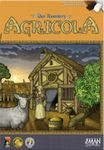
Agricola
The definitive classic worker-placement Euro game: become a 17th-century Central European farmer, expanding your house, plowing fields, growing crops, and raising livestock.
Rules
Play a 17th-century European farmer sending workers to Action spaces over 14 rounds to expand your house, plow fields, and raise livestock in this classic worker-placement game. Failing to feed your family at harvest costs you Begging markers, so balancing expansion against food security drives the whole game.
Components
| Component | Count | Notes |
|---|---|---|
| Farmyard boards | 4 | One per player — 3×5 spaces, no fields |
| Game board + extensions | 1 + 2 | Attach the extension matching your player count |
| Wood room/field tiles | 23 | Wood room on one side, field on the other — split in half to set up |
| Clay/stone room tiles | 16 | Placed on top of wood rooms when you renovate |
| Sheep · wild boar · cattle | 18 · 15 · 13 | Kept in pastures and stables |
| Wood · clay · reed · stone | 30 · 24 · 14 · 16 | Building resources |
| Grain · vegetables | 24 · 16 | Sown in fields or consumed as food |
| People · stables · fences (per color) | 5 · 4 · 15 | Family, animal housing, and pasture borders |
| Action space cards | 14 | One new card enters play per round across stages 1-6 |
| Major (red) · Minor (orange) · Occupation (yellow) cards | 10 · 48 · 48 | Majors are shared; Minors and Occupations are dealt 7 each to start |
| Food markers (1 and 5) | 36 + 8 | Used for feeding and tracking Begging penalties |
Setup
- 1Each player takes a farmyard board plus 5 people, 4 stables, and 15 fences of their color. Place 2 of your people in the 2 starting wood rooms; the other 3 stay in your supply (unborn family members).
- 2Attach the game board extension matching your player count — the 2-player and 3-4 player boards have different Action spaces.
- 3Randomly determine the starting player. The starting player takes 2 food; everyone else takes 3 food.
- 4Shuffle the 48 Minor improvement cards and deal 7 to each player. Do the same with the 48 Occupation cards. Return any leftover cards to the box — you will not draw more during the game.
- 5Place all 10 Major improvement cards face up on the supply board; they are shared by everyone.
- 6Sort the 14 Action space cards by the stage number on their backs and stack them with stage 1 on top. Reveal one new card from this stack each round.
You never draw more Minor improvements or Occupations
The 7 cards of each you start with are all you'll ever get. There is no draw step, so how you combine your starting hand is a major part of your strategy.
Round structure — 4 phases
Every round follows Preparation → Work → Return home → Harvest (on harvest rounds only). All 14 rounds are played, and a harvest occurs only at the end of rounds 4, 7, 9, 11, 13, and 14.
- 1① Preparation: draw the top Action space card and place it on the round space matching the current round number, revealing a new Action space. Refill every accumulating space (marked with an ochre arrow) with its listed goods, even if goods remain from the previous round.
- 2② Work: starting with the first player and going clockwise, each player places one person on an empty Action space and immediately carries out its action. Continue until everyone has placed all their people. Each Action space holds only 1 person per round.
- 3③ Return home: only after everyone has placed all their people do you return them to their rooms — never earlier.
- 4④ Harvest (on harvest rounds only): resolve the Field phase, then the Feeding phase, then the Breeding phase. Rounds without a harvest skip this step entirely.
Each Action space has its own rule
Some spaces offer a choice between two actions ("and/or"), some grant both in sequence ("and afterward"), and some require the first action before the second becomes available. Always follow the exact wording printed on the space.
Types of worker-placement Action spaces
| Type | Description | Examples |
|---|---|---|
| Permanent spaces | Offer the exact same action every round | Plow a Field, Farm Expansion (rooms/stables), Grain Seeds, Major/Minor Improvement, Meeting Place |
| Accumulating spaces | Gain new goods every round; whoever uses the space takes everything on it | Forest (wood), Reed Bank (reed), Clay Pit (clay), Quarry (stone), Fishing, Traveling Players |
| Newly introduced spaces | One new card enters play per round across stages 1-6 and stays available afterward | Sheep Market (stage 1), House Redevelopment (stage 2), Pig Market (stage 3), Cattle Market (stage 4), Urgent Wish for Children (stage 5), Fencing (stage 6) |
Only one person per space
Regardless of type, every Action space can be used by only one person per round. If someone else claims the space you wanted first, it's unavailable to you for that round.
Expanding your house and growing your family
- 1Use the "Build Rooms" action on the Farm Expansion space, paying 5 wood + 2 reed, to add one wood room. It must be empty and adjacent to an existing room; you may build several rooms in a single action if you can afford them.
- 2Once you have more rooms than people, use "Family Growth with Room Only" (available between rounds 5-7) to bring a person in from your supply. They move into an empty room during Return home, and can act starting next round.
- 3On the House Redevelopment space (available between rounds 5-7), take the "Renovation" action to turn all of your wood rooms into clay rooms at once — paying 1 reed for the roof plus 1 clay per room.
- 4Later, take "Renovation" again on the same space to turn all clay rooms into stone rooms — paying 1 reed for the roof plus 1 stone per room.
- 5Once your house is clay (or stone), building new rooms costs clay (or stone) instead of wood — 5 units plus 2 reed.
- 6The Urgent Wish for Children space (appears in round 12 or 13) lets you grow your family even without a spare room. That new person still needs somewhere to live, so if you also built a room that turn, they move into it.
Families cap at 5
You may have at most 5 people, and you can never have more people than rooms. Growing your family always requires a spare room first — except through Urgent Wish for Children.
Cultivation and animal husbandry
- 1Use "Plow a Field" to place 1 field tile on an empty space. Your first field may go anywhere empty; later fields must be adjacent to an existing field.
- 2The Grain Seeds space (available from the start) grants 1 grain into your supply. On the Sow space (available between rounds 1-4), take "Sow" to place 1 grain or vegetable from your supply onto an empty field, then add 2 more grain (or 1 more vegetable) from the general supply — a newly sown grain field holds 3, a vegetable field holds 2.
- 3Sown crops stay on the field, unusable, until harvested. Only the Field phase of a harvest moves 1 crop per field into your supply where you can actually use it.
- 4On the Fencing space, pay 1 wood per fence to enclose a pasture. Your first pasture may be built anywhere empty (as long as it's fully enclosed); later pastures must be adjacent to an existing one.
| Structure | Cost | Effect |
|---|---|---|
| Fence (1 pasture space) | 1 wood/space | Must form a fully enclosed pasture. Up to 2 animals of 1 type per space |
| Stable (inside a pasture) | 2 wood | Doubles that pasture's capacity. You may own up to 4 |
| Stable (outside a pasture, standalone) | 2 wood | Holds 1 animal without any fence |
| In your house (pet) | Free | 1 animal of any type, independent of family size |
One type per pasture
A pasture can only hold one type of animal at a time. To raise sheep, wild boar, and cattle together, you need separate pastures.
Harvest — Field, then Feeding, then Breeding
- 1Field phase: move exactly 1 crop from each of your fields into your supply. You must harvest every field, with no exceptions.
- 2Feeding phase: pay 2 food per person in your family (newborns from this round need only 1). Grain and vegetables each count as 1 food, and Major improvements like the Fireplace or Cooking Hearth can convert them more efficiently.
- 3If you can't pay enough food, take 1 Begging marker for each unit still missing.
- 4Breeding phase: if you have at least 2 animals of the same type, gain 1 offspring of that type from the general supply, but only if you have room for it. At most 1 newborn per type, per harvest.
Begging markers cost -3 points each, permanently
Missing 1 food gets you 1 Begging marker; missing 3 gets you 3. Each is worth -3 points at the end of the game, and there is no way to remove or pay them off.
Cards — Major, Minor, and Occupation
Three card types shape every game differently: Major improvements (red, 10 cards, shared), Minor improvements (orange, 7 of 48 in your hand), and Occupations (yellow, 7 of 48 in your hand). This guide does not list every individual card's effect — it covers only the structure, since actual effects always follow the text printed on your cards.
| Card type | Count | How you get them | How you play them |
|---|---|---|---|
| Major improvements | 10 | Shared by everyone, face up on the supply board | Pay building resources on the Major/Minor Improvement space |
| Minor improvements | 7 of 48 | Dealt to your hand at the start | Same space, paying building resources (some require a prerequisite) |
| Occupations | 7 of 48 | Dealt to your hand at the start | Played on a Lessons space — the first is free, later ones cost food (varies by space and player count) |
Fireplaces and Cooking Hearths anchor your food supply
There are 2 Fireplaces and 2 Cooking Hearths among the Major improvements; once built, a "Bake Bread" action turns 1 grain into 2-3 food. Building one early greatly eases feeding at harvest.
Final scoring
| Category | Scoring |
|---|---|
| Fields | 0-1: -1 / 2: 1 / 3: 2 / 4: 3 / 5+: 4 |
| Pastures | 0: -1 / 1-4, each worth 1 (max 4) |
| Grain | 0: -1 / 1, 4, 6, or 8+: 1, 2, 3, or 4 |
| Vegetables | 0: -1 / 1 point per 4 (max 4) |
| Sheep | 0: -1 / 1, 4, 6, or 8+: 1, 2, 3, or 4 |
| Wild boar | 0: -1 / 1, 3, 5, or 7+: 1, 2, 3, or 4 |
| Cattle | 0: -1 / 1, 2, 4, or 6+: 1, 2, 3, or 4 |
| Unused farmyard spaces | -1 each, no cap |
| Fenced stables | 1 per stable inside a pasture (max 4) |
| Clay rooms | 1 each |
| Stone rooms | 2 each |
| People | 3 each (max 5 = 15) |
| Card points/bonuses | As printed (Minor/Major improvements only; Occupations have no printed value) |
| Begging markers | -3 each, no cap |
Breaking ties
A tie is broken by whoever has more leftover building resources (wood, clay, reed, stone). If still tied, the players share the rank.
End of the game
The game ends once the harvest of round 14 is complete. There are no extra rounds or bonus turns — final scoring happens immediately afterward.
Strategy tips
- Secure food self-sufficiency (baking grain, raising sheep or boar) early — unpaid harvests pile up Begging markers that cost a lot at the end.
- More people means more actions per round, but also a bigger food bill every harvest — deciding your family size around round 7 is a common turning point.
- Every unused farmyard space loses a point, so avoid leaving fields, pastures, or rooms empty for the whole game.
- Since you never draw more Minor improvements or Occupations, review your starting 7+7 cards early and commit to a direction — animals, cultivation, or card combos.
- The Major/Minor Improvement and Lessons spaces are popular and get claimed quickly, so plan your turn order around cards you really need.
Player-count variants and editions
The 2-player and 3-4 player games attach different board extensions, changing which Action spaces are available. The round count and harvest timing stay the same regardless of player count.
- Solo game: play the 2-player rules alone. You start with 0 food, each adult needs 3 food at feeding (newborns still only need 1), and only 2 wood (instead of 3) is placed on the Forest space each round.
- The 2016 Revised Edition significantly reduced the Minor improvement/Occupation deck (308 cards down to 96) and redesigned the resource tokens. This guide follows that revised English rulebook.
- Korea Boardgames officially distributes an "Agricola 15th Anniversary Edition" (along with expansions such as the Neighborhood Rivals deck). However, this guide cross-checked the English Revised Edition rulebook, and the exact wording of the Korean 15th Anniversary manual has not been verified.
"All Creatures Big and Small" is a separate game
The 2012 title All Creatures Big and Small simplifies Agricola into a 2-player game. It is a different game entirely — don't mix its components, rules, or scoring with this guide.
Frequently confused rules
Q. Do I always need a spare room before growing my family?
Usually, yes — you need more rooms than people to use "Family Growth with Room Only." The exception is Urgent Wish for Children (round 12 or 13), which lets you grow your family even without a spare room.
Q. If I renovate to clay, do any wood rooms remain?
No. Renovation converts every room you own at once, so you can't keep some unrenovated. Any room built afterward also costs that material (clay or stone).
Q. Do unsown, empty fields still score points?
Yes. Field scoring only counts the number of field tiles, regardless of whether they're sown. The Field phase, however, only harvests crops that were actually grown.
Q. Can I pay off Begging markers with food later?
No. Once taken, a Begging marker stays until the end of the game and is always worth -3 points.
Q. Do Occupations have printed point values like Minor improvements?
No. Occupation cards have no printed point value. They only contribute points if their text explicitly grants bonus points at the end of the game.
Q. Can the pet animal in my house breed?
No. Your house holds only 1 animal of any type, so it can never meet the breeding requirement of 2+ animals of the same type.
History and editions
Agricola was designed by Uwe Rosenberg, published in German by Lookout Games in 2007 and in English by Z-Man Games in 2008. It won the 2008 Deutscher Spiele Preis (ranked #1) and the International Gamers Award for strategy games, and for a time took over the #1 spot on BoardGameGeek's rankings from Puerto Rico.
The 2016 edition substantially trimmed the Minor improvement and Occupation decks (from 308 cards down to 96) and redesigned the resource tokens. This guide cross-checked that revised rulebook. A simplified 2-player spin-off, All Creatures Big and Small, was released in 2012.
Namuwiki's Korean-language article on Agricola confirms the lineage from the 2006 original to the 2016 revision, and notes that an upcoming "SE" edition combining both decks is planned for crowdfunding around October 2026, with no Korean localization announced yet. The article does not confirm any official Korean release or distributor for the earlier editions; a Danawa price-comparison listing separately confirmed a Korea Boardgames "Agricola 15th Anniversary Edition" product.
Sources
Lookout Games — Agricola 2016 Revised Edition official English Rules of PlayLookout Games — Agricola 2016 Revised Edition official English AppendixWiki cross-check — English Wikipedia: Agricola (board game)Wiki cross-check — Namuwiki: Agricola (board game, Korean)Danawa price comparison — confirmed listing for the Korea Boardgames "Agricola 15th Anniversary Edition"Rule summaries are reference content written by us, not quotations from the official rulebook. Always check the official rulebook for exact rules. Diagrams are original schematics, not rulebook illustrations.
Spotted a mistake? Tell us in the comments below →
Last updated 2026-10-11
💡 Master tip
Feeding your family without taking Begging penalties is the top priority. Decide early whether to pursue a 'family expansion' strategy — adding rooms to grow your workforce early — or a card-combo strategy, rather than splitting your focus between both.
Similar games
Ready for something heavier
If this one has gotten too easy, try these — same feel, one step up in weight.
Tools you can request
Not built yet. Let us know if you want one — it goes on the list.
Harvest & Feeding Calculator
Tracks the food needed at each harvest and counts starvation penalties
Comments
Share your thoughts, report a mistake, or request a tool. No sign-in needed — nicknames are not verified, so anyone can use the same one.
Loading…