Top 35 · #26 of 40 in Strategy
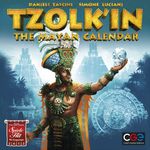
Tzolk'in: The Mayan Calendar
A weighty Euro game where you develop Mayan civilization's resources and temples using a system of giant interlocking gears that physically rotate on the board. The sense of timing for when to place and when to pick up your workers is what decides the outcome.
Rules
Five great gears interlock and turn on this board, and every turn you must choose either placing workers or picking them up, never both. Waiting longer to pick up a worker moves it to a better space, but running out of corn means starving workers and losing points.
Components
| Component | Count | Notes |
|---|---|---|
| Game board | 6 interlocking pieces | 1 Tzolk'in gear + 5 smaller gears (Palenque, Uxmal, Tikal, Yaxchilan, Chichen Itza) |
| Workers | 24 (4 colors × 6) | Placed on gears or kept in front of you |
| Player boards | 4 (two-sided, one per color) | Lighter side = privilege ready; darker side = spent |
| Buildings | 32 cards (16 each for Ages 1 and 2) | Constructed for an immediate effect or an ongoing farm benefit |
| Monuments | 13 cards | Dealt out only at setup; converted to points at game end |
| Harvest tiles | 28 (16 corn + 12 wood) | Pre-placed on Palenque's jungle spaces |
| Resource blocks | 65 | Wood, stone, and gold |
| Corn tokens | 65 (value 1 or 5) | Both food and currency |
| Crystal skulls | 13 | Once exhausted, no more can be gained |
| Starting wealth tiles | 21 | Each player keeps 2 of 4 dealt |
| Scoring and player markers | 4 scoring counters + 28 player markers (7 per color) | Player markers mark the 3 temples plus the 4 technology tracks |
For 2–4 players, taking about 90 minutes, ages 12 and up. Designed by Daniele Tascini and Simone Luciani, the game runs for one full revolution (26 teeth) of the Tzolk'in gear, and whoever has the most points at the end wins.
Setup
- 1Place the board in the center. Put wood, stone, gold, crystal skulls, and spare workers in a shared bank; place the corn bank in the middle of the Tzolk'in gear.
- 2Place one Corn Harvest Tile on each of Palenque's 4 jungle spaces. On action spaces 3, 4, and 5, stack a Wood Harvest Tile on top (space 2 is corn-only).
- 3Rotate the Tzolk'in gear so the arrow points to one of the end-of-age Food Day teeth (blue-green stickers). That tooth actually represents the 4th Food Day, so the first round of the game is not a Food Day.
- 4Give the Starting Player Marker to whoever most recently sacrificed something. On a tie, give it to whoever volunteers for the next sacrifice.
- 5Each player takes a player board lighter-side up, 3 workers, sets their scoring counter to 0, and places 3 markers on the bottom step of each temple plus 4 markers on the starting space of each technology track.
- 6Split buildings and monuments into 3 face-down stacks by their backs — Age 1 buildings, Age 2 buildings, and monuments — and shuffle each. Deal 6 monuments and 6 Age 1 buildings face up to their spaces on the board.
- 7Shuffle the starting wealth tiles and deal 4 face down to each player; each keeps 2 and discards 2. Once everyone has chosen, reveal simultaneously and apply the effects.
2- and 3-player games use fewer monuments, fewer tiles, and dummy workers
A 3-player game uses only 5 monuments and 3 harvest tiles per jungle space; a 2-player game uses only 4 monuments and 2 tiles. Before players choose their 2 starting wealth tiles, the discarded tiles' depicted action spaces are used to place non-player 'dummy' workers (6 in a 3-player game, 12 in a 2-player game) that block those spaces for the entire game.
A round — turns → Food Day (if any) → advance the calendar
- 1① Every player takes a turn, starting player first, clockwise. Each turn is either placing workers or picking them up — never both, and you cannot skip your turn.
- 2② On a Food Day: feed your workers and collect the gods' rewards. There are only 4 Food Days in the whole game, so most rounds skip this entirely.
- 3③ Advance the Tzolk'in gear, usually by 1 day. Because all 5 gears interlock, every placed worker advances one space. A worker on the highest space (the free-choice space) is pushed off the gear and returned to its owner.
Your first turn must be a placement
With no workers on any gear yet, the first turn of the game must always be a placement. Conversely, if you cannot afford to place any worker and have none on the gears, you must beg for corn first.
Placing and picking up workers
| Choice | Rule | Cost |
|---|---|---|
| Place | Any number of workers onto any gear(s). A new worker must go onto the lowest-numbered unoccupied space on that gear | The sum of space numbers, plus your player board's per-worker surcharge for how many you place this turn |
| Pick up | One, some, or all of your workers already on gears | For each: perform the action at that space, or pay 1 corn per step back to perform a lower-numbered action on the same gear instead, or perform no action |
| Beg for corn | Only when you have 2 or fewer corn at the start of your turn | Discard all your corn and take 3 from the bank — this angers the gods, dropping you 1 step on a temple of your choice |
The last space is always 'free choice'
On most gears, spaces 6 and 7 (space 10 on Chichen Itza) are free-choice spaces. Picking up a worker from one lets you perform any action on that gear with no extra cost.
The exact per-worker surcharge table is ⚠️ unverified
Placing several workers in one turn adds a per-worker surcharge printed on your player board. The rulebook's example only shows +0 for the first worker and +1 for the second; the full table for further workers is printed only on the physical component, so this guide could not confirm every value. Check your physical player board.
The five gears and the Starting Player Space
| Gear | Core actions |
|---|---|
| Palenque | Harvest corn or wood from jungle tiles, fish for a fixed 3 corn, or burn the forest to uncover hidden corn tiles (angers the gods) |
| Yaxchilan | Take wood, stone, gold, or a crystal skull directly from the bank |
| Tikal | Advance 1–2 technology levels and/or construct buildings or monuments (monuments can only be built via Tikal action 4) |
| Uxmal | Climb one temple step (3 corn), exchange corn/resources at the market rate, gain an extra worker, or build using only corn (2 corn per resource required; monuments not allowed this way) |
| Chichen Itza | Place a crystal skull for points, a temple step, and sometimes a resource — each space can be used only once per game |
| Starting Player Space | Costs 0. Collect all accumulated corn + take or pass the Starting Player Marker + (if your board is lighter-side-up) advance the calendar 2 days instead of 1 |
On every gear, higher numbers mean better rewards but also a longer wait to pick up. Unlike the other gears, each Chichen Itza space can be used only once in the entire game — whoever gets there first claims it.
The three temples and angering the gods
Quetzalcoatl (yellow), Kukulcan (green), and Chaac (brown) each have a temple of a different height. You climb by using Uxmal or Tikal actions, placing a crystal skull at Chichen Itza, or certain buildings, technologies, and starting-wealth-tile effects. Only one player may occupy the top step, while lower steps can be shared.
Angering the gods drops you only one step
Begging for corn or burning the forest at Palenque lets you choose any one temple and drop one step. You cannot choose a temple where you are already at the bottom, and if you are at the bottom of every temple, you cannot beg at all (in that rare case, you may place exactly 1 worker for free instead).
Reaching the top recharges your player board
The first time you reach a temple's top step, your player board immediately flips to its lighter side. Only while lighter-side-up can you advance the calendar 2 days from the Starting Player Space; using that privilege flips it to the darker (spent) side — reaching a top step again recharges it.
Technology tracks
The four tracks — Agriculture, Resource Extraction, Architecture, and Theology — each have a starting space, 3 levels, and a bonus space. Advancing makes the actions tied to that track (such as Agriculture boosting Palenque harvests, or Theology boosting Chichen Itza) pay off more.
| Advancement | Cost |
|---|---|
| Start → level 1 | 1 resource block |
| Level 1 → level 2 | 2 resource blocks (same type or mixed, your choice) |
| Level 2 → level 3 | 3 resource blocks |
| Beyond level 3 (bonus space) | 1 resource block for a repeatable one-time bonus (the marker no longer moves) |
Food Days — two kinds
| Kind | Timing | Reward |
|---|---|---|
| Mid-age Food Day (brown-orange) | At the 1/4 and 3/4 marks of each age (1st and 3rd of the game) | Resources or crystal skulls shown on your current step and every step below it on each temple |
| End-of-age Food Day (blue-green) | At the end of each age (2nd and 4th of the game) | Points shown on your current step only + a bonus for the highest-ranked player on each temple (split on ties) |
Buildings turn over on the second Food Day
On the first end-of-age Food Day (the 2nd of the game), after feeding workers, all remaining Age 1 buildings are discarded and 6 new Age 2 buildings are dealt out. Monuments and already-constructed buildings are unaffected.
Game end and final scoring
- 1The game ends on the 4th Food Day — one full revolution of the Tzolk'in gear.
- 2Convert all your wood, stone, and gold to corn at the market exchange rate.
- 3Score 1/4 point for each corn.
- 4Score 3 points for each crystal skull you still hold.
- 5Score any additional points from the monuments you constructed.
- 6The player with the most points wins. Ties go to whoever has the most workers left on the gears; if still tied, the win is shared.
Points accumulate throughout the game
Final scoring is not a single end-game calculation. Points build up across the four Food Days, Chichen Itza offerings, and building bonuses throughout the game — the final step only converts remaining resources, skulls, and monuments.
Strategy tips
- Picking up early is cheap but gives a weak reward; waiting longer costs more corn to place but advances workers to better spaces. Time your pickups against how many rounds remain until the next Food Day.
- Since each turn is either placement or pickup, picking up every worker at once forces your next turn to start from placement again.
- Keeping your corn above 2 avoids being forced to beg, which would anger the gods and cost you a temple step.
- Each Chichen Itza space can only be used once in the whole game — grab the rewards you want before someone else does.
- Reaching level 3 on a technology track does not end its usefulness — you can keep paying 1 resource for the bonus indefinitely.
- Adding workers before a Food Day also adds to your feeding bill. Plan your corn income against the number of workers you'll need to feed next.
Player-count adjustments and expansion
| Players | Adjustment |
|---|---|
| 2 | 4 monuments, 2 harvest tiles per jungle space, 12 dummy workers blocking spaces in advance |
| 3 | 5 monuments, 3 harvest tiles per jungle space, 6 dummy workers blocking spaces in advance |
| 4 | No adjustment — full base-game setup |
The 2013 expansion 'Tribes and Prophecies' added 5-player support, quick actions, and 14 tribe/prophecy cards (per Namuwiki). That same year, Tzolk'in placed 2nd at the Deutscher Spiele Preis, behind Terra Mystica (confirmed via English Wikipedia's Deutscher Spiele Preis article). CGE's own file server hosts an official Korean rulebook, confirming a Korean localization exists, but neither wiki checked could confirm which domestic distributor sells it (⚠️ unverified).
Frequently confused rules
Q. Can I place a worker and pick one up in the same turn?
No. Each turn is either placement or pickup, never both.
Q. Can I place a new worker on any empty space I like?
No. It must go on the lowest-numbered unoccupied space on that gear. If that space is taken, it goes to the next-lowest empty one.
Q. When I pick up a worker, must I use that exact space's action?
No. You may instead perform a lower-numbered action on the same gear by paying 1 corn per step back, or take no action at all and just retrieve the worker.
Q. What happens if someone already used a Chichen Itza space?
That space can never be used again by anyone for the rest of the game. If all 13 crystal skulls run out, actions that grant a skull simply stop granting one — other rewards like points and temple steps still apply.
Q. What if I can't feed any of my workers?
You feed as many as you can afford and lose 3 points for each one you cannot. You cannot deliberately withhold corn to starve a worker — you must pay as much as you can.
Q. Can I use the 2-day calendar privilege whenever I want?
Only when your player board is lighter-side-up and you placed a worker on the Starting Player Space. You also cannot use it to avoid pushing off a worker from space 6 of a small gear or space 9 of Chichen Itza if that worker would not normally be pushed off.
History and editions
Designed by Italian designers Daniele Tascini and Simone Luciani, the game was released by Czech Games Edition (CGE) in October 2012 (per the official rulebook's copyright line). In 2013, it placed 2nd at the Deutscher Spiele Preis, behind the 1st-place Terra Mystica.
A 2013 expansion, 'Tribes and Prophecies,' added 5-player support, quick actions, and 14 tribe/prophecy cards (per Namuwiki). This guide covers only the base 2–4 player game without the expansion.
Neither Namuwiki nor English Wikipedia confirmed a domestic Korean distributor or release year for a Korean edition (⚠️ unverified, as of a 2026-10-11 search). This guide can only confirm that CGE's own file server distributes an official Korean rulebook.
Sources
Czech Games Edition official English rulebook (2012) PDFCzech Games Edition official Korean rulebook (2012) PDFCzech Games Edition official product page — players, age, time, designersWiki cross-check — English Wikipedia: Deutscher Spiele Preis (confirms the 2013 2nd-place finish)Wiki cross-check — Namuwiki: Tzolk'in: The Mayan Calendar (Korean)Rule summaries are reference content written by us, not quotations from the official rulebook. Always check the official rulebook for exact rules. Diagrams are original schematics, not rulebook illustrations.
Spotted a mistake? Tell us in the comments below →
Last updated 2026-10-11
💡 Master tip
Placing several workers at once costs a lot of corn, so design a flexible rhythm between turns spent placing workers and turns spent picking them up for rewards. If you run short on corn before a Food Day, you lose 3 points for every worker you cannot feed, so plan ahead.
Similar games
Ready for something heavier
If this one has gotten too easy, try these — same feel, one step up in weight.
Tools you can request
Not built yet. Let us know if you want one — it goes on the list.
Gear rotation predictor
Check in advance which reward space a worker will reach after N turns
Corn (feeding) payout timer
Calculates how much corn you'll need for the 4 Food Days
Comments
Share your thoughts, report a mistake, or request a tool. No sign-in needed — nicknames are not verified, so anyone can use the same one.
Loading…