Top 43 · #29 of 40 in Strategy
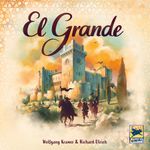
El Grande
Set across nine regions of Spain, this classic area-majority game has players place knights (Caballeros) to contest regional majorities — winner of the 1996 Spiel des Jahres. Its distinctive action-selection system uses cards each round to set turn order and troop counts, while the Castillo mechanic of secretly moving troops into a hidden castle creates deep psychological play.
Rules
A classic area-majority game where Grandes compete for control of nine regions of Spain by placing Caballeros. The Power card you reveal sets both turn order and how many Caballeros you may bring into play, and troops hidden in the Castillo can overturn the standings right before scoring. Winner of the 1996 Spiel des Jahres.
Components
| Component | Count | Notes |
|---|---|---|
| Game board | 1 | 9 regions of Spain + Castillo space + success track + 9-round track |
| Grandes (large cubes) | 1 per color (5) | Marks each player's home region. Not counted toward majorities |
| Caballeros (small cubes) | 31 per color (155 total) | Placed in regions to compete for majorities |
| King | 1 | A black pawn. The region where it stands is the King's Region |
| Round marker | 1 | Tracks the 9-round track and the three general scorings |
| Power cards | 13 per color (1–13) | Set both turn order and how many Caballeros move to court |
| Action cards | 45 (1–5 Caballero stacks) | A placement allowance plus one special action |
| Region cards | 9 | Rule summary on the back; used to assign home regions |
| Secret disks | 1 per color (5) | Secretly choose a region to send Castillo troops during scoring |
| Castillo (castle) | 1 | A hidden storage space treated separately from the regions |
| Mobile scoreboards | 2 (8/4/0, 4/0/0) | Placed via action cards to change a region's scoring values |
No confirmed Korean retail edition
No official Korean edition from Korean distributors was found within the scope of this check. The region names used here (Old Castile, etc.) are direct translations of the English rulebook for explanatory purposes, not official localized terms.
Setup
- 1Unfold the board and place the Castillo on its marked space.
- 2Shuffle the 9 region cards and reveal the top card. That region becomes the first King's Region; place the King there.
- 3Each player draws 1 region card to become their home region and places their Grande there.
- 4Each player takes 2 of their 31 Caballeros next to their Grande (home region) and 1 onto the first space of the success track. Of the remaining 28, 7 form the player's court (kept visible) and 21 remain unseen in the provinces (reserve).
- 5Each player takes a secret disk and the set of 13 power cards (1–13).
- 6Sort the 45 action cards by the Caballero count printed on the back (1–5), shuffle each stack separately, and place them beside the board (the 5 stack has only the King card).
- 7Place the round marker on space 1 of the round track (space 2 for the 6-round short game).
Grandes are never counted toward a region's majority — they only mark whose home region it is.
A turn — bid a power card, pick an action card, then place
- 1Start of round: advance the round marker one space and reveal the top card of each action-card stack.
- 2All players simultaneously reveal one power card (1–13). No two players may reveal the same value in the same round.
- 3Players take their turns in order of highest revealed value first. On your turn, first move the number of Caballeros shown on your power card from the provinces into your court (removing board Caballeros to make up any shortfall is allowed).
- 4Choose one of the revealed action cards. It lets you move up to its printed number of court Caballeros into regions adjacent to the King's Region and/or the Castillo, and lets you execute or skip its special action, in either order you prefer.
- 5After your turn, set the chosen action card face up so no one else may pick it this round. The player with the next-highest power card then takes their turn.
- 6Once everyone has acted, discard any remaining face-up action cards and start the next round with 5 new cards. Played power cards do not return to hand — they pile up face down except for the top card.
Spent power cards do not come back
A played power card stays face down in your pile (only the top card shows); it does not return to your hand. Once all 13 are spent, only the 'retrieve 1 power card from your discard pile' action card can return one to your hand.
The King's Region and placement limits
Wherever the King stands is the King's Region. When moving Caballeros from the court to the board, you may place them only in regions adjacent to the King's Region, and/or into the Castillo. Only special actions on certain action cards (intrigue cards, etc.) can place Caballeros elsewhere.
- The King's Region itself is taboo — aside from action cards that move the King, no Caballero, Grande, or mobile scoreboard may enter or leave it.
- The King's Region is still scored like any other region.
- Whoever holds the majority of Caballeros in the King's Region receives a +2 King's Bonus every time that region is scored (including special scorings). The bonus is lost on a tie for first.
The Castillo and secret disks
The Castillo is not a region but a separate, hidden storage space. Whenever adding or moving Caballeros, any or all of them may be placed into the Castillo, and Caballeros can only leave it during a general scoring.
Only opens at a general scoring
The Castillo is only emptied during the general scorings after rounds 3, 6, and 9. Each player secretly chooses, via their secret disk, one region to send their Castillo Caballeros to (the King's Region cannot be chosen); after all disks are revealed, the troops move. Anyone who chose the King's Region sends those Caballeros back to their court instead.
Scoring — after rounds 3, 6, and 9, in four steps
- 1① Choose a region with the secret disk — everyone secretly picks a destination region for their Castillo troops, then all reveal simultaneously.
- 2② Score the Castillo — before the troops move out, score the Castillo's contents by majority.
- 3③ Move — send each player's Castillo Caballeros to the region shown on their disk.
- 4④ Score the regions — score all 9 regions by majority, one at a time, in the order shown on the round track.
| Example scoreboard | 1st | 2nd | 3rd |
|---|---|---|---|
| 5/3/1 region (2p scores only 1st; 3p scores only 1st and 2nd) | 5 pts | 3 pts | 1 pt |
| 6/4/2 region | 6 pts | 4 pts | 2 pts |
| 8/4/0 or 4/0/0 (mobile scoreboard) | As printed | As printed | As printed |
Ties bump the rest down a rank
If two players tie for the most, both score the 1st-place value and the 2nd-place value is skipped entirely. Rulebook example: in a 6/4/2 region, red has 4, blue has 3, and yellow and green each have 2 — tied for what would be 3rd. Both yellow and green instead get the bumped 4th-place value: 0 points.
- When the King's Region is scored, its 1st place also receives a +2 King's Bonus (none on a tie for first).
- Holding 1st place in your own home region adds a +2 home-region bonus (none on a tie for first).
- Grandes are never counted toward any majority — they only mark whose home region it is.
Matches the scoring calculator above
The per-round region scoring calculator at the top of this page simply accumulates whatever totals you enter at each scoring (rounds 3, 6, 9, or 2, 4, 6 in the short game). It does not add the King's Bonus or home-region bonus automatically — include them yourself using the rules above.
Game end and winning
The game ends after the third general scoring, following round 9 (rounds 2, 4, and 6 in the 6-round short game). Whoever has advanced the furthest on the success track wins and earns the title of El Grande.
Strategy tips
- A low power card means you act later, but it can also mean more action cards remain to choose from — weigh turn order against which cards are likely to survive until your turn.
- The Castillo hides Caballeros you don't need immediately. Loading it up in the round right before a scoring can make opponents misjudge who actually holds a majority.
- Holding an intrigue or Royal Adviser card that moves the King lets you confine placements to regions favorable to you on your turn. Holding a Veto! card deters opponents even before you use it, since it can cancel one special action outright.
- Right before a scoring, double-check for ties in your home region and the King's Region — a single Caballero can create or erase a +2 bonus.
The short game and expansions
| Variant / expansion | Notes |
|---|---|
| 6-round short game | Skip rounds 1, 4, and 7; score after rounds 2, 4, and 6 instead. Runs about 1 hour versus roughly 2 hours for the 9-round game. |
| König & Intrigant (1997) | Per English Wikipedia, swaps in new action and power cards. |
| Grand Inquisitor & Colonies (1997) | Adds new regions (colonies). |
| El Caballero (1998) | A standalone game built on El Grande's systems. |
Expansions are outside this guide's scope
The expansion notes above come only from a Wikipedia cross-check; their rulebooks were not checked directly. This guide's rules cover only the base 9-round game (or its 6-round short variant).
Frequently confused rules
Q. Can two players reveal the same power card value in one round?
No. Every player's revealed power card value must be unique within a round.
Q. Does the King's Region score a majority bonus too?
Yes, it is scored like any region. However, if there is a tie for first, nobody receives the +2 King's Bonus.
Q. Can Caballeros be taken back out of the Castillo before a scoring?
No. The Castillo only empties during a general scoring (after rounds 3, 6, and 9). Until then you may only add to it.
Q. What if there aren't enough provincial Caballeros to fill the power card's amount?
You may remove board Caballeros of your own to make up the shortfall. You are never required to move the full amount; moving fewer than the power card's value is fine.
Q. Can the King's Region be chosen on the secret disk?
No, it cannot be chosen as a destination for Castillo troops at a general scoring. Some action cards' special scorings, however, do allow choosing the King's Region or even the Castillo itself.
Q. Is a region always good for you just because your Grande is there?
The Grande itself is never counted toward the majority. It only grants an extra +2 home-region bonus if you also hold 1st place there.
History and verification scope
Designed by Wolfgang Kramer and Richard Ulrich, the game was published in 1995 by Hans im Glück (German) and in 1996 by Rio Grande Games (English). It won the 1996 Spiel des Jahres.
Per the rulebook, the setting is 15th-century Spain, and a Spanish pronunciation note explains that 'Castillo' is pronounced 'Castiyo' and 'Caballero' is pronounced 'Cabayero.'
As of 2026-10-10, searches of Namuwiki and English Wikipedia did not confirm an official Korean release. Expansion rule details (König & Intrigant, etc.) and Korean distribution history are not covered in this guide.
Sources
Official El Grande English rulebook (Hans im Glück / Rio Grande Games, copy hosted by yucata.de)Wiki cross-check — English Wikipedia: El GrandeWiki cross-check — Namuwiki: El Grande (Korean)Rule summaries are reference content written by us, not quotations from the official rulebook. Always check the official rulebook for exact rules. Diagrams are original schematics, not rulebook illustrations.
Spotted a mistake? Tell us in the comments below →
Last updated 2026-10-10
💡 Master tip
Use action cards that control the King's position to confine your opponents' placement range, and time the release of troops hidden in the Castillo for the decisive moment. Repositioning troops right before the scorings after rounds 3, 6, and 9 to overturn your opponents' expectations is also an advanced strategy.
Ready for something heavier
If this one has gotten too easy, try these — same feel, one step up in weight.
Tools you can request
Not built yet. Let us know if you want one — it goes on the list.
Per-round region scoring calculator
Automatically totals the scoring from the rounds 3/6/9 scorings
Comments
Share your thoughts, report a mistake, or request a tool. No sign-in needed — nicknames are not verified, so anyone can use the same one.
Loading…