Top 100 · #40 of 40 in Strategy
Torres
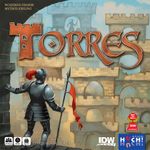
An abstract strategy game by Kramer & Kiesling where you build castles taller and wider to put your knight at the highest, widest spot — winner of the 2000 Spiel des Jahres. Deciding how to spend your 5 action points each turn is the central puzzle of the game.
Rules
Each turn you split 5 action points (AP) among adding or moving knights, building castles, playing action cards, and advancing on the score track. Scores are the castle's floor area multiplied by the knight's level, so growing wide matters as much as building tall. Winner of the 2000 Spiel des Jahres.
Components
| Component | Count | Notes |
|---|---|---|
| Game board | 1 | 8×8 castle-building area plus an outer scoring track |
| Tower blocks | 92 | Stacked to build castles; every block has a door on all four sides |
| Knights | 6 per color (24 total) | Stand atop castles to compete for the highest level |
| Scoring markers | 4 | Advance along the outer scoring track |
| King | 1 | The castle where it stands becomes the King's Castle, granting bonus points |
| Action cards | 40 (10 per color) | One-time special actions; cannot be played the turn they're acquired |
| Codex cards | 4 | Summarize action point costs |
| Phase cards | 3 (for 2, 3, or 4 players) | State the round count and tower-block allotment for that player count |
| Master cards | 8 | Extra scoring conditions used in the master version |
Setup
- 1Place the board in the middle of the table.
- 2Each player chooses a color and takes 1 scoring marker and the 6 knights of that color. Place scoring markers on the start of the scoring track.
- 3Each player takes 1 Codex card. Reveal only the Phase card matching the player count (2, 3, or 4) and return the other two to the box.
- 4Shuffle all 40 action cards together, regardless of color, and place the deck face down.
- 5Set the King aside, off the board for now.
- 6Take 8 tower blocks from the common supply and place one on each of the board's 8 marked starting spaces — these begin the 8 castles and may later be removed during play.
- 7Starting with the youngest player and moving clockwise, each player places one knight on a different, empty castle.
- 8The last player to place a knight places the King on any empty castle — that castle becomes the King's Castle for the first year.
- 9Levels are counted from the board itself (level 0): a knight on a single tower block is level 1, on two stacked blocks is level 2, and so on.
Turn structure — three years (phases), 5 action points per turn
The game is divided into three years (phases). With 4 players, the first year lasts 4 rounds and the second and third last 3 rounds each (with 2 players, all three years instead last 4 rounds). Every player takes one turn per round, in clockwise order. At the start of each year, players take tower blocks from the common supply as specified on the Phase card and stack them into their personal supply (no stack taller than 3).
| Action | Action point (AP) cost |
|---|---|
| Add a knight | 2 (per knight) |
| Move a knight | 1 (per space) |
| Place a tower block | 1 (per block) |
| Acquire an action card | 1 (per card, up to 2 per turn) |
| Play an action card | 0 (up to 1 per turn; not the turn it was acquired) |
| Advance the scoring track | 1 (per space) |
Freely combine exactly 5 points each turn
Each turn you spend exactly 5 action points, split among the actions above in any order or combination. If there's nothing better to do with leftover points, convert them directly into scoring-track advancement (1 point per AP).
Adding and moving knights
- To add a new knight (2AP), place it on an empty space orthogonally adjacent to an existing knight of the same color (on the board or on a tower block). Diagonal adjacency does not count.
- A new knight must be placed at the same level or lower than the existing knight it is adjacent to — any number of levels lower is fine, but never higher.
- Moving a knight (1AP per space) is also orthogonal only. Moving up is limited to 1 level per move, while moving down has no limit.
- A knight may not move onto a space occupied by the King or by another knight, of either the same or a different color.
- Every tower block has doors on all four sides, letting a knight enter a castle through one door and exit another (1AP). While passing through this way, the knight may only descend, never ascend — this lets a single turn's worth of AP carry a knight through several castles.
Building castles — only diagonal contact is allowed
- Placing a tower block (1AP per block) must always extend an existing castle — either onto the board (level 0) next to it to grow its floor area, or onto an empty block on top to raise that space by one level.
- A castle's height can never exceed its floor area. A castle with 3 floor spaces can be built no taller than 3 levels.
- Growing a castle's area may never make it touch another castle orthogonally. Castles may only touch each other diagonally.
- A castle consisting of a single tower block can only be relocated or removed via certain action-card effects (not as a basic action), and even then the total number of castles may never drop below 6.
Scoring — floor area × height
At the end of each year, every player scores every castle where they have a knight. Even with several same-colored knights on one castle, only the single highest knight counts, scoring that castle once. However, knights of a different color on the same castle score independently — players' knights do not affect each other.
Scoring proceeds clockwise starting with the starting player. If a marker would land on a space already occupied on the scoring track, it moves to the next empty space, so ties never occur.
The King's bonus
After everyone scores their castle positions, the King's Castle is scored once more. Among players with a knight there, only those with a knight standing exactly on the level matching that year receive the extra King's bonus. The regular castle score (area × level) is still earned separately from the bonus.
One of your two knights can qualify even if the other doesn't
Rulebook example: at the first-year scoring, you have two knights in the King's Castle — one on level 1 and one higher. The level-1 knight earns the +5 bonus, and the higher knight earns its own area×level score separately. If neither knight sits on the matching level, you only receive the regular castle score.
After all scoring is complete, the player with the lowest total score so far may move the King to any empty space of any castle at any level (or choose not to move it). The next year then begins.
Game end and winning
The game ends after the third year's scoring, including the King's Castle bonus. Whoever is furthest along the scoring track wins.
Strategy tips
- Because different-colored knights on the same castle never reduce each other's score, joining an already large, tall castle is often strong — you share the work of growing its floor area.
- Since height can never exceed floor area, chasing a high score means growing the footprint first. Overloading a narrow castle with knights quickly runs out of room to build higher.
- The King's bonus only pays off on the exact level matching that year — level 1 in year 1, level 2 in year 2, level 3 in year 3 — so plan several turns ahead to have a knight there at the right time.
- The lowest scorer after each year's scoring gets to move the King. Sometimes sacrificing a bit of score in one year to control the King's position directly is the better trade.
- Don't let leftover action points go to waste — convert them into scoring-track advancement, since 1 AP is immediately 1 point.
Rule variant and the master version
| Version | Notes |
|---|---|
| Rule variant (personal action-card decks) | Instead of one shared deck, each player shuffles their own 10 color-matched action cards separately. Acquiring a card means drawing the top 3 of your own deck, keeping 1, and returning the other 2 to the top or bottom of your deck. |
| Master version — initial castle placement | Instead of the board's printed 8 spaces, players place the starting castles themselves in clockwise order starting with the youngest. Each new castle must be at least 2 orthogonal spaces from any other. |
| Master version — action cards | Each player starts the game holding their own 10 color-matched cards in hand. With no shared deck, the 'acquire an action card' action no longer exists. |
| Master version — master cards | Reveal 1 of the 8 master cards to set an extra scoring condition for that year (or the rest of the game). Players who meet it score the extra points automatically, with no need to announce intent. |
Frequently confused rules
Q. Can a knight move diagonally?
Not with the basic move action — both moving and adding knights are orthogonal only (certain action cards are the exception, allowing a diagonal move).
Q. Can a knight gain levels while passing through a castle's doors?
No. While passing through doors, a knight may only descend, never ascend.
Q. Do I score twice if I have two knights of my color on the same castle?
No. Even with several same-colored knights on one castle, only the single highest one scores, once. Knights of a different color on that castle, however, score independently.
Q. Can only one player receive the King's bonus?
No. Every player with a knight standing exactly on the level matching that year receives the bonus, even if several qualify at once.
Q. Can two castles be merged into one?
No. Castles may only touch diagonally, and extending a castle's area so that it would touch another orthogonally is forbidden.
Q. What happens to leftover action points?
They are not wasted — spend them to advance the scoring track, 1 space per point.
History and verification scope
Designed by Wolfgang Kramer and Michael Kiesling, the game was published in 1999 and won the 2000 Spiel des Jahres.
Publisher history is reported inconsistently across sources — English Wikipedia names FX Schmid (German edition) and Rio Grande Games (English edition) in 1999 with a 2005 reprint, while Namuwiki currently lists HUCH!&friends as the distributor. The exact reprint years and publisher succession were not independently confirmed, as the two sources disagree.
As of 2026-10-10, searches of Namuwiki and English Wikipedia did not confirm an official Korean release. The rule variant and master version were checked directly in the rulebook, but actual Korean distribution history is not covered in this guide.
Sources
Official Torres English rules (Rio Grande Games' own site, archived 2000 snapshot)Wiki cross-check — English Wikipedia: Torres (board game)Wiki cross-check — Namuwiki: Torres (board game) (Korean)Rule summaries are reference content written by us, not quotations from the official rulebook. Always check the official rulebook for exact rules. Diagrams are original schematics, not rulebook illustrations.
Spotted a mistake? Tell us in the comments below →
Last updated 2026-10-10
💡 Master tip
Choose, depending on the situation, between piggybacking on a castle where the King stands — growing it together with others — or building a narrow, tall castle for your knight alone. Since the King's bonus grows larger with each scoring phase, watching the King's position becomes especially important heading into the later evaluations.
Similar games
Ready for something heavier
If this one has gotten too easy, try these — same feel, one step up in weight.
Tools you can request
Not built yet. Let us know if you want one — it goes on the list.
Height × area score calculator
Automatically calculates each knight's score when settling a castle
Comments
Share your thoughts, report a mistake, or request a tool. No sign-in needed — nicknames are not verified, so anyone can use the same one.
Loading…