Top 76 · #36 of 40 in Strategy
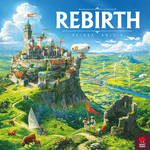
Rebirth
A reconstruction-themed tile-placement game designed by Reiner Knizia, set across Scotland and Ireland, packing deep choices into clear rules. Winner of the 2026 Kennerspiel des Jahres, making Knizia the first designer ever to win all three SDJ award categories (Spiel des Jahres, Kennerspiel des Jahres, and Kinderspiel des Jahres).
Rules
A tile-laying game designed by Reiner Knizia and winner of the 2026 Kennerspiel des Jahres (Connoisseur's Game of the Year). Each turn you place the one tile in your hand, score it immediately, and draw a new one. Simple rules hide deep choices about farm clusters, Settlement majorities, and Castle control.
Components
| Component | Count | Notes |
|---|---|---|
| Board | 1, double-sided | Scotland on one side, Ireland (advanced mode) on the other |
| Tiles | 144 (36 per color) | 12 Energy Farm, 12 Food Farm, 12 Settlement (3 each of influence 1/2/3/4) |
| Castles | 48 (12 per color) | Claimed by adjacency majority around a Castle space |
| Cathedrals | 32 (8 per color) | Claimed the first time you're adjacent, plus 1 Mission Card |
| Mission Cards | 32 | Drawn from Cathedrals, kept secret, scored at game end if completed |
| Scoring Achievement tile / Scoring Counter | 2 / 1 per color | Track points on the perimeter score track |
| Player Aid Cards | 4 | Turn order and scoring summary |
Setup
- 1Lay the board Scotland-side up and place the shuffled Mission Card deck face down at its spot.
- 2Each player picks a color, places their Scoring Counter on 0, puts all their Castles and Cathedrals in front of themselves, and places their Scoring Achievement tile blank-side up.
- 32-player games only: take 32 tiles of an unused color and place them face down on the spaces marked with the yellow hex icon (neutral blockers).
- 4With 2 or 3 players, each player takes all 36 tiles of their color. With 4 players, each player returns 3 Energy Farm, 3 Food Farm, and one Settlement tile of each influence 2/3/4 (8 total) to the box, leaving 27.
- 5Shuffle your tiles face down. Draw 2 of them, look at them privately, and set them aside (unused this game, though you may check them anytime). The rest form your supply.
- 6Draw 1 tile at random from your supply to your hand. The player who most recently visited Scotland goes first; play proceeds clockwise.
More players means fewer personal tiles
Only a 4-player game removes 8 tiles per color up front, leaving 27. A 2- or 3-player game keeps all 36, but a 2-player game also pre-fills the board with 32 neutral tiles.
Turn structure and placement rules
- 1① Place the tile from your hand on an unoccupied matching hex space (or a blank space).
- 2② Immediately score the tile you just placed.
- 3③ Draw 1 tile from your supply into your hand. Play passes clockwise.
| Tile type | Where it may go | Exception |
|---|---|---|
| Energy Farm | Energy Farm space or blank space | If no Energy Farm or blank spaces remain, it may go on a Food Farm space |
| Food Farm | Food Farm space or blank space | If no Food Farm or blank spaces remain, it may go on an Energy Farm space |
| Settlement | Only a Settlement-icon space | No exception |
No tile is ever placed on Castle or Cathedral spaces
Castle and Cathedral spaces are permanently blocked — no tile goes there. Their effects trigger only when you place a tile adjacent to them.
Scoring farms — only same type, same color clusters
Placing an Energy or Food Farm tile immediately scores 1 point per tile in the contiguous cluster of the same type and color, including the tile just placed. Energy and Food tiles of the same color touching each other never combine into one cluster.
Settlements — size-based majorities with opposite tiebreaks
| Settlement size | Completion | Score |
|---|---|---|
| Small (1 space) | Immediately on placement | Scores points equal to that tile's influence number |
| Medium (2 spaces) | When both spaces are occupied | Most influence scores 5, second scores 3. On a tie, the completing player scores 5, the other scores 3 |
| Large (3 spaces) | When all three spaces are occupied | 8 / 5 / 0 for most / second / others. On a tie, the completing player loses — ties then resolve clockwise |
If a single player occupies every space of a Medium or Large Settlement with their own tiles, they score both ranks combined (Medium 5+3=8, Large 8+5=13). Influence is the sum of the influence numbers on your tiles in that Settlement.
Medium and Large tiebreaks run opposite ways
In a Medium Settlement, the player who completes it wins ties. In a Large Settlement, it's the reverse — the completing player loses ties. This is an easy rule to get backwards.
Castles and Cathedrals — adjacency majority and Mission Cards
- 1The first player to place a tile adjacent to a Castle space claims it (placing their Castle piece there).
- 2Placing a tile that gives you more occupied spaces adjacent to that Castle than its current holder steals it — return the previous Castle piece to its owner and place yours instead.
- 3Ties on adjacent space count go to whoever has more adjacent Energy + Food Farm tiles. If that's also tied, the player currently placing the tile keeps or takes control.
- 4The first time you (personally) place a tile adjacent to a Cathedral space, place your Cathedral piece there (stacking even if others already claimed it) and draw 1 Mission Card to keep secret. Each Cathedral grants at most 1 card per player.
- 5Placing a Settlement tile on a space with a Port icon scores 1 extra point immediately. If that space also completes the Settlement, resolve Settlement scoring at the same time.
Mission Cards don't compete with each other
In the base (Scotland) game, Mission Cards are private, so multiple players can satisfy the same condition and each still scores it. That differs from Ireland's shared Public Mission Cards.
Game end and final scoring
The game ends once every player has placed every tile from their supply (the 2 tiles set aside at setup don't count). Then add three more sources of points.
| Source | Scoring |
|---|---|
| Incomplete Settlements | Scored as if Small — each player scores their own influence value there |
| Castles | 5 points for each Castle you control at game end |
| Mission Cards | Reveal your private Mission Cards and score any whose condition is satisfied |
Ties go to a named Castle
Ties favor whoever controls Edinburgh Castle. If no tied player controls it, whoever controls Stirling Castle wins instead — even if they weren't tied for first place.
Strategy tips
- Controlling a Castle first is no guarantee — adjacency counts can flip it at any time, so keep defending the spaces around it.
- Completing a Large Settlement loses ties, so widen your influence lead before forcing the final space rather than rushing to complete it.
- Each of the 8 Cathedrals grants only 1 card per player, so claiming ones nobody else has reached yet nets you more Mission Cards overall.
- Mixing Energy and Food tiles of the same color splits your cluster in two, so keep one type running in a single direction for bigger cluster scores.
The Ireland advanced mode and player-count differences
Ireland, on the reverse side of the board, is the 'advanced mode': it reuses every Scotland rule (farms, Settlements, Castles, Cathedrals) with these differences.
| Element | Scotland (base) | Ireland (advanced) |
|---|---|---|
| Port bonus | +1 for a Settlement tile on a Port space | +1 for a farm tile on an 'Offshore Farm' space (same mechanic, different name) |
| Largest Settlement size | Small/Medium/Large (1/2/3 spaces) | Those three plus a 4-space 'Sprawling Settlement' (12/8/5/0, tiebreak as in Large) |
| Mission Cards | Only private cards drawn from Cathedrals | 8 Public Mission Cards are always visible — whoever completes one first scores higher, later players score lower (once per player per card) |
| Round Towers | None | 14 bonus tiles placed randomly. First adjacency to a Tower triggers its bonus once (extra tile, doubling marker, etc.); multiple players can each trigger the same Tower's bonus |
| 2-player neutral tiles | 32 | 24 (the board shape differs) |
| Tiebreak | Edinburgh Castle → Stirling Castle | Blarney Castle → most adjacency at the Hill of Tara Round Tower (if still tied, players share the win) |
A Korean retail release could not be confirmed (see rulebooks.ko above). No expansion was officially announced as of 2026-10-10, though Mighty Boards' blog mentions a follow-up title, 'Rebirth 2,' in development — apparently a separate product from this game.
Frequently confused rules
Q. Does completing a Large Settlement help you in a tie?
No. In a Medium Settlement the completing player wins ties, but in a Large Settlement the completing player loses ties instead, with remaining ties resolved clockwise.
Q. If adjacency counts are tied for a Castle, does the active player automatically take it?
No. First compare adjacent Energy + Food Farm tile counts. Only if that is also tied does the player currently placing a tile take or keep control.
Q. If someone else already placed a Cathedral piece on a space, can I still get a Mission Card there?
Yes. If this is the first time you personally place adjacent to that Cathedral, stack your own Cathedral piece there and draw a card. Each Cathedral grants at most 1 card per player.
Q. If all Energy Farm spaces are full, can I never place an Energy Farm tile?
You may place it on a Food Farm space, but only as an exception when no Energy Farm space or blank space remains. The same exception applies in reverse for Food Farm tiles.
Q. What happens to the 2 tiles set aside during setup?
They are not used this game. You may look at them privately at any time, but they are never placed and don't count toward the end-game trigger of emptying your supply.
Designer and awards
Designed by German designer Reiner Knizia, born in 1957 (per English Wikipedia). Mighty Boards first published it in 2024; this international English edition is a 2nd Edition combining both the Scotland and Ireland modes in one rulebook.
It won the 2026 Kennerspiel des Jahres (confirmed via Mighty Boards' official blog post dated 2026-07-14), alongside nominees Boss Fighters and Moon Colony Bloodbath that year. Namuwiki had no dedicated article as of 2026-10-10, so Korean reception could not be cross-checked.
Sources
Mighty Boards — official product page for Rebirth (international English edition)Mighty Boards — official English rulebook PDF (2nd Edition v1.2b)Mighty Boards official blog — Rebirth wins the 2026 Kennerspiel des JahresWiki cross-check — English Wikipedia: Reiner KniziaWiki cross-check — Namuwiki search: no dedicated article confirmed (2026-10-10)Rule summaries are reference content written by us, not quotations from the official rulebook. Always check the official rulebook for exact rules. Diagrams are original schematics, not rulebook illustrations.
Spotted a mistake? Tell us in the comments below →
Last updated 2026-10-10
💡 Master tip
Strategic spots (Castles, Ports) belong to whoever claims them first, so in the early game it's usually better to prioritize key locations over expanding. Watch which terrain your opponents are collecting and grab the tiles they need to check them.
Ready for something heavier
If this one has gotten too easy, try these — same feel, one step up in weight.
Tools you can request
Not built yet. Let us know if you want one — it goes on the list.
Regional score calculator
Automatically totals farm-cluster, Settlement, and strategic-spot scores
Comments
Share your thoughts, report a mistake, or request a tool. No sign-in needed — nicknames are not verified, so anyone can use the same one.
Loading…