Top 17 · #13 of 40 in Strategy
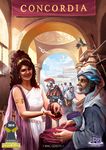
Concordia
A clean Euro strategy game where you send colonists into Roman imperial territory, build houses, and expand your trade network.
Rules
Play one card from your hand each turn to carry out that character's single action in this trading game set across the Roman Empire. There is no card draw, so deciding how long to keep cycling your hand before recovering it with the Tribune drives the whole game's pacing.
Components
| Component | Count | Notes |
|---|---|---|
| Game board | 1 of 2 sides | Imperium (3–5 players) or Italia (2–4 players) — rules are identical |
| Storehouse | 1 per player | 12 storage spaces shared by colonists and goods |
| City tokens | 30 | Randomly assigned by letter, then flipped to reveal each city's good |
| Bonus markers (province tiles) | 24 | One per province, assigned by that province's most valuable good |
| Wooden pieces | 15 houses + 3 land colonists + 3 sea colonists + 1 score marker per player | 5 colors (red, green, yellow, blue, black) — use as many as there are players |
| Goods cubes | 80 | Five types: brick, food, tool, wine, and cloth |
| Personality cards | 72 | 35 starting cards (7 per player) + 30 cards for sale across decks I–V + 1 Concordia card + 1 Præfectus Magnus card + 5 player aids |
| Sestertii coins | 1, 2, 5, and 10 denominations | Bank supply is treated as unlimited |
Personality cards fall into 8 action roles (Architect, Prefect, Colonist, Mercator, Diplomat, Senator, Consul, Tribune) and 5 specialist roles (Mason, Farmer, Smith, Vintner, Weaver). This guide groups the specialists together, since each simply produces one unit of its good per matching city where you own a house.
Setup
- 1Shuffle the 30 city tokens, display them letter-side up, assign them randomly to the cities, then flip them to reveal their goods. (The Italia board does not use the "D" tokens.)
- 2For each province, identify its most valuable good (cloth 7 > wine 6 > tool 5 > food 4 > brick 3) and assign that bonus marker to it.
- 3Sort the 30 cards for sale by their Roman numeral (I–V), remove any numeral higher than the player count, shuffle within each numeral, and stack them into one deck with I on top.
- 4Reveal the top 7 cards into the display area, and set the remaining deck and the Concordia card aside.
- 5Each player places 1 land and 1 sea colonist in Roma, fills their storehouse with 2 land and 2 sea colonists plus 2 food, 1 cloth, 1 wine, 1 brick, and 1 tool (10 of 12 spaces used), and keeps their 15 houses in reserve.
- 6Deal 7 starting cards to each player and randomly determine turn order. The first player takes 5 sestertii, the second 6, and so on. The last player in turn order receives the Præfectus Magnus.
Try intermediate scoring on your first game
The rulebook recommends calculating intermediate scores the first time each player plays their Tribune, if this is anyone's first game. Experienced groups can skip it.
A turn — there is no card draw
- 1Choose 1 personality card from your hand, reveal it, and execute the action printed on it.
- 2The played card goes on top of your personal discard pile. Only the top card of that pile stays visible.
- 3Play passes to the next player, clockwise.
Unlike most games, there is no replenishing draw
Your hand only shrinks as you play cards. The only way to get played cards back is to play the Tribune card. Timing that recovery is the central decision of the game.
Core rule 1 — The eight personality card actions
| Card | Action |
|---|---|
| Architect | Freely distribute movement steps equal to your colonist count among your own colonists, then build up to 1 house in each city adjacent to one of your colonists |
| Prefect | Choose one: activate one province to collect its bonus good (all houses in it then produce that good too), or reset all provinces and collect 1 sestertius per visible coin |
| Colonist | Choose one: pay 1 food + 1 tool to place a new colonist in Roma or any city where you own a house, or take 5 sestertii plus 1 per colonist you already have on the board |
| Mercator | Receive 3 sestertii from the bank (5 with a purchased Mercator), then buy and/or sell up to 2 types of goods at the fixed storehouse prices |
| Diplomat | Copy the action of any opponent's top face-up discard card as if you had played it (cards just used via Diplomat or just recovered via Tribune cannot be copied) |
| Senator | Buy up to 2 cards from the display into your hand; price is each card's own cost plus the cost shown under its display position |
| Consul | Buy exactly 1 card from the display into your hand; only the card's own printed cost applies, the display-position cost is ignored |
| The 5 specialists (Mason, Farmer, Smith, Vintner, Weaver) | Produce 1 unit of their matching good for every city of that type where you own a house |
Buying cards is buying points
Personality cards are both action tools and, at game end, multipliers for their god's score. Collecting cards with the Senator and Consul can out-earn simply stockpiling resources.
Core rule 2 — The cost of building houses
Houses may only be built in cities adjacent to one of your colonists, and only 1 house per player per city. No one may build in Roma. Each house costs both goods and sestertii.
| City type | Goods cost | Sestertii cost (the city's 1st house) |
|---|---|---|
| Brick city | 1 food | 1 |
| Food city | 1 brick + 1 food | 2 |
| Tool city | 1 brick + 1 tool | 3 |
| Wine city | 1 brick + 1 wine | 4 |
| Cloth city | 1 brick + 1 cloth | 5 |
An Architect's movement steps equal your colonist count
The number of movement steps available when you play an Architect equals your number of colonists on the board. Land colonists move only on brown lines and sea colonists only on blue lines; a colonist may not stop on an already-occupied line, but it may pass through one.
Core rule 3 — The Tribune and recovering your hand
- 1Playing the Tribune recovers every card you have played so far back into your hand.
- 2Starting with the 4th card recovered (counting the Tribune itself), you receive 1 sestertius per card from the bank (no reward for the first 3).
- 3You may also pay 1 food + 1 tool to place a new colonist (land or sea) in Roma (optional).
| Mechanic | Effect |
|---|---|
| Præfectus Magnus | Its current holder doubles the production bonus when choosing to produce with a Prefect (not when taking the cash bonus). It passes to the player on the holder's right after their turn, and must be used whenever applicable |
| Intermediate scoring (optional rule) | The first time each player plays their Tribune, they score their cards as-is. After everyone has done so once, 1st place gets 2 sestertii, 2nd gets 1, then every score marker resets to zero |
Not just a card for when your hand is empty
Playing the Tribune early returns little reward; waiting too long costs you other actions. How many cards to stockpile before recovering them is the most frequent decision in this game.
Final scoring by god
At game end, gather every personality card you hold — including your discard pile — by its ancient god. Each god pays the following per card.
| God | Points per card |
|---|---|
| Vesta | 1 point per full 10 of cash plus storehouse goods value (calculated once, not per card) |
| Jupiter | 1 point per house in a non-brick city, × cards held |
| Saturnus | 1 point per province with one of your houses, × cards held |
| Mercurius | 2 points per type of good you produce, × cards held |
| Mars | 2 points per colonist you have on the board, × cards held |
| Minerva specialists | The value printed on the card × matching cities (each card calculated separately) |
| Concordia card | A fixed 7 points for whoever ended the game |
The Concordia calculator above
This site's god-by-god calculator (/score/concordia) takes the same inputs: 1 point per 10 for Vesta, card count × value for Jupiter, Saturnus, Mars, and Mercurius, printed value × matching cities for each Minerva specialist, and a fixed 7 for the Concordia card.
Game end and winning
- 1The instant someone buys the last card from the display, emptying it, or builds their 15th house, they receive the Concordia card (7 points).
- 2Every other player takes one final turn.
- 3All cards are sorted by god and scored; the highest total wins.
Either emptying the display or building a 15th house ends the game immediately. Both stacking houses and buying out cards can bring the end closer.
Strategy tips
- The cards in your hand are themselves point multipliers. Spending early actions on the Senator and Consul to collect cards often outperforms stockpiling resources alone.
- Expand your colonists before playing the Architect to build — a single colonist only reaches a handful of adjacent cities.
- Sestertii costs double with every additional house in the same city, so spreading to new cities is usually cheaper overall than stacking one.
- The Tribune pays more the longer you wait, but you lose access to those cards' actions the whole time. Base your timing on whether you're currently blocked, not on a fixed card count.
- Choosing to produce with the Prefect benefits every player with a house in that province — if you have none there yourself, weigh the cash bonus instead.
Expansions and variants
| Name | Content |
|---|---|
| Venus (2018) | Adds new personality cards and a goods variant |
| Salsa (2015) | A variant that randomizes setup using dice |
| Britannia/Germania, Gallia/Corsica, Aegyptus/Creta, Balearica/Cyprus (2014–2019) | A series of map expansions adding new regions to the board |
| Roma/Sicilia (2023) | The most recent expansion, adding the Rome/Sicily region |
| Solitaria (2021) | Solo-play variant rules, released separately in German and English |
PD-Verlag's own store also lists a shared Concordia/Navegador expansion and wooden Game Stones accessories. The original release came through PD-Verlag and Rio Grande Games, and the publisher's site links to a 'Concordia Special Edition' crowdfunded by Awaken Realms on Gamefound, though this research did not independently verify that edition's specific contents.
A Korean edition could not be confirmed
No official Korean release could be confirmed or ruled out in this research (no dedicated Namuwiki article, and the Korean distributor's site is a dynamic page this research could not check directly). This guide does not claim it is unreleased in Korea — it will be updated once confirmed either way.
Frequently confused rules
Q. Do I draw a new card after playing one?
No. Concordia has no replenishing draw. Played cards sit on your discard pile, and the only way to get them back into your hand is to play the Tribune.
Q. When I copy an action with the Diplomat, does that opponent's card move to my discard pile?
No. Using the Diplomat to copy an opponent's action leaves their card exactly where it was. Only your own Diplomat card goes onto your discard pile.
Q. Can houses be built in Roma?
No. Roma is only a placement spot for colonists; no player ever builds a house there.
Q. Can I build more than one of my own houses in the same city?
No, each player may build at most 1 house per city. If other players already have houses there, your sestertii cost still rises based on the total number of houses that will be in that city.
Q. What happens to the bonus markers when a Prefect takes the cash bonus?
Taking the cash bonus collects 1 sestertius per visible coin, and then every bonus marker is flipped back to its goods side. Only choosing to produce flips a single province's marker to its coin side, leaving the rest untouched.
Q. If the Præfectus Magnus holder copies a Prefect via the Diplomat instead of playing their own Prefect, does the double bonus still apply?
Yes. The rulebook treats a copied action as if the holder had played that card themselves, so choosing to produce still doubles the bonus.
History and editions
Concordia is a 2013 design by German designer Mac Gerdts, known for the rondel mechanism in Antike, Imperial, and Navegador, published by Hamburg's PD-Verlag. The official Almanach closes with a designer's note dated October 2013 in Hamburg, which this research used directly to confirm the publication date.
Cross-checking German Wikipedia shows the game won the 2013 Meeples' Choice Award, was nominated for Germany's Kennerspiel des Jahres and the International Gamers Award in 2014, and won a Dutch expert-game award in 2015. The same source lists eight expansions released from 2014 through 2023 — Britannia/Germania, Salsa, Gallia/Corsica, Aegyptus/Creta, Venus, Balearica/Cyprus, Solitaria, and Roma/Sicilia — matching the product list confirmed directly on PD-Verlag's official store.
Searching Namuwiki for the Korean terms for Concordia on 2026-10-10 did not surface a dedicated board-game article, and English Wikipedia's Concordia page is a disambiguation page that only briefly names the designer. For that reason, this guide does not make claims about Korean release history or whether it has gone out of print.
Sources
PD-Verlag official English rulebook — Concordia: Game Rules (v1.1)PD-Verlag official setup sheet — Game SetupPD-Verlag official Almanach — background on the gods and history (Mac Gerdts, October 2013)Wiki cross-check — English Wikipedia: Concordia (disambiguation page; the board game gets only a brief mention)Wiki cross-check — German Wikipedia: Concordia (Spiel) — awards, expansions, and publisherWiki cross-check — Namuwiki search: no dedicated article found for the board game (2026-10-10)Rule summaries are reference content written by us, not quotations from the official rulebook. Always check the official rulebook for exact rules. Diagrams are original schematics, not rulebook illustrations.
Spotted a mistake? Tell us in the comments below →
Last updated 2026-10-10
💡 Master tip
The key is steadily collecting point-multiplier cards with the Consul and Senator. Cards are points, so don't just stockpile resources — buy cards too!
Similar games
Ready for something heavier
If this one has gotten too easy, try these — same feel, one step up in weight.
Tools you can request
Not built yet. Let us know if you want one — it goes on the list.
God-by-god final score calculator
Multiplies your held cards by your houses, colonists, and cities to work out each god's score
City goods production board
Quickly check which goods each province produces
Comments
Share your thoughts, report a mistake, or request a tool. No sign-in needed — nicknames are not verified, so anyone can use the same one.
Loading…