Top 18 · #14 of 40 in Strategy
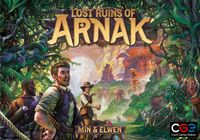
Lost Ruins of Arnak
A standout exploration game in which you explore the unknown island of Arnak, combining worker placement, deck building, and a research track to dig into the secrets of the ruins. What sets it apart is having to run a double engine: you play cards to make resources, and spend those resources to send workers out to the sites again.
Rules
Choose whether each card is travel or an effect, then weave site exploration and research into a scoring engine over five rounds.
The whole game first
The game lasts 5 rounds. At the start of each round, draw until you have 5 cards. Beginning with the starting player, take turns until everyone passes, then return archaeologists, adjust the card row, pass the starting player marker, and move the moon staff.
What makes a turn
Take one main action on your turn. You may take any number of free actions before, during, or after it, but you cannot take only free actions and end your turn.
- Main actions are Dig at a Site, Discover a New Site, Overcome a Guardian, Buy a Card, Play a Card, Research, and Pass.
- After you pass, you take no more turns that round. If only one player remains, that player takes consecutive turns.
- Cards in your play area do not return to your deck during the round. If the deck is empty, you cannot draw more cards.
Components and setup
| Area | Components | Setup key |
|---|---|---|
| Player | Player board, 2 archaeologists, magnifying glass, notebook, 4 basic cards | Build the starting deck from 4 basic cards and 2 Fear cards. |
| Island | 10 level-I sites, 6 level-II sites, 16 idols, 15 guardians | Shuffle site tiles and guardians into separate stacks. |
| Research | 18 research bonuses, 24 temple tiles, 12 assistants | Place assistants silver-side up in 3 stacks of 4. |
| Cards and resources | 40 items, 35 artifacts, 19 Fear cards, 5 resource types | Deal 1 artifact left of the moon staff and 5 items to its right. |
- 1Use the Bird Temple side for your first game. The Snake Temple side has separate setup rules.
- 2Place research tokens below the track, with the magnifying glass on top of the notebook because your first research must use the glass.
- 3Take starting resources by player order, shuffle your starting deck, and draw to 5 cards.
Blocking by player count
Use no blocking tiles with four players. With three, randomly block the second space at 3 base sites. With two, block the second space at all 5 base sites. Solo uses the two-player setup.
One card, one use
A card in hand is either spent for its travel value or played for its effect. It cannot do both. When paying travel, you may use the travel hierarchy to pay with the matching or a higher value.
| Card | When bought | When played later |
|---|---|---|
| Item | Place it face down on the bottom of your deck | Resolve its effect with no tablet activation cost |
| Artifact | Move it to your play area and resolve it immediately, ignoring the tablet cost | Pay the corner tablet cost and any additional cost |
| Fear | Gain it when returning from a guardian's site | It has no effect, only travel value, and scores -1 |
When the deck is shuffled
Leave played cards face up in your play area. At round end, shuffle only those cards and put them under your existing deck. Newly bought items sit above them and are likely to appear next round.
Sites and guardians
| Action | Requirement | Result |
|---|---|---|
| Dig at a Site | Travel cost of an empty action space | Place an archaeologist and resolve the revealed site |
| Discover a New Site | Region's compass cost plus the empty space's travel cost | Take idol → reveal and activate site → reveal guardian |
| Overcome a Guardian | Your archaeologist at that site plus the resources printed on the guardian | Take the guardian for a one-use boon and 5 end-game points |
Guardians do not always cost arrowheads
The cost is the resource combination printed on that guardian. You may still dig at a guarded site. If the guardian remains when your archaeologist returns at round end, gain 1 Fear card.
When you gain an idol, resolve its face-up reward and store it face down. Every idol scores 3 points wherever it is. Placing one in an idol slot grants a free-action effect, but the idol cannot move again and you lose the points printed in that now-occupied slot.
- After the discovering archaeologist leaves, any player can dig at that site.
- A guardian's boon is one use, but the guardian still scores 5 points after it is flipped.
- You do not have to overcome every guardian. Compare the Fear risk with the resources your research needs.
Research with glass and notebook
- 1Choose your magnifying glass or notebook and a space one row higher connected by a bridge.
- 2Pay the full bridge cost before gaining any reward. A reward from this action cannot pay its own cost.
- 3Take the research bonus if it remains, then resolve the row effect for the token you moved. You may reverse those last two steps.
First arrival bonus
Only the first player to reach a space takes its research bonus tile. Even without the tile, you still resolve the row effect and score that research position at game end.
When your magnifying glass reaches the top, place it in the highest remaining Lost Temple scoring space and choose one hidden temple bonus. Later magnifying-glass research pays a temple resource combination instead of a bridge cost and buys a temple tile.
Passing and round cleanup
- 1After everyone passes, return all archaeologists. Gain 1 Fear into your play area for each one returning from a site with a guardian.
- 2For each card left in hand, either discard it to your play area or keep it for next round.
- 3Shuffle your play-area cards onto the bottom of your deck and refresh exhausted assistants.
- 4Exile the two cards beside the moon staff, move it to the next round, and refill the card row.
- 5Pass the starting player marker left and draw until everyone has 5 cards.
Gain Fear before shuffling
Put Fear from guardians into your play area before shuffling that area. This puts the new Fear into next round's deck.
After round V, return archaeologists and gain guardian Fear, then skip all other cleanup and proceed directly to final scoring.
Final scoring and ties
| Source | Score |
|---|---|
| Research | Rows occupied by glass and notebook, plus Lost Temple arrival score |
| Temple tiles | Points printed on each tile |
| Idols | 3 per idol plus points printed in empty idol slots |
| Guardians | 5 per guardian overcome |
| Cards | Points in the lower-right corner of items and artifacts |
| Fear | -1 per Fear card and -2 per Fear tile |
Tie-break order
A tie goes to the player who reached the Lost Temple first. If none of the tied players reached it, compare research score. If still tied, share the victory.
Idol-slot rewards can be strong, but they erase the points printed in occupied slots. Late in the game, compare what the effect creates with the points the slot costs.
Game and editions
Lost Ruins of Arnak was designed by Mín and Elwen and published by Czech Games Edition in 2020. Its cards double as travel icons, joining deck building and worker placement at the level of each turn.
- It won the 2021 Deutscher Spiele Preis.
- Expedition Leaders adds six asymmetric leaders, new research tracks, and more content.
- The Missing Expedition adds a story campaign for one or two players plus new leaders and components.
Scope of this guide
This guide focuses on the base game's Bird Temple side. It does not mix in the Snake Temple's special setup or expansion maps, leaders, and campaign rules.
Frequently confused rules
Q. Can the notebook move ahead of the magnifying glass?
No. It may be on the same row or below the glass, never above it. Your first research must move the magnifying glass.
Q. Must I pay the guardian cost as soon as I discover a site?
No. After resolving the site, simply reveal the guardian there. On a later turn, you may take a separate main action to overcome it while your archaeologist is present.
Q. Are guardians always overcome with arrowheads?
No. Each guardian shows its own combination of resources, and you pay exactly that cost.
Q. Why does a newly bought artifact cost no tablet?
Buying an artifact lets you resolve it immediately while ignoring the corner tablet cost. When you later play it from hand, pay 1 tablet plus any additional cost.
Q. Do I reshuffle when my deck runs out during a round?
No. You cannot draw more cards. Cards in your play area are shuffled under your deck only at round end.
Q. Does using a guardian's boon remove its 5 points?
No. Flip it to mark the boon used; it still scores 5 points at game end.
Sources
Official CGE Korean base-game rulebook (24 pages)Official CGE English base-game rulebook (24 pages)Official CGE game page — components, player count, and release informationBoardGameGeek — player count, duration, and complexity cross-checkWikipedia cross-check — Lost Ruins of ArnakKorean release cross-check — official Boardpia Arnak pageRule summaries are reference content written by us, not quotations from the official rulebook. Always check the official rulebook for exact rules. Diagrams are original schematics, not rulebook illustrations.
Spotted a mistake? Tell us in the comments below →
Last updated 2026-09-15
💡 Master tip
Early on it matters to move up the research track quickly to open up your view, and to clear the low-value cards piling up in your deck so your engine runs better. Claiming the popular site spaces early in the round works in your favor.
Similar games
Ready for something heavier
If this one has gotten too easy, try these — same feel, one step up in weight.
Tools you can request
Not built yet. Let us know if you want one — it goes on the list.
Counts include public tool requests only, excluding repeats from the same browser. These are not signed-in people counts: other devices or cleared cookies can be counted again.
Research track reward guide
Reminder of the rewards you gain as the magnifying glass and notebook move up
Comments
Share your thoughts, report a mistake, or request a tool. No sign-in needed — nicknames are not verified, so anyone can use the same one.
Loading…