Top 24 · #19 of 40 in Strategy
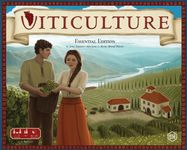
Viticulture Essential Edition
Inherit a vineyard in Italy's Tuscany region and build a worker-placement game around planting, aging, and crafting fine wines. Each spring, choosing your spot on the 'wake-up chart' sets both turn order and your bonus at once — the game's signature twist.
Rules
Inherit a vineyard in Tuscany, plant vines, harvest grapes, age them into wine, and fill wine orders in this worker-placement game. Each spring, the wake-up slot you choose sets both your turn order and your bonus for the whole year.
Components
| Component | Count | Notes |
|---|---|---|
| Worker meeples (6 colors) | 30 + 1 temporary worker | 5 per color; the temporary worker goes only to whoever chooses wake-up slot 7 that year |
| Grande worker | 6 | 1 per color. May be placed on an action space even if it is already full |
| Game board / vineyard mats | 1 / 6 | Wake-up chart, summer and winter action spaces (board) plus 3 fields, crush pad, and cellar (player mat) |
| Grape and wine tokens | 48 | Value (1–9) is determined by the crush-pad or cellar space the token occupies |
| Structure tokens | 8 types per color, 48 total | Trellis, irrigation, yoke, cottage, windmill, tasting room, medium cellar, large cellar |
| Lira coins | 72 (52 bronze £1, 12 silver £2, 8 gold £5) | Currency |
| Wake-up tokens (roosters) / VP tokens (corks) / residual tokens (wine bottles) | 1 each per color, 6+6+6 total | Mark turn order, victory points, and residual payments respectively |
| 232 cards | 42 vine, 36 wine order, 38 summer visitor, 38 winter visitor, 18 field, 24 Automa, 36 red/blue | The vine, wine order, and visitor decks are reshuffled from their discard piles when exhausted |
A worker-placement game for 1–6 players ages 14 and up, playing in 45–90 minutes. The goal is to be the first to reach 20 victory points, representing your reputation as a vineyard owner.
Setup
- 1Each player takes a vineyard mat and 3 field cards (max values 5, 6, and 7), placing them side by side with the field side up.
- 2Shuffle the vine (green), wine order (purple), summer visitor (yellow), and winter visitor (blue) decks and place them in their spots on the board.
- 3Randomly choose a first player, then deal everyone one red card and one blue card. The red card grants 2 workers and starting cards (1 vine, 1 summer visitor, 1 wine order); the blue card grants 1 grande worker plus a choice between lira or extra worker, or a structure.
- 4After all starting resources are collected, discard the red and blue cards — they are used only for setup.
- 5Each player places their rooster token on the wake-up chart, their cork token on the 0 space of the victory point track, and their wine bottle token in the middle of the residual payment tracker.
Public information
Your vineyard mat, remaining workers, lira, and the number and type of cards in hand cannot be concealed. Only the contents of your cards are hidden.
The year — four seasons of worker placement
- 1Each worker may be used only once per year. A worker placed in summer cannot be used again that winter.
- 2On your turn, place 1 worker on an open action space for that season and you must take that action. You cannot take only the bonus without the action.
- 3The number of open action spaces depends on player count — 2 players use only the left space, 3–4 players use the left and middle spaces, and 5–6 players use all three. You may claim them in any order.
- 4If you have no more workers to place in summer or winter, or want to save them, you pass. Once you pass, you may place no more workers that season.
- 5Fall has no worker placement. In wake-up order, everyone simply draws 1 summer or winter visitor card.
The bonus is optional, the action is not
With 3 or more players, some action spaces carry a bonus such as lira or a card. You must take the action, but the bonus is optional — and you cannot claim the bonus alone.
Spring — the wake-up chart
Starting with whoever holds the first-player token and proceeding clockwise, each player places their rooster on an open row (1–7) of the wake-up chart. That row number becomes this year's turn order (1 acts first), and it also grants an immediate bonus.
| Slot | Bonus |
|---|---|
| 1 | None (acts first) |
| 2 | Draw 1 vine card |
| 3 | Draw 1 wine order card |
| 4 | Gain £1 |
| 5 | Draw either a summer or winter visitor card (your choice) |
| 6 | Gain 1 victory point |
| 7 | Gain the temporary worker for this year (usable as a regular worker) |
The first-player token is not the turn order
The first-player token only decides the order players place roosters in spring. The actual turn order for summer, fall, and winter follows whichever wake-up slot (1–7) each player chose that year.
Planting, harvesting, and winemaking
- 1With the summer 'plant a vine' action, play a vine card from your hand onto a field — an empty one, or on top of a card already planted there.
- 2The combined value of all vines planted on a field may never exceed that field's maximum (5, 6, or 7). Some varieties also require a trellis or irrigation before they can be planted.
- 3With the winter 'harvest one field' action, choose a field and total all red pips on its vine cards into 1 red grape token, and all white pips into 1 white grape token, both placed on the crush pad. The vine cards remain on the field.
- 4A field can be harvested only once per year. If a token's value slot is already occupied, the new token moves down to the nearest open lower-value slot.
- 5With the winter 'make up to two wine tokens' action, convert crush-pad grape tokens into cellar wine tokens. One red grape token becomes one red wine token of the same value, and likewise for white — you may not combine two same-color grape tokens into one.
- 6Blush wine combines 1 red and 1 white token, summing their values (requires a medium cellar); sparkling wine combines 2 red and 1 white token, summing their values (requires a large cellar).
Structures gate the ceiling
Without a medium cellar, wine tokens stop aging at value 3; without a large cellar (which requires the medium cellar first), they stop at value 6. Without trellis or irrigation, the varieties that need them cannot be planted at all.
Structures and the grande worker
| Structure | Cost | Effect |
|---|---|---|
| Trellis | £2 | Prerequisite for some varieties (Pinot, Syrah, Trebbiano, etc.) |
| Yoke | £2 | Once per summer or winter, without placing a worker: uproot a vine or harvest 1 extra field |
| Irrigation | £3 | Prerequisite for some varieties (Merlot, Sauvignon Blanc, etc.) |
| Medium cellar | £4 | Allows wine tokens to age past value 3; enables making blush wine |
| Cottage | £4 | Draw an additional visitor card in fall |
| Windmill | £5 | 1 victory point each time you plant a vine (max 1 per year) |
| Tasting room | £6 | 1 victory point when you take 'give a tour' while you hold at least 1 wine in your cellar (max 1 per year) |
| Large cellar | £6 | Allows wine tokens to age past value 6, up to a maximum of 9; enables making sparkling wine (requires the medium cellar first) |
The grande worker acts just like a regular worker, except it may be placed on an action space even if other workers already fill it. Stacking it this way still takes the action, but gives no bonus from that space. Placed normally on an open bonus space, it grants the bonus just like a regular worker.
Worker limits
A player may hold at most 5 regular workers plus 1 grande worker; the temporary worker does not count toward this limit. New workers are gained via the winter 'train a new worker' action (£4), usually unusable until the following year.
Filling wine orders and residual payments
- 1With the winter 'fill 1 wine order' action, reveal a wine order card from your hand. It lists the wine types and minimum values required.
- 2Discard cellar wine tokens that exactly match those requirements — a higher value than required is fine.
- 3Once filled, gain the card's listed victory points, move your wine bottle token on the residual payment tracker forward by the card's lira value, then discard the card.
- 4The residual tracker position never resets and accumulates; at each year's end you gain lira equal to that position (maximum £5).
Hand size and discarding
A wine order card may be played only when you can fully meet its requirements, and you may hold several at once to choose from. At year end, discard your whole hand (vine, order, and visitor cards combined) down to 7 cards.
Ending the game and winning
- 1During year-end steps, every grape and wine token ages by +1, all workers return to their owners, players collect lira equal to their residual tracker position for each filled order, and the first-player token rotates one seat counter-clockwise.
- 2When any player reaches 20 or more victory points, the game does not end immediately — it finishes after that year's remaining seasons (summer through winter) and the year-end steps are completed.
- 3The player with the most victory points wins. Ties are broken, in order, by ① most lira, ② total value of wine in the cellar, ③ total value of grapes on the crush pad.
Victory points never drop below −5
Some visitor cards cost victory points, but a card may not be played if it would take your score below −5. The victory point track itself stops at −5.
Early strategy
- Early wake-up slots (1–3) let you claim the action space you want first; late slots (5–7) grant cards, lira, or victory points. Read your opponents' vineyards to judge which matters more each spring.
- Medium and large cellars cost lira to build, but without them you cannot store wine above value 3 or 6 at all — which blocks high-value wine orders entirely. Investing early buys more aging time.
- Varieties that need a trellis or irrigation (Merlot, Cabernet Sauvignon, and others) carry high values that translate well into points, but you must plan the build order before you can plant them.
- The grande worker is the only way to follow an opponent onto a popular action space they already claimed. It is worth giving up the bonus when the action itself is urgent.
Player-count scaling and the solo mode
| Players | Open action spaces | Notes |
|---|---|---|
| 2 | Left space of each action only | Fewer bonuses, faster pace |
| 3–4 | Left and middle spaces | The middle space starts carrying a bonus |
| 5–6 | All three spaces | The most competitive scaling |
A friendly variant restricts placing a worker on a bonus action space unless you can fully use that bonus (such as playing a second visitor card) or no other space remains open, reducing pure blocking plays.
The Essential Edition includes an official single-player Automa, designed by Morten Monrad Pedersen. Automa cards automatically fill action spaces each season to simulate an opponent, and you win if your victory points exceed the Automa's after 7 years. Five difficulty levels run from Very Easy to Very Hard, and a campaign mode links 8 challenges in sequence.
This guide covers the Essential Edition (2015). It layers the Grande Worker, the red/blue starting cards (Mamas and Papas), and the individual Fields cards — modules hand-picked from the Kickstarter-funded Tuscany expansion by designer Uwe Rosenberg — onto 2nd-edition Viticulture rules, rather than including the full Tuscany expansion (its seasonal board extension, extra visitors, and more).
Frequently confused rules
Q. Do unused summer workers carry over to winter automatically?
Yes. If you pass in summer, remaining workers are available in winter. However, a worker already placed on a summer action space cannot be used again that winter — each worker is placed only once per year.
Q. Does the grande worker always grant a bonus?
No. It grants a bonus only when placed normally on an open bonus action space, just like a regular worker. When stacked onto an already-full action space, it takes the action but gains no bonus.
Q. Can two red wine tokens be combined into one larger red wine?
No. Same-color tokens cannot be combined. Combining different colors (red with white) is possible only when making blush or sparkling wine.
Q. What happens if a harvested grape's value slot is already occupied?
The new token moves down to the nearest open lower-value slot (for example, if the 4 slot is full, it goes to 3, or to 2 if that is also full).
Q. If I cross 20 victory points in spring, does the game end right away?
No. The game ends only after that year's remaining summer, fall, and winter, plus the year-end steps, are completed.
Q. Do grape and wine token values keep rising forever?
No. The maximum value is 9, and tokens do not age past 9 even with a large cellar.
History and editions
Viticulture was designed by Jamey Stegmaier and Alan Stone and first released via Kickstarter in 2013. The Tuscany expansion was also Kickstarter-funded, and the 2015 Essential Edition combines 2nd-edition rules with select Tuscany modules in a single box. English Wikipedia notes that by 2018 the game ranked in the top 25 of all games on BoardGameGeek.
The official solo Automa was designed by Morten Monrad Pedersen and is printed as a dedicated ruleset at the back of the Essential Edition rulebook. As of 2026-10-11 the catalog lists a BGG average weight of 2.9 and an overall BGG rank of 44.
Namuwiki's Korea Boardgames article lists 'Viticulture' only within that distributor's alphabetical catalog, suggesting the title reached Korea at some point, but no dedicated Korean rulebook or retail product page was confirmed during this research. A search for a dedicated Namuwiki article also found none (2026-10-11).
Sources
Stonemaier Games official rules page — Viticulture Essential Edition Rules (20-page PDF)BoardGameGeek 183394 — Viticulture: Essential EditionWiki cross-check — English Wikipedia: Viticulture (board game)Wiki cross-check — Namuwiki: Korea Boardgames (lists 'Viticulture' in its distribution list; no dedicated article confirmed)Rule summaries are reference content written by us, not quotations from the official rulebook. Always check the official rulebook for exact rules. Diagrams are original schematics, not rulebook illustrations.
Spotted a mistake? Tell us in the comments below →
Last updated 2026-10-11
💡 Master tip
Early on, use visitor cards to secure lira, then quickly complete a medium or large cellar so you can supply higher-value wines.
Similar games
Ready for something heavier
If this one has gotten too easy, try these — same feel, one step up in weight.
Tools you can request
Not built yet. Let us know if you want one — it goes on the list.
Wine Cellar Aging Tracker
Automatically tracks red/white/sparkling wine values that rise each year while stored in the cellar
Wine Order Fulfillment Calculator
Calculates required wine tiers and resulting victory points
Comments
Share your thoughts, report a mistake, or request a tool. No sign-in needed — nicknames are not verified, so anyone can use the same one.
Loading…