Top 133 · #31 of 60 in Family
Lexio
A classic hand-shedding tile game played with hefty mahjong-style tiles numbered 1 to 15 across four suits — Sun, Moon, Star, and Cloud. Play poker-style hands (Single, Pair, Triple, Straight, Flush, Full House, and more) to be the first to empty your hand.
Rules
A Korean tile game played with mahjong-style tiles in four suits — Sun, Moon, Star, and Cloud — where you play poker-style hands to empty your rack first. Its scoring is the twist: everyone except last place collects chips based on the gap in remaining tiles, so each round you weigh racing for 1st against safely locking in 2nd.
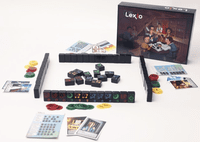
Components — 60 tiles and scoring chips
| Component | Count | Notes |
|---|---|---|
| Tiles | 15 each of Sun, Moon, Star, Cloud = 60 | Numbers 1-15, one tile per number per suit |
| Scoring chips | 4 each of 1-point (yellow), 5-point (green), 10-point (red) | Same for every player regardless of player count |
| Reference cards | 5 | One per player, summarizing the hand rankings |
Black and White editions differ only in color
The Black and White boxes differ only in cosmetic color — tiles and rules are identical. The 2020 'LEXIO Plus' edition adds heavier metal-weighted chips (1, 2, 5, 10, 50, 100 points), but the core rules are the same.
Setup — the tile range depends on player count
| Players | Tiles in use | Tiles per player |
|---|---|---|
| 3 | 1-9 (36 tiles) | 12 |
| 4 | 1-13 (52 tiles) | 13 |
| 5 | 1-15 (60 tiles) | 12 |
- 1Shuffle only the tiles in the range used for your player count; leave the rest in the box.
- 2Deal the shuffled tiles equally and stand them up so only you can see your own.
- 3Deal scoring chips the same way regardless of player count: 4 yellow (1 point), 4 green (5 points), and 4 red (10 points) to each player.
- 4Give each player one reference card.
Flow — beat the Lead's combination with a higher one
- 1The player holding the 'Cloud 3' tile becomes the Lead and plays any combination freely. Playing Cloud 3 itself is not required.
- 2The next player must play the same number of tiles with a higher value. If unable to, the player must 'pass'.
- 3If every other player passes, the last player to play becomes the new Lead and may again play any combination freely.
- 4The round ends the instant a player gets rid of all their tiles, and scoring follows immediately.
Four tiles can never be played at once
LEXIO has no 4-tile combination. Two pairs must be played as separate pairs, and a Four Card (four same-numbered tiles) must be padded with one extra tile to make five.
Combinations — only 1, 2, 3, or 5 tiles
| Count | Name | Composition |
|---|---|---|
| 1 | Single | One tile |
| 2 | Pair | Two same-numbered tiles |
| 3 | Triple | Three same-numbered tiles |
| 5 | Made | One of Straight, Flush, Full House, Four Card, or Straight Flush |
Playing five tiles means forming one of five hands that are almost identical to poker hands: five consecutive numbers regardless of suit make a Straight; five tiles of one suit regardless of number make a Flush; a triple plus a pair make a Full House; four of a kind plus one extra tile make a Four Card; and five consecutive numbers of the same suit make a Straight Flush.
Ranking — 2 is strongest, 1 is second
LEXIO's number order runs lowest at 3, highest at 2 (3-4-5-...-13-14-15-1-2). When numbers tie, suit decides — SUN > MOON > STAR > CLOUD.
| Combination | Tie-break rule |
|---|---|
| Single | Number first; if tied, suit (SUN > MOON > STAR > CLOUD) |
| Pair | Number first; among pairs of the same number, the pair containing a SUN tile wins |
| Triple | Number only (the official sources give no suit tie-break for Triple) |
| Straight | Highest number first; if the sets of numbers are identical, compare the suit of the highest-numbered tile |
| Flush | Compare the highest number first, then the next, and so on; if all five numbers tie, compare suit |
| Full House | Compare only the Triple's number (the Pair's number is irrelevant) |
| Four Card | Compare only the number held four times (the extra tile is irrelevant) |
| Straight Flush | Highest number first; if tied, compare suit |
Special function of '1'
To complete a Straight or Straight Flush, '1' can be used as the number right after the highest number in play. With 3 players (1-9 in use) it can act as '10'; with 4 players (1-13) as '14'; with 5 players (1-15) as '16'. But '2' cannot be chained after it.
Five-tile combinations can be beaten with a stronger type
The strength of Made hands runs Straight < Flush < Full House < Four Card < Straight Flush. Unlike Single, Pair, or Triple, if the previous player played a Flush, the next player may beat it with a higher Flush or a Full House — but not with a Straight, which is weaker.
Scoring — everyone except last place collects
- 1When the round ends, each player counts their remaining tiles. For every '2' tile among them, double the whole count (e.g., 5 tiles including two '2's count as 5 x 4 = 20).
- 21st place (0 tiles) collects chips from every other player, equal to each player's remaining count.
- 3From 2nd place down, each player collects the difference from players with more remaining tiles, and pays the difference to players with fewer.
- 4Settlement proceeds in order: 1st, then 2nd, then 3rd, then 4th. Play about 5 rounds; whoever holds the most chips at the end wins.
Running out of chips ends your game on the spot
If a player runs out of chips to pay during settlement, they are 'OUT OF CHIP, OUT OF GAME' instantly — no longer collecting or paying (this rule appears only on the official English page, not in the Korean sources). Unverified: the official sources do not clarify whether this elimination applies only to that round's settlement or to the rest of the match.
End of the match — totals after about 5 rounds
A round ends the instant a player gets rid of all their tiles. Players typically repeat about 5 rounds, reshuffling and redealing each time. After the final round, whoever holds the most chips in total wins the match.
Strategy — LEXIO is a game about keeping the Lead
- Only the Lead can freely choose how many tiles and which combination to play. Every decision should serve the goal of becoming or keeping the Lead.
- Track how many '1' and '2' tiles have appeared, so you know when your high combinations can actually take the Lead.
- If you hold several Singles or Pairs, play the lowest ones first — low combinations (especially Pairs of 3 or 4, and Straights) are hard to play except as the Lead.
- Because everyone but last place scores, the official site notes it can be better to finish quickly and widen the gap for 2nd place than to chase a long, close win for 1st.
Editions — from Black/White to Plus
| Edition | Notes |
|---|---|
| LEXIO Original Black/White (2004-) | Differ only in box color; same components and rules. The edition this guide covers |
| LEXIO Plus (2020, Wadiz crowdfunding) | Adds heavier metal-weighted chips worth 1, 2, 5, 10, 50, and 100 points; core rules unchanged |
| LEXIO Cute / LEXIO Mini | Spin-offs with redrawn tile art (Cute) or a compact travel size (Mini) |
The name briefly changed and changed back
Wiki cross-check — in 2015 the game was renamed 'Lectio', which led to a trademark dispute and a sales halt; a 2016 relaunch was halted again over a paint-safety issue, and the 2020 'LEXIO Plus' crowdfunding campaign restored the current name and form.
Frequently confused rules
Q. Can I play four tiles at once?
No. Four same-numbered tiles (two Pairs or a near-Four-Card) must be split into two Pairs, or padded with one extra tile to play as a five-tile Four Card.
Q. Which is stronger, 1 or 2?
2 is the strongest number and 1 is second. Aside from those two, higher numbers are stronger, with 3 being the weakest.
Q. How does '1' work in a Straight?
It can extend once past the highest number in play for that player count (for example, right after 15 with 5 players). You cannot then chain '2' after that '1'.
Q. Must a five-tile combination be beaten by the exact same type?
No. Unlike Single, Pair, or Triple, a Made hand can be beaten by a stronger type — a Flush can be beaten by a higher Flush or a Full House, but not by a weaker Straight.
Q. What happens if I'm still holding a '2' tile when the round ends?
Your total remaining tile count is doubled for every '2' tile you hold, which can sharply worsen your score if you lose.
Q. What happens if I run out of scoring chips?
If you run out of chips to pay during settlement, you are immediately out of the game and no longer collect or pay further (per the official English page).
History — a home-grown Korean tile game
LEXIO takes its name from the Latin 'LECTIO' ('selecting' or 'choosing'). It was designed by Kwang Hee Lee, CEO of Didanonia (formerly DagoY Games), and first released in 2004. Wiki cross-check — Namuwiki describes it as the climbing card game 'Big Two' reimagined with mahjong-style tiles.
BGG lists the game as 'Lexio / Lectio' (ID 19184). Wiki cross-check — a search of English Wikipedia on 2026-10-10 did not confirm a dedicated article.
Sources
LEXIO official rulebook (Didanonia, Korean PDF, 8 pages) — board postLEXIO official website — How To Play (Korean)LEXIO official website — Basic Strategy (Korean)LEXIO official website — HOW TO PLAY (English)LEXIO official website — DETAILED RULES COMBINATION (English)LEXIO official website — POINT-COUNTING SYSTEM (English)LEXIO official website — BASIC STRATEGY (English)LEXIO official website — About LEXIO (designer, components, intro)Wiki cross-check — Namuwiki: Lexio (Korean)Wiki cross-check — English Wikipedia: search did not confirm a dedicated article (2026-10-10)Rule summaries are reference content written by us, not quotations from the official rulebook. Always check the official rulebook for exact rules. Diagrams are original schematics, not rulebook illustrations.
Spotted a mistake? Tell us in the comments below →
Last updated 2026-10-10
💡 Master tip
Holding onto the strongest tile, '2', until your hand gets stuck will double the chips you pay out for each '2' you hold when the round ends. Use your '2' tiles quickly to seize the lead instead.
Similar games
Ready for something heavier
If this one has gotten too easy, try these — same feel, one step up in weight.
Tools you can request
Not built yet. Let us know if you want one — it goes on the list.
LEXIO Hand Ranking Guide
A ranking table for Straight, Flush, Full House, Four Card, and Straight Flush
Automatic Chip Scoring Calculator
Settles chips based on remaining tiles and the penalty for holding '2' tiles
Comments
Share your thoughts, report a mistake, or request a tool. No sign-in needed — nicknames are not verified, so anyone can use the same one.
Loading…