Top 103
Mahjong
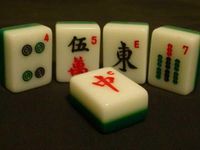
A traditional four-player tile game in which you draw and discard among 136 beautifully crafted tiles to complete four sets (sequences, triplets, or quads) plus one pair and score a valuable yaku.
Rules
A four-player tile game played with 136 tiles, where you race to complete a hand of four sets and one pair and declare a win. The most widely played style, both in Korea and worldwide, is Japanese Riichi mahjong, famous for betting 1,000 points to declare 'Riichi' while keeping your hand concealed.
Components — 136 tiles
| Group | Types | Count |
|---|---|---|
| Suit tiles | Characters (Manzu), Circles (Pinzu), Bamboo (Souzu) — numbered 1-9 | 3 suits x 9 x 4 = 108 tiles |
| Honor tiles — winds | East, South, West, North | 4 types x 4 = 16 tiles |
| Honor tiles — dragons | White, Green, Red | 3 types x 4 = 12 tiles |
| Total | 136 tiles |
Red fives (akadora)
Most retail sets and online clients include 'red fives' — one five of each suit (or two for circles) printed in red. Holding a red five on a winning hand adds one han, the same as a dora. EMA's official competition rules do not use red fives.
Setup — seating, the wall, the deal, and dora
- 1The four players roll dice to determine seating and who starts as dealer (East). South sits to East's right, West across, and North to East's left.
- 2Shuffle all 136 tiles and build a wall of 17 stacks, two tiles high, in front of each player; the four walls form a square.
- 3The dealer rolls to decide where the wall breaks, then tiles are dealt counter-clockwise starting with the dealer: four tiles three times, then one tile each, giving everyone 13 tiles (14 for the dealer).
- 4The rightmost 14 tiles of the wall are set aside as the dead wall. Flip the third tile from the dead wall's end to reveal the dora indicator; the next tile in sequence is the dora.
Suit tiles run 1 through 9; honors cycle on their own
If the indicator is a 9, the dora is 1 in the same suit. If it's North, the dora is East; if it's Red dragon, the dora is White dragon — winds cycle East-South-West-North, and dragons cycle White-Green-Red, each wrapping back to the start.
Flow — draw and discard
- 1The dealer discards the first tile from their 14, laying it in front of themselves to start the discard row.
- 2Play then proceeds counter-clockwise: on your turn, draw one tile from the wall ('tsumo') and discard one tile you don't need ('discard').
- 3Once a discarded tile touches the discard row, that turn is final — it cannot be taken back, and no tsumo win or kan may follow it.
- 4Even out of turn, a player may call 'chi', 'pon', or 'kan' on someone else's discard to claim it, and may declare 'ron' to win immediately if that tile completes a yaku.
Running out of the wall ends the hand in a draw
If every tile outside the dead wall (14 tiles) has been drawn and nobody has won, the hand ends as an exhaustive draw ('ryuukyoku'). See the Ending section for how that is settled.
Hand shape — four sets plus one pair
To win, your 13 tiles plus the winning tile (14 total) must divide into four sets and one pair. A set is one of the three types below, and the pair is two identical tiles.
| Set type | Composition | How to form it |
|---|---|---|
| Sequence (shuntsu) | Three consecutive numbers of one suit (e.g. Characters 3-4-5) | Build it in hand, or call 'chi' on the player to your left |
| Triplet (koutsu) | Three identical tiles | Build it in hand, or call 'pon' on anyone's discard |
| Quad (kantsu) | Four identical tiles | Declare 'kan' — draw one replacement tile from the dead wall |
A 13-tile hand that is one tile away from completion is called tenpai. Waiting shapes include the two-sided 'ryanmen', the edge-blocked 'penchan', the gapped 'kanchan', the 'shanpon' (waiting on either of two pairs to become a triplet), and the 'tanki' single-tile wait. A tenpai hand with no yaku is only a 'formal tenpai' and cannot actually win.
Calls — chi, pon, and kan
| Call | Condition | Effect |
|---|---|---|
| Chi | Only on the discard of the player directly to your left, to form a sequence | Take the tile, reveal the sequence, then discard one tile |
| Pon | Holding two matching tiles, on anyone's discard | Take the tile, reveal the triplet, then discard one tile |
| Kan | Holding three (open/concealed call) or four (self-drawn) matching tiles | Form the quad, draw a replacement tile from the dead wall, reveal a new dora indicator |
- If chi, pon, kan, and ron are all possible on the same discard, pon, kan, and ron take priority over chi.
- Calling (pon or chi) ends your hand's concealed (menzen) status, which locks you out of menzen-only yaku such as Riichi, Fully Concealed Hand, and Pinfu.
- Declaring kan draws a replacement tile from the dead wall; winning on that replacement tile earns the separate yaku 'After a Quad' (rinshan kaihou).
Swap-calling restrictions
A tile that could substitute for part of an already-completed sequence ('suji'), or a tile identical to one already discarded ('genbutsu'), cannot simply be discarded right back after being called in certain situations. See the official guidebook's section on swap-calling for the exact conditions.
Riichi and furiten
- 1If your hand is concealed (menzen) and tenpai, you may discard a tile while betting 1,000 points to declare 'Riichi'.
- 2Riichi itself grants one han, and winning within the first uninterrupted go-around afterward adds the 'Ippatsu' yaku for one more han.
- 3After Riichi, you may not rearrange your hand; if the tile you draw isn't your winning tile, you must discard it as drawn. On winning, you also reveal the hidden 'ura dora' indicators under the dead wall.
| Furiten situation | Result |
|---|---|
| A tile you yourself discarded is among your winning tiles | No ron for the rest of the hand; tsumo wins are still allowed |
| You passed on a winning tile while tenpai with a yaku, without declaring Riichi | No ron only until your turn comes back around ('temporary furiten') |
| You passed on a winning tile after declaring Riichi | No ron for the rest of the hand; tsumo wins are still allowed |
After Riichi, you must reveal your hand even if not tenpai
Because Riichi is a public declaration of tenpai, your hand must be revealed at an exhaustive draw. Declaring Riichi while actually noten (not tenpai) is a chombo penalty.
Yaku — at least one is required to win
Even a perfectly shaped hand cannot win without at least one yaku. Here are 11 representative yaku common to both the Korean guidebook and EMA's rules. Han values stack; the value in parentheses applies when the hand is open (not concealed).
| Yaku | Han | Condition |
|---|---|---|
| Riichi | 1 | Declared with a concealed tenpai hand, betting 1,000 points |
| Fully Concealed Hand (Menzen Tsumo) | 1 | Winning by self-draw with a concealed hand |
| Pinfu | 1 | Four sequences plus a valueless pair and a two-sided wait; concealed only |
| All Simples (Tanyao) | 1 | No terminals (1/9) or honor tiles anywhere in the hand |
| Yakuhai | 1 (per type) | A triplet/quad of a dragon or your seat/round wind — the double wind is worth 2 |
| Pure Double Sequence (Iipeikou) | 1 | Two completely identical sequences; concealed only |
| Ippatsu | 1 | Winning within one uninterrupted go-around after declaring Riichi |
| Half Outside Hand (Chanta) | 1 (2 concealed) | Every set and the pair contains a terminal or honor tile |
| All Triplets (Toitoi) | 2 | Four triplets/quads plus a pair, with no sequences |
| Half Flush (Honitsu) | 2 (3 concealed) | Only one suit, combined with honor tiles |
| Full Flush (Chinitsu) | 5 (6 concealed) | Only one suit, with no honor tiles at all |
Yakuman — the rarest hands
Hands such as Thirteen Orphans (one of each terminal and honor), Four Concealed Triplets (four triplets completed without calling), and Big Three Dragons (all three dragon sets) are called 'yakuman' and score four times a mangan. As a beginner, it's enough to know these exist.
Scoring — han and fu
A score is set by two numbers: han (the sum of your yaku plus dora) and fu (minipoints from the shape of your sets, pair, and wait). Fu starts at 20 and is rounded up to the nearest 10 after adding bonuses. Each additional han roughly doubles the score, and from a certain point the score is simply a named fixed amount regardless of fu.
| Han | Name | Total points (non-dealer / dealer) |
|---|---|---|
| 5 | Mangan | 8,000 / 12,000 |
| 6-7 | Haneman | 12,000 / 18,000 |
| 8-10 | Baiman | 16,000 / 24,000 |
| 11-12 | Sanbaiman | 24,000 / 36,000 |
| 13+ | Yakuman | 32,000 / 48,000 |
A smaller example — 30 fu, 3 han
An ordinary hand below mangan is scored from the fu table. For example, 30 fu and 3 han scores 3,900 points on a non-dealer ron. Scores rise exponentially as han and fu increase.
On a ron, the player whose discard was claimed pays the full amount. On a tsumo, the three other players split the payment; the dealer pays double what each non-dealer pays, and a dealer's win is worth 1.5 times a non-dealer's win of the same hand.
Ending a hand — exhaustive draws and all-last
- 1A hand ends the moment someone wins, or when the wall outside the dead wall runs out (an exhaustive draw, 'ryuukyoku').
- 2If the dealer won, or was tenpai at a draw, the same seating repeats as a 'renchan', adding one to the honba counter and a small bonus to the next hand's score. Otherwise, the next player becomes dealer.
- 3Once all four winds have each served as dealer at least once (East 1 through South 4 in a half-game), the final hand, called 'all-last' (oorasu), is reached.
- 4The game ends at all-last when a player other than the current leader wins, or when the dealer is noten at a draw. Whether a leading dealer chooses to end the game on a win or tenpai, or to continue, depends on house rules.
Busting out below zero
If any player's score drops below zero, the game may end immediately under a 'bust' (tobi) rule. Whether this rule is used varies by house rule.
Tips for beginners
- If your hand is full of unneeded terminals and honors, aim for Tanyao by building around 2-8 suit tiles — it's one of the easiest yaku to complete.
- Even with no yaku in sight, reaching a concealed tenpai lets you declare Riichi to manufacture one. As a beginner, staying concealed generally makes it easier to find a yaku.
- Calling pon or chi speeds up your hand, but it locks out every menzen-only yaku (Riichi, Fully Concealed Hand, Pinfu, Iipeikou) — calling early isn't always the better choice.
- Get in the habit of checking which tiles have already been discarded each turn; picking a tile already seen elsewhere (genbutsu) reduces your chance of dealing into someone else's hand.
Variants — three-player mahjong and local rules
| Aspect | Common variation |
|---|---|
| Player count | Three-player mahjong (removing the 2-8 Circles tiles or the North wind) — this guide covers the more common four-player game |
| Open Tanyao (kuitan) | Whether Tanyao counts when built partly through calls (chi/pon) varies by ruleset; most modern rulesets allow it |
| Red fives (akadora) | Whether they're used, and how many, varies by set and club; EMA's official competition rules do not use them |
| Online play | Services such as 'Mahjong Soul' have helped popularize the game, including in Korea |
This guide covers four-player Riichi mahjong, which the official guidebook treats as the more widely played format. Three-player mahjong changes some flow and yaku rulings and should be checked separately.
Frequently confused rules
Q. Can I win if I'm tenpai but have no yaku?
No. A tenpai hand with no yaku is only a 'formal tenpai' — both tsumo and ron wins require at least one yaku.
Q. Does declaring a kan give me an extra tile overall?
No. A kan draws one replacement tile from the dead wall, so your hand size stays the same — the dead wall simply shrinks by one tile. At the win, the quad still counts as one of your four sets.
Q. Can I kan anything after declaring Riichi?
Only a concealed kan (ankan) made from a tile you just self-drew, matching three already in your concealed hand, is allowed — and only if it doesn't change your waiting shape.
Q. Can two players win by ron on the same discard?
It depends on the ruleset. Rulesets allowing 'double ron' let both wins stand; rulesets using 'head bump' only award the win to whichever winner sits closest to the discarder.
Q. Does nobody score anything at an exhaustive draw?
No — players who were tenpai receive points (commonly 3,000 total) from the players who were noten. If everyone is tenpai or everyone is noten, no points change hands.
Q. Do online platforms like Mahjong Soul use the same rules?
The core rules (sets, yaku, scoring) follow the same Riichi mahjong, but details like red-five use and other local-rule choices can differ by service or table.
History — from China through Japan to Riichi mahjong
Mahjong is said to have originated in ancient China, and the basic idea of four players building sets from tiles to win is shared across its many variants. Wiki cross-check — English Wikipedia traces its establishment to 19th-century China, spreading worldwide in the early 20th century.
Riichi mahjong developed its own distinct rule set after mahjong spread from Qing-dynasty China to Japan in the early 1900s, and it has continued to evolve since. The spread of internet and online play from the 2000s onward made it more widely accessible, and in Korea, dedicated playing venues have grown since around the 2010s. Wiki cross-check — Namuwiki describes it as having also found a place as a 'mind sport' alongside chess, janggi, and go.
The European Mahjong Association (EMA) first established official rules while preparing for the first European Riichi Championship in Hannover, Germany, in 2008; the 2025 edition takes effect on January 1, 2026. In Korea, the Korea Mahjong League (KML), together with Yostar (publisher of the online mahjong game Mahjong Soul), released an official Korean-language guidebook for free in 2024 to help popularize the game.
Sources
'A Complete Guide to Riichi Mahjong' — written by the Korea Mahjong League (KML), produced by Yostar, official PDF (47 pages, Korean)European Mahjong Association — Riichi: Rules for Japanese Mahjong, 2025 edition (English, 46 pages)Wiki cross-check — Namuwiki: Riichi Mahjong (Korean)Wiki cross-check — English Wikipedia: Japanese mahjongRule summaries are reference content written by us, not quotations from the official rulebook. Always check the official rulebook for exact rules. Diagrams are original schematics, not rulebook illustrations.
Spotted a mistake? Tell us in the comments below →
Last updated 2026-10-10
💡 Master tip
Calling other players' tiles (chi/pon) without thinking breaks your concealed (menzen) status, locking you out of high-scoring Riichi-based yaku. Whenever possible, keeping your hand concealed instead of calling is the key to a high score.
Ready for something heavier
If this one has gotten too easy, try these — same feel, one step up in weight.
Tools you can request
Not built yet. Let us know if you want one — it goes on the list.
Automatic yaku and han/fu scoring calculator
Enter your completed hand to calculate the yaku score
Wall tile count and wind tracker
Displays the round wind and seat wind
Comments
Share your thoughts, report a mistake, or request a tool. No sign-in needed — nicknames are not verified, so anyone can use the same one.
Loading…