Top 27 · #1 of 60 in Family
Heat: Pedal to the Metal
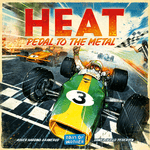
A racing game set among 1960s race cars, where you shift gears and manage your engine's Heat so you don't overheat through the corners. Push too hard and your hand clogs up with Heat cards, slowing your next turns, so balancing speed against Heat management is the core of the fun.
Rules
Shift gears and play number cards whose total moves your car that many spaces. Exceed a corner's speed limit and you must pay Heat cards from your hand; run out of Heat and you spin out — managing speed against your engine is the whole game.
Components
| Component | Count | Role |
|---|---|---|
| Game boards | 2 double-sided (USA, France, Great Britain, Italy tracks) | The race track; each corner shows a speed limit |
| Cars and Gear pawns | 6 each (player colors) | Your car and current gear (1st–4th) |
| Player mats | 6 | Gear dial, Boost/Cooldown summary, and the Engine spot for Heat |
| Basic cards | 72 (12 per player: three each of 1, 2, 3, 4) | Play as many as your gear to build Speed |
| Starting Upgrade cards | 18 (3 per player: 0, 5, and one spare Heat card) | Special cards shuffled into your starting deck |
| Stress cards | 37 (typically 3 per player per track) | Contribute an unknown '+' value to Speed when played |
| Heat cards | 48 (typically 6 per player per track) | Can't be played or discarded; only pay for corner overages |
Setup
- 1Unfold a game board. For a first game, use the USA track and race just 1 lap instead of the printed 2.
- 2Each player chooses a color and takes a car, player mat, Gear pawn, 12 Basic cards, and 3 Starting Upgrade cards in that color.
- 3Take the number of Heat and Stress cards shown on the board (typically 6 Heat and 3 Stress).
- 4Shuffle your 12 Basic cards, 3 Starting Upgrade cards, and 3 Stress cards (18 total) and place them face down as your draw deck. Place the 6 Heat cards face up on your mat's Engine spot. Set your Gear pawn to 1st gear.
- 5Keep the remaining Stress cards as a shared reserve near the board.
- 6Place all participating cars on the starting grid one at a time, at random, to set turn order (closest to the inside first).
- 7Draw 7 cards from your draw deck into your hand. You're ready to begin.
Game turn — 9 steps
- 1① (Mandatory) Shift Gears — keep your current gear or move it up or down by one step. Shifting two steps at once costs 1 Heat.
- 2② (Mandatory) Play Cards — play exactly as many cards from your hand as your gear number (1st = 1 card, 2nd = 2, 3rd = 3, 4th = 4), face down in your Play Area. Heat cards may never be played.
- 3③ (Mandatory) Reveal & Move — reveal your played cards, add their values (your Speed), and move forward that many spaces.
- 4④ (Situational) Adrenaline — only for the last car to move this round (last two cars if 5 or more are racing). Grants +1 Speed and/or 1 extra Cooldown to use in the React step.
- 5⑤ (Situational) React — activate your current gear's Boost and/or Cooldown symbols (plus Adrenaline), in any order, as many times as available.
- 6⑥ (Situational) Slipstream — if you are in the same space as or directly behind another car, optionally move 2 extra spaces (once per turn).
- 7⑦ (Situational) Check Corner — if you crossed a Corner Line this turn, compare your Speed to that corner's Speed Limit and pay Heat equal to any excess.
- 8⑧ (Situational) Discard — discard any cards you no longer want from your hand (Heat and Stress cards can never be discarded).
- 9⑨ (Mandatory) Replenish Hand — move all Play Area cards to your discard pile, then draw back up to 7 cards.
Steps ①–② are simultaneous; ③–⑨ go car by car
All players complete steps ① and ② at the same time. Then, starting with the car closest to the Race Line, each car completes steps ③ through ⑨ in full before the next car begins.
Heat and Stress — the price of speed
- Paying for a Boost (spend 1 Heat for a '+' symbol) or a corner overage moves 1 Heat card from your Engine to your discard pile.
- When your discard pile is reshuffled into your draw deck, Heat cards go with it and can be drawn into your hand. A Heat card in hand can neither be played nor discarded, so it clogs your hand.
- Cooldown (typically 3 in 1st gear, 1 in 2nd) moves 1 Heat card from your hand back to your Engine. Driving in a low gear is the only way to recover Heat.
- Using a '+' symbol (Boost, a Stress card, or Adrenaline) flips cards from the top of your draw deck until a Basic card appears. That Basic card joins your Play Area for its 1–4 value; any other card (Upgrade or Stress) is immediately discarded and flipping continues.
- A Stress card played for your gear's card count is always treated as one of these unknown '+' symbols when adding to Speed.
Corner speed limits and spinning out
Your Speed this turn is the total value of the cards in your Play Area (including any +1 from Adrenaline, but not the +2 from Slipstream). If you crossed any Corner Line this turn, compare it to that corner's Speed Limit.
- 1If your Speed is at or below the Speed Limit, nothing happens.
- 2If your Speed exceeds the Speed Limit, pay Heat cards from your Engine to your discard pile equal to the difference.
- 3If you crossed several corners this turn, pay for each one separately, starting with the first one you crossed.
- 4If you don't have enough Heat, pay all the Heat you have and spin out — move your car back to the first available space before the Corner Line that caused the spin out, set your Gear pawn to 1st gear, and take 1 extra Stress card if you were in 1st/2nd gear or 2 extra Stress cards if you were in 3rd/4th gear.
Movement, blocking, and Slipstream
- Cars never prevent you from passing through them. But if your move would end in a space where every Spot is already occupied, you're blocked and placed in the first space with a free Spot behind the blocking cars.
- If two cars sit in the same space, the one closer to the Race Line counts as ahead.
- Slipstream is available only when you are in the same space as, or the space directly behind, another car. It is optional, usable once per turn, and moves you 2 extra spaces. If every Spot in the destination is full, you land in the nearest space behind it with a free Spot instead.
- The 2 spaces gained from Slipstream are not added to your Speed for the Check Corner step.
End of the race and winning
- 1A player finishes the race by completing the printed number of laps and crossing the finish line.
- 2After the finish line, disregard any remaining Speed Limits in corners and move as far as you can.
- 3If several cars finish in the same round, the car closer to (further along toward) the Race Line is considered ahead for that round.
- 4At the end of the round, remove every car that crossed the finish line and place them in order on the Hall of Fame space. Repeat until every car has finished.
- 5The first player to cross the finish line wins the game.
Slipstream can never cross the finish line
Slipstream may not be used for the move that crosses the finish line, nor at any point after a car has already finished.
Strategy tips
- Recover Heat with Cooldown while driving in a low gear, so you have it ready to spend on Boosts or corner overages on the straights.
- If the cards in your hand would push your Speed over an upcoming corner's limit, shifting down early lets you pass without spending Heat.
- A hand clogged with Heat cards leaves you fewer playable cards, making it hard to sustain a high gear. Cycling through low gears regularly to use Cooldown keeps your hand clear.
- Slipstream gives 2 free spaces without spending a card, so positioning right behind another car is worth pursuing.
- A Stress card only leaves your hand once you play it, so working it into a low-gear turn early is usually better than hoarding it for a high gear.
Tracks, player count, and expansions
- The two double-sided boards hold four tracks — USA, France, Great Britain, and Italy — each with its own number of corners, spaces per lap, and Speed Limits.
- The game supports 1 to 6 players. This guide covers only the core Rules booklet; solo-specific rules and deeper options such as buying Upgrade cards or Garage mode live in the separate Advanced Rules booklet and are not covered here.
- Days of Wonder's official page lists four expansions: Heat: Tunnel Vision, Heat: Heavy Rain, Heat: Rocky Roads, and Heat: Legends. This guide covers only the base game's core Rules booklet and does not include their modules.
Frequently confused rules
Q. Can I shift two gears at once?
Yes, but it costs 1 Heat. Since everyone shifts gears at the same time, announce it, pay the Heat, and move your Gear pawn accordingly.
Q. Can Slipstream carry me across the finish line?
No. Slipstream can't be used for the move that crosses the finish line, nor after a car has already finished.
Q. If I cross two corners in one turn, do I pay Heat once for both?
No. Pay separately for each corner, starting with the first Corner Line you crossed this turn.
Q. Can I just discard a Heat card from my hand?
No. Heat cards can never be played or discarded from your hand. The only way to remove one is to spend a Cooldown and return it to your Engine.
Q. What happens if I don't have enough Heat to pay at a corner?
Pay all the Heat you have and spin out: move back to the first available space before that Corner Line, set your Gear pawn to 1st gear, and gain 1 extra Stress card (1st/2nd gear) or 2 (3rd/4th gear).
Q. What if I don't have enough playable cards for my gear?
Play as many as you can and do not move this turn. Move your Gear pawn to 1st gear, discard your Play Area cards, and skip straight to step 9 (Replenish Hand).
Q. Can I drive through a space that already has another car?
Yes. Cars never block passing through. The only restriction is when your move would end in a space where every Spot is already occupied.
Edition and history
Heat: Pedal to the Metal was designed by Asger Harding Granerud and Daniel Skjold Pedersen, illustrated by Vincent Dutrait, developed by Sidekick Studio, and published by Days of Wonder in 2022. According to English Wikipedia, it won the 2022 Golden Geek Award for Medium Game of the Year and Best Thematic Board Game, was a finalist for Most Innovative Board Game, and was also a finalist for Best Thematic Game at the Board Game Quest Awards.
No official Korean retail edition or Korean rulebook was found. A Namuwiki search did not confirm a dedicated article (checked 2026-10-10). The BGG 366013 page returned an automated block (403) on direct access, so player count (1–6), age (10+), and playtime (about 60 minutes) were cross-checked against the official rulebook's cover and the catalog instead.
The four expansions are outside this guide
Days of Wonder's official page lists Tunnel Vision, Heavy Rain, Rocky Roads, and Legends as expansions (English Wikipedia instead vaguely states 'three expansions' with no names given, so the official page was followed here). This guide covers only the core Rules booklet.
Sources
Days of Wonder official English core Rules booklet (PDF, Rules v1.1)Days of Wonder official Heat product page — expansion listBoardGameGeek 366013 — players/age/time cross-check (automated block prevented direct access; cross-checked against the official rulebook cover instead)Wiki cross-check — English Wikipedia: Heat: Pedal to the MetalWiki cross-check — Namuwiki search: no dedicated article confirmed (2026-10-10)Rule summaries are reference content written by us, not quotations from the official rulebook. Always check the official rulebook for exact rules. Diagrams are original schematics, not rulebook illustrations.
Spotted a mistake? Tell us in the comments below →
Last updated 2026-10-10
💡 Master tip
Saving up Heat cards and spending them in a burst on the straights is more stable over a long race than forcing your way through every corner. Shifting down early before a corner lets you pass it without spending any Heat at all.
Ready for something heavier
If this one has gotten too easy, try these — same feel, one step up in weight.
Tools you can request
Not built yet. Let us know if you want one — it goes on the list.
Corner speed limit and overheat guide
Calculates how many Heat cards are spent when you exceed a corner's speed limit
Comments
Share your thoughts, report a mistake, or request a tool. No sign-in needed — nicknames are not verified, so anyone can use the same one.
Loading…