Top 78 · #13 of 60 in Family
Santorini
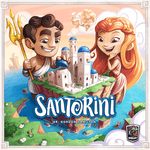
Granted the powers of Greek gods, players race to build three-level towers on the island of Santorini and be the first to climb onto the third level in this mythic abstract strategy puzzle. Each god card changes the move or build rules in its own way, so every game plays differently.
Rules
On a 5x5 island, move a worker and build a level, aiming to be the first to climb onto a level-3 tower. A single god card can bend the move-and-build rules just enough to make every game different.
Components
| Component | Notes |
|---|---|
| Board | Cliff Pedestal + Ocean Board + 5x5 Island Board, assembled together |
| Workers | 2 per player (up to 4 players, distinguished by color). Whoever places first becomes the start player |
| Building blocks | A distinct, progressively smaller shape for levels 1, 2 and 3. The rulebook does not state exact quantities — follow your box's component list |
| Dome | The capstone of a tower. Nothing may ever be placed on top of a dome |
| God/Hero cards | 10 Simple gods + roughly 20 Advanced gods + 10 Hero cards (two-player only) |
The rulebook does not list exact block counts
The official rules never state how many blocks or domes are included. Defer to your own box's component list.
Setup
- 1Assemble the board: Ocean Board on the Cliff Pedestal, then the Island Board on top, forming a 5x5 grid.
- 2The youngest player becomes the start player and places their 2 workers on any unoccupied spaces.
- 3The other players then place their 2 workers each, in turn.
A turn — move, then you must build
- 1Choose one of your workers.
- 2You must move it to an adjacent unoccupied space (no worker, no dome).
- 3You must then build a block or dome on a space adjacent to the worker that moved.
- 4If you cannot move or cannot build, you lose immediately.
Moving and building are both mandatory
Each turn moves exactly one worker, and that turn must include both a move and a build. Being unable to do either loses the game.
Movement — only one level up
- A worker may move into any of up to 8 neighboring spaces that are unoccupied (no worker, no dome).
- You may move up only one level. Moving down any number of levels, or staying on the same level, is unrestricted.
- You cannot move into a space that is two or more levels higher, or one blocked by a dome.
Building — a different block per level, the Complete Tower
- You may build only on an unoccupied space (no worker, no dome) adjacent to the worker that just moved — never on your own space or the one you just left.
- Build the block shape matching that space's current level — a level-1 block on bare ground, a level-2 block on top of level 1, and so on.
- On top of a level-3 block, build a dome instead of another block. Domes can normally only be built on level 3, unless a god or hero power says otherwise.
- A tower with all three block levels plus a dome is called a Complete Tower.
A dome is not a block
If a god power's text only mentions «blocks», it does not affect domes. Read the two terms as distinct.
God cards — the 10 Simple powersSimple God Powers
God cards are special abilities usable on your turn that slightly bend the move-and-build rules. The rulebook recommends starting with the 10 Simple gods for your first few games using powers. Any «cannot» or «must» in a card's text is mandatory — breaking it loses the game instantly.
| God | Effect |
|---|---|
| Apollo | Your Move: may move into an opponent Worker's space by forcing their Worker to the space yours just vacated. |
| Artemis | Your Move: may move one additional time, but not back to its initial space. |
| Athena | Opponent's Turn: if your Worker moved up on your last turn, opponent Workers cannot move up this turn. |
| Atlas | Your Build: may build a dome at any level. |
| Demeter | Your Build: may build one additional time, but not on the same space. |
| Hephaestus | Your Build: may build one additional block (not dome) on top of your first block. |
| Hermes | Your Turn: if your Workers do not move up or down, they may each move any number of times (even zero), then build. |
| Minotaur | Your Move: may move into an opponent Worker's space if that Worker can be forced one space straight backward to an unoccupied space at any level. |
| Pan | Win Condition: you also win if your Worker moves down two or more levels. |
| Prometheus | Your Turn: if your Worker does not move up, it may build both before and after moving. |
Forced is not moved
A Worker «forced» by another player's power does not count as having moved. Being forced onto level 3 does not win the game.
Winning and losing
- 1If one of your Workers moves up onto level 3 on your turn, you win instantly.
- 2Moving from one level-3 space to another does not trigger a win — only the first move up onto level 3 does.
- 3If you cannot move or cannot build on your turn, you lose immediately.
The one base win condition is reaching level 3. Only certain god powers add other win or lose conditions (such as Pan's descent win).
Strategy tips
- Since you can only climb one level per move, pre-building a level-3 tower next to an opponent standing on level 2 lets you climb it on your very next turn.
- Capping a space with a dome can deny an opponent a level-2 or level-3 foothold entirely — nothing can ever be built or stood on there again.
- Avoid trapping your own Worker with no legal move or build nearby; always keep an escape or a buildable space open.
3-4 player rules and expansions
| Players / variant | Rule changes |
|---|---|
| 3 players | God powers are mandatory. A player who loses immediately removes their Workers, tokens and god power; if only one player remains, they win. |
| 4 players (teams) | Two teams of two sit across from each other and share 2 Workers per team. Each player keeps their own god power but may not use it on their teammate's turn; if either teammate wins or loses, the team does too. |
| ~20 Advanced god cards | Used once players are comfortable with the Simple gods; some have listed banned matchups that should not be combined. |
| 10 Hero cards | Two-player only. Weaker, once-per-game abilities, useful for balancing a skill gap by giving one to the weaker player. |
| Golden Fleece variant (separate expansion) | No individual god powers — only the player neighboring the Ram figure on the board may use the single shared god power that turn. |
The 2nd Edition (Pantheon) is a separate product
The 2025 Santorini 2nd Edition (Pantheon) rebalance adds new elements such as Mode cards and a die. This guide covers only the base rules of the 2016 Roxley Kickstarter / retail edition.
Frequently confused rules
Q. If I can neither move nor build, do I lose right away?
Yes. If you have no legal move and no legal build on your turn, you lose immediately.
Q. Do god powers that mention 'blocks' also affect domes?
No. A dome is not a block. If a god power's text only refers to blocks, domes are unaffected.
Q. If my Worker is forced up onto level 3, do I win?
No. Being 'forced' is not 'moving'. You only win by moving up onto level 3 on your own turn.
Q. Can I build anything on top of a Complete Tower's dome?
No. Nothing may ever be placed on a dome. You must build elsewhere.
Q. Does moving between two level-3 spaces trigger a win?
No. Only the first move up onto level 3 satisfies the win condition; moving between level-3 spaces afterward does not.
Q. Do I have to use god powers?
No. The base rules alone make a complete game, and the rulebook recommends playing several games without powers first. Only 3- and 4-player games require them.
History and editions
Math educator Gordon Hamilton (also known as Dr. Pickle) designed Santorini in 1985 and first published an all-white wooden version in 2004. Roxley Games relaunched it via Kickstarter in 2016 with its current Greek-mythology theme and cartoon-style art, in a campaign that became one of the most successful Alberta-based Kickstarters at the time.
Spin Master later took over distribution worldwide, and Korea Boardgames is the official domestic distributor. A 2025 2nd Edition (Pantheon) rebalance added new elements such as Mode cards and a die as a separate product — its components differ from the base rules covered here.
A Namuwiki search on 2026-10-10 did not confirm a dedicated article for this game. Unverified facts such as the exact Korean release year are omitted.
Sources
Roxley Games official English rulebook (2016.08.14 Web edition)Wiki cross-check — English Wikipedia: Santorini (game)Wiki cross-check — Namuwiki search: no dedicated article found (2026-10-10)Korea Boardgames product page — confirms Korean distributionRule summaries are reference content written by us, not quotations from the official rulebook. Always check the official rulebook for exact rules. Diagrams are original schematics, not rulebook illustrations.
Spotted a mistake? Tell us in the comments below →
Last updated 2026-10-10
💡 Master tip
The key is to position your two workers so that once you've built a level-2 tower, you can immediately build the level 3 and climb up on your very next turn. If an opponent is about to complete a level 3, don't hesitate to seal it off with a dome.
Ready for something heavier
If this one has gotten too easy, try these — same feel, one step up in weight.
Tools you can request
Not built yet. Let us know if you want one — it goes on the list.
Greek god/hero power matchup checker
Checks compatibility between the special powers of 40-some god cards
Tower level tracker
Automatically flags areas at risk of a completed level-3 tower
Comments
Share your thoughts, report a mistake, or request a tool. No sign-in needed — nicknames are not verified, so anyone can use the same one.
Loading…