Top 84 · #15 of 19 in Co-op
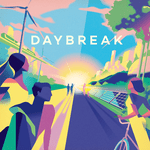
Daybreak
A cooperative game from Pandemic creator Matt Leacock and Matteo Menapace, in which the world's powers (the United States, China, Europe, and the Majority World) join forces to cut carbon emissions and stave off climate crisis. Released in 2023 and winner of the 2024 Kennerspiel des Jahres. The tension comes from racing against time to reach net-zero carbon emissions (Drawdown) before the planet's temperature crosses the 2-degree-Celsius threshold.
Rules
In this cooperative game, four World Powers — the United States, China, Europe, and the Majority World — work together to stop climate change. Every round you stack cards to grow Clean Energy and build Resilience, but if the Thermometer ever hits 2.0°C, or any single World Power reaches 12 Communities in Crisis, everyone loses together.
One way to win, three ways to lose
Victory — reach Drawdown, then survive the Crisis stage
Reaching Drawdown (the round in which you sequester more carbon than you produce) during the Emissions stage flips the round marker over. But this is not an immediate win — you must get through that same round's Crisis stage, and only win if the marker still shows Drawdown when you reach the Growth stage.
| Losing condition | What it means |
|---|---|
| The Thermometer reaches 2.0°C (8 Temperature Bands) | The planet has warmed past the point of no return |
| Any single World Power reaches 12+ Communities in Crisis | That society collapses — everyone loses |
| Round 6 ends without reaching Drawdown | Time has run out |
Because this is a cooperative game, a single World Power collapsing loses it for everyone. Don't just watch your own temperature and crises — supporting the most vulnerable player with cards is central to winning (see 'Playing cards' for tag-support mechanics).
Components
| Component | Count | Notes |
|---|---|---|
| Central board | 1 | Thermometer, Recent Emissions area, Global Project slots, Tree/Ocean/DAC spaces |
| Player boards | 4 (2 pieces each) + 2 extenders | Each World Power's Energy Demand, Dirty/Clean Energy, Emissions, Resilience, and Communities in Crisis areas |
| Local Project cards | 158 | Each World Power starts with 5 unique cards; players draw more each round |
| Crisis cards | 48 | Drawn each round based on the number of Temperature Bands — 1 Forecast card plus the rest face down |
| Global Project cards | 24 | 2 are drawn each Global stage; the group keeps 1 on the board |
| Challenge cards | 42 | Difficulty variant cards not used in your first game |
| Reference cards | 9 | Summarize each World Power's starting values and Tree/Ocean counts by player count |
| Dirty/Clean Energy tokens | 60 at value 1 + 14 at value 5 | Used to meet Energy Demand and to calculate carbon |
| Resilience tokens | 48 at value 1 + 12 at value 5 | Social, Ecological, and Infrastructure types, used to reduce Crisis effects |
| Emissions tokens | 69 | Accumulate on player boards and add to carbon generation |
| Communities in Crisis tokens | 48 | Capped at 12 per World Power — reaching 12 is an immediate loss |
| Temperature Band tokens | 10 (8 used + spares) | Replace a completely filled row on the Thermometer |
| Tree, Ocean, and DAC tokens | Varies by player count | The core resources for sequestering carbon |
| Dice | 1 Planetary Effects, 1 Geoengineering | Rolled once per Temperature Band; also used to break ties for Crisis targeting |
Energy and Emissions are different tokens
Dirty Energy and Clean Energy tokens meet your Energy Demand, while Emissions tokens come from transportation, industry, agriculture, and more, counting only toward carbon generation. Reducing Dirty Energy and replacing it with Clean Energy is the central transition of the game.
Setup
- 1Put the Current Round token on space '1' of the central board, and the 6 Planetary Effects tokens on their starting spaces.
- 2Place all 8 Temperature Bands and the 2 dice beside the Thermometer.
- 3Add Tree and Ocean tokens to the board per the player-count chart (4 players: 24/16, 3: 16/12, 2: 11/7, 1: 6/4).
- 4Shuffle the Global Project, Crisis, and Local Project cards into separate face-down decks. Do not use the Challenge cards in your first game.
- 5Choose World Powers for your player count (4 players use all of them; 3 use Majority World, Europe, and the US; 2 use China and the US; 1 may use any).
- 6Each player takes their World Power's 5 starting Local Project cards and places them face up in their Play Area.
- 7Set the Energy Demand marker, Dirty/Clean Energy tokens, and Emissions tokens on each board according to the Reference card.
- 8Add the starting Resilience and Communities in Crisis tokens indicated on the Reference card. Leave the board extenders in the box for now.
Solo play has its own adjustments
In a solo game, remove every card marked with the 'not for solo play' symbol from all decks, and your Energy Demand increases by a larger +2 each round.
A round — 5 stages
- 1Global stage: review the Forecast Crisis card, then draw 2 Global Project cards and agree as a group on which 1 to place on the board.
- 2Local stage: each player draws back up to 5 Local Project cards, then plays as many cards as they like from their Play Area, in any order.
- 3Emissions stage: check that Energy Demand is met, generate carbon equal to Dirty Energy plus Emissions tokens, sequester it with Tree/Ocean/DAC tokens, and move the rest onto the Thermometer.
- 4Crisis stage: roll the Planetary Effects die once per Temperature Band, then resolve that round's Crisis cards in order.
- 5Growth stage: if the round marker shows Drawdown, victory is confirmed; otherwise, advance to the next round and increase everyone's Energy Demand.
There is no player order
Daybreak has everyone managing their own board simultaneously. No turn order dictates who plays cards first in the Local stage — the group simply moves on once everyone agrees they are finished.
Playing cards — in front, tucked behind, or discarded
- Play in front: place a card from your hand at the front of a stack to make a new action available. You can then use the tags on every card behind it as well.
- Tuck behind: slide a card behind an existing stack to add to the front card's tag count. More tags make that action stronger (the same technique reduces Crisis effects, supports Global Projects, and supports other Local Projects).
- Discard to pay a cost: some actions require discarding 1 card from your hand. If that action has no 'Limit' printed, you may repeat it as many times as you keep discarding cards.
- Your Play Area can hold up to 5 stacks, with no limit on how deep any stack can go. There's no hand size limit either, and both your hand and Play Area carry over unchanged between rounds.
Using an action before covering it is never wasted
You can use a front card's action, then play a new card over it to gain that new card's action too (the covered card's tags keep supporting from below). You simply can no longer take the covered card's own action directly.
Energy demand and the Thermometer
- 1Check demand: your Dirty Energy plus Clean Energy tokens must equal or exceed your board's Energy Demand. If you fall short, add that many Communities in Crisis.
- 2Generate carbon: take carbon cubes equal to your Dirty Energy tokens plus your Emissions tokens, and place them in the Recent Emissions area of the central board.
- 3Sequester: remove carbon from Recent Emissions by covering an equal value of Tree, Ocean, and DAC tokens on the board (the removed carbon returns to the supply).
- 4Check Drawdown: if Recent Emissions is at 0 carbon after sequestering, and uncovered Tree/Ocean/DAC tokens remain, you have reached Drawdown — you may keep sequestering, now drawing carbon from the Thermometer itself.
- 5Raise temperature: fill the Thermometer with any remaining carbon, using as many columns as there are players. Whenever a row fills completely, replace it with 1 Temperature Band (0.1°C), which adds another Planetary Effects die roll and more Crisis cards to draw.
Producing excess Clean Energy has no immediate benefit
Replacing Dirty Energy with Clean Energy reduces carbon generation long-term, but Clean Energy beyond your Demand gives no extra effect that round. Dirty Energy counts fully toward carbon every round regardless of whether Demand is met.
Resolving Crisis cards
- 1The number of Temperature Bands sets how many Crisis cards are drawn that round. 1 becomes the face-up Forecast card; the rest stay face down as Unknown.
- 2During the Crisis stage, resolve every card in play from bottom (earliest placed) to top, with no upper limit — if Temperature Bands increase mid-round, draw and add more cards face down on the spot.
- 3Flip each card and check who is targeted (some affect everyone, others only a player meeting certain criteria). On a tie, roll the Geoengineering die: the single lowest roll is targeted.
- 4A targeted player holding matching Resilience tokens may reduce the effect by 1 per token (tokens are not spent, and this only applies to that player). A card tucked under the Crisis during the Local stage, if it meets the stated conditions, reduces or ignores the effect for every targeted player.
- 5After applying all effects, discard the Crisis card along with any cards tucked beneath it.
You cannot tuck cards under an Unknown Crisis
Pre-emptively reducing a Crisis only works on a face-up Forecast card. Unknown cards are only revealed once the Crisis stage begins, so there's no way to prepare for them in advance.
Adding Communities in Crisis and reduced card draws
Communities in Crisis tokens fill the board top row first, left to right. At 4-7 Communities in Crisis, draw 1 fewer Local Project card next round; at 8-11, draw 2 fewer; and reaching 12 is an immediate loss for everyone.
Game end — one more round after Drawdown
Reaching Drawdown during the Emissions stage immediately flips the round marker. But that round's Crisis stage still has to happen. If a Crisis card pushes a losing condition first — more Temperature Bands or too many Communities in Crisis — you can still lose even after reaching Drawdown.
Victory is only confirmed once the round marker still shows Drawdown when you reach the Growth stage. If it doesn't, advance the round and increase everyone's Energy Demand before starting the next one. If Drawdown is never reached by the end of Round 6, everyone loses.
Strategy that follows directly from the rules
- Holding at least 1 Resilience token of each type per Temperature Band keeps you safely able to reduce Crisis effects.
- Using a front card's action, then covering it with a new card, keeps the covered card's tags supporting from below while also gaining the new card's action.
- Cards that remove Dirty Energy require you to replace that capacity with Clean Energy to keep meeting Demand, so plan both actions together.
- Tucking a conditions-matching card under a visible Forecast Crisis is the most efficient defense — Unknown cards give you no chance to do the same.
Editions and variants
| Item | Details |
|---|---|
| Challenge cards | 42 variant cards that raise difficulty (red), lower it (green), or add variety (gray). Both group-wide and individual versions exist, and they are not used in your first game. |
| Adjusting difficulty via World Power combinations | 2- and 3-player games range from 'easier' to 'extreme' depending on which World Powers are chosen, per the rulebook's combination chart. |
| Solo mode | Any World Power may be played solo; cards marked 'not for solo play' are removed from every deck, and Energy Demand grows by a larger +2 each round. |
| Co-publishing | Jointly published in 2023 by the UK's CMYK and Germany's Schmidt Spiele (per Wikipedia). |
| Korean release | Price-comparison sites confirm Korea Boardgames distributes 《Daybreak》 (1-4 players, ages 10+, 60-90 minutes, 281 cards). The official site's 'Korean' locale translates its UI and FAQ, but the rulebook PDF it links to is the same file as the English edition. |
Frequently confused rules
Q. Does reaching Drawdown win the game immediately?
No. It only flips the round marker. You must get through that same round's Crisis stage, and win only if the marker still shows Drawdown at the Growth stage.
Q. Is there any benefit to producing more Clean Energy than my Demand?
Not that round. You just need Dirty Energy plus Clean Energy to meet or exceed your Demand.
Q. Is there a limit on how many Crisis cards resolve in one round?
Temperature Bands set the base number, but there is no upper limit. If Temperature Bands increase mid-round, draw and add more cards face down on the spot.
Q. What if a Crisis card makes me lose Resilience tokens I don't have?
If you have none of that type, add 1 Community in Crisis for each token you would otherwise have lost.
Q. If one World Power hits 12 Communities in Crisis, does only that player lose?
No. This is a cooperative game — any single World Power reaching 12 or more means everyone loses together, immediately.
Q. Can I tuck a card under an Unknown Crisis to prepare for it?
No. Pre-emptively reducing or ignoring a Crisis only works on the face-up Forecast card.
History and reception
Designed by Matt Leacock (the designer of Pandemic) together with Matteo Menapace, and jointly published in 2023 by the UK's CMYK and Germany's Schmidt Spiele (per Wikipedia). The official rulebook credits Wingspan, Terraforming Mars, and Race for the Galaxy as inspirations.
The game won the 2024 Kennerspiel des Jahres (Germany's Connoisseur Game of the Year award) — Leacock's first win after multiple prior nominations (per Wikipedia). In February 2025, it also received the Lizzie Magie award at France's Rennes en Jeux festival (per Wikipedia).
It has been reviewed in the journal *Science* and is used as a teaching tool at the London School of Economics and the College of the Holy Cross (per Wikipedia). Price-comparison sites confirm Korea Boardgames distributes a Korean edition, but as of 2026-10-11, no dedicated Namuwiki article was found for it.
Sources
CMYK — official English Rules of Play v1.0 for DaybreakCMYK — official Daybreak website (rules download, FAQ)BoardGameGeek 334986 — DaybreakWiki cross-check — Wikipedia: Daybreak (board game)Wiki cross-check — Namuwiki search: no dedicated article confirmed (2026-10-11)Price-comparison cross-check — confirms Korea Boardgames distributes 《Daybreak》 (not a rulebook source)Rule summaries are reference content written by us, not quotations from the official rulebook. Always check the official rulebook for exact rules. Diagrams are original schematics, not rulebook illustrations.
Spotted a mistake? Tell us in the comments below →
Last updated 2026-10-11
💡 Master tip
Early on, focus on expanding your clean-energy base, and let players cooperate by sending resources to whichever power is being hit hardest by crises — that collaboration is what decides victory or defeat.
Similar games
Ready for something heavier
If this one has gotten too easy, try these — same feel, one step up in weight.
Tools you can request
Not built yet. Let us know if you want one — it goes on the list.
Global temperature / crisis tracker
Shows the round-by-round temperature rise and each power's accumulated crisis status
Comments
Share your thoughts, report a mistake, or request a tool. No sign-in needed — nicknames are not verified, so anyone can use the same one.
Loading…