Top 2 · #1 of 19 in Co-op
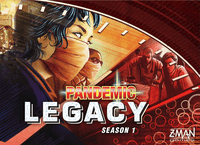
Pandemic Legacy: Season 1
The original and best known legacy game, where you fight diseases all over the world and the board and the rules change permanently based on what happens in each play. Its biggest feature is a campaign of about 12 to 24 plays in which the characters and the world carry over from one game to the next.
Rules
Pandemic played as a campaign, once, across 12 months. You put stickers on the board, write names on cards, and sometimes tear them up. Those changes stay for the next game, so the same box becomes a different story for every group.
Read this first
There are no spoilers in this guide
What happens in each month, what is inside the sealed dossiers, what the Legacy Deck tells you to do — none of it is written here, on purpose. Finding out as you open it is what this game is worth. This guide covers only what is safe to know before the first game: the campaign structure and what differs from the base game.
If you have never played Pandemic
This is a rulebook recommendation. Play a few games without the legacy parts first. Leave out objectives, funding, the game calendar, panic levels, scars, and losing characters, and what is left is simply “Pandemic.” It is better to feel the weight of the decisions before you start January.
What is the same as the base game
The turn structure — 4 actions, then draw 2 cards, then infect — the four movement actions, treating disease, sharing knowledge, the Increase / Infect / Intensify steps of an Epidemic card, outbreaks and chain reactions, and the 7-card hand limit are the same as in “Pandemic.” This guide covers only what changed.
What legacy means — what stays and what resets
| Stays permanently | Resets every game |
|---|---|
| Writing on the board | Cubes and pawns on the board |
| Stickers on the board, cards, and characters | Cards in hand |
| Components you tore up | Outbreak marker and infection rate |
| Character upgrades and scars | Research station placement (except where a starting marker is) |
The rulebook itself grows
The rulebook has empty slots for rules A through Y. When you earn a rule sticker during play, you stick it in its slot, and from then on the rules are permanently changed. It cannot be undone.
- The Legacy Deck is a stack of cards describing what happens over the 12 months. It is in a set order, so do not look through it or shuffle it.
- At the start of a game, draw and read cards one at a time until you reach a card marked “STOP.” The back of that card tells you when to draw again.
- The Legacy Deck is a one-way trip. Even if you replay a month, you do not put its cards back.
- The sealed dossiers in the box stay closed until you are told to open them.
- If the deck order gets scattered, someone who is not playing puts the cards back in order using the number in the corner of each card.
How the 12 months work
Losing does not end the campaign
Win, and you move on to the next month. Lose, and you play that same month one more time. Lose again, and you move on to the next month anyway. So a month is at most two games, and a campaign runs 12 to 24 games.
- Each month has its own objectives. It is not always just “find 4 cures” as in the base game.
- You record results on the game calendar. The months you won and the months you lost both stay there.
- As a city's panic level rises, there is less you can do in that city.
- Funding arrives as special event cards that are used only in that game.
You pick two things when a game ends
Win or lose, once you finish a game you choose 2 game end upgrades. They reflect the experience you have gained and make what follows a little easier.
| Game end upgrade | What it does |
|---|---|
| Character upgrade | Add an ability to a character who was in the game you just played. You may place it on top of an existing upgrade, but an upgrade that gets covered can no longer be used |
| Unfunded event | Add an event to a City card that does not have a sticker yet. It can still be played as a normal city card and does not count toward funding |
| Starting research station | Mark one city that had a research station in the game you just played. In later games you set up with a station there for free |
| Positive mutation | Add a mutation sticker to a disease you eradicated in the game you just played. They must be added in order: level 1, 2, 3, 4 |
Eradicating a disease is not needed to win in the base game, but in Legacy it is the only way to get a positive mutation. If you keep giving up eradication just to win, the loss piles up as the campaign goes on.
Characters — you name them, and they collect scars
- You write a name on the character card yourself. That character becomes a person in your group.
- Characters have upgrade slots and can gain an ability at the end of each game.
- Characters form relationships and gain a benefit when the paired characters are together.
- A scar is a permanent weakness. Once scars pile up, that character can no longer be used.
- A spare “Civilian” character is included. It has no special ability, upgrades, or relationships, and when it would gain a scar it discards its hand instead.
Scars stay on the character and follow them through the whole campaign. Keep sending a well-built character into dangerous cities and you will lose that character. Deciding who to sacrifice is the real decision in this game.
Structures — research stations, extended
The base game's “Build a Research Station” becomes “Build a Structure.” Discard the card for the city you are in to place a structure there. As the campaign goes on, kinds of structures other than research stations appear.
Positive mutations include things like “you no longer need to be in a research station to discover a cure for this disease,” “you no longer spend an action to discover a cure,” and “you need one fewer card.” Which disease to attach them to is decided by looking at the board at that moment.
Rules people get wrong
Q. Do we really have to put stickers on the board and tear up cards?
Yes. That is the design. It cannot be undone, and not undoing it is the heart of the fun.
Q. Once we play it, can we never play it again?
Once a campaign is finished, that copy is essentially done. A fresh campaign needs a fresh copy. Many people find 12 to 24 games plenty of value.
Q. Does losing end the campaign?
No. You play the same month one more time, and if you lose again you move on to the next month anyway. You always reach December.
Q. Do we need the same people every time?
It is recommended, because characters and relationships carry over. If the group changes, players swap characters or use the Civilian character.
Q. Do the cubes on the board carry over to the next game?
No. Cubes, pawns, hands, and the outbreak marker all reset every game. Only writing, stickers, and what you tore up stay.
Q. Can we open a sealed dossier early?
Do not open it until you are told to. Opening it early removes the tension of that month entirely.
Q. Can we play Season 2 or Season 0 first?
You can. They are independent campaigns. Still, Season 1 is the reference point for the line, so most people recommend playing it first.
History and editions
| Item | Detail |
|---|---|
| Designers | Matt Leacock · Rob Daviau |
| Published | Z-Man Games, 2015 |
| Based on | “Pandemic,” 2008 |
| Significance | The game that made the “legacy” genre popular. It held a top spot in the BGG overall ranking for a long time |
| Related title | Released | Note |
|---|---|---|
| Pandemic Legacy: Season 2 | 2017 | Set after Season 1, but playable on its own |
| Pandemic Legacy: Season 0 | 2020 | 1960s espionage setting. Widely called the hardest of the three |
“Legacy” comes in a red box and a blue box. The contents are the same; only the character art differs. Either one is fine.
Sources
Official Z-Man Games rulebook (Pandemic Legacy Season 1, English)Wiki cross-check — Wikipedia: Pandemic LegacyWiki cross-check — Namuwiki: Pandemic (includes the Legacy entry)Rule summaries are reference content written by us, not quotations from the official rulebook. Always check the official rulebook for exact rules. Diagrams are original schematics, not rulebook illustrations.
Spotted a mistake? Tell us in the comments below →
Last updated 2026-09-08
💡 Master tip
If a city's panic level climbs too high, moving through it gets restricted, so treat the diseases in dangerous areas early and place research stations where they do the most work. Because legacy changes to cards and stickers cannot be undone, talk it over with your team before you decide.
Related games
Similar games
Ready for something heavier
If this one has gotten too easy, try these — same feel, one step up in weight.
Tools you can request
Not built yet. Let us know if you want one — it goes on the list.
Campaign status log
Record character scars, character ability stickers, and each city's panic level.
Monthly objective reminder
A checklist of the secret goals and required objectives opened for that month.
Comments
Share your thoughts, report a mistake, or request a tool. No sign-in needed — nicknames are not verified, so anyone can use the same one.
Loading…