Top 36 · #27 of 40 in Strategy
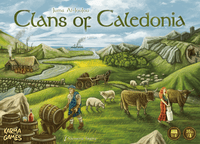
Clans of Caledonia
A 19th-century Scottish economic strategy game in which clan leaders produce milk, wool, and grain, process them into whisky and other goods, and export them to the fluctuating global market. Players build production chains and fulfil export contracts to grow their wealth in this worker-placement game.
Rules
Lead a 19th-century Scottish clan producing wool, milk, and grain, processing them into cheese, bread, and whisky, then trading on the fluctuating market or fulfilling export contracts over five rounds. Each turn offers exactly one action, but that single choice ripples through your whole production chain.
Components
| Type | Count | Notes |
|---|---|---|
| Wooden goods tokens | 10 Milk · 14 Wool · 10 Cheese · 10 Grain · 10 Bread · 10 Whisky, plus 1 each Cotton/Tobacco/Sugar cane (import-track markers) | 6 types are traded on the market as Basic/Processed goods |
| Cows, Sheep, Fields, Cheese dairies, Bakeries, Distilleries, Workers | 16/16/16/16/16/16/32 per color (4 colors) | Placed in order from each resource column on the Player board |
| Map modules | 4 double-sided boards | Combine to form 16 possible map layouts |
| Market board / Export board | 1 double-sided board each | Use the side matching your player count |
| Export contract tiles | 50 | Refill the empty slots on the Export board each round |
| Clan tiles | 9 | Reveal player count + 1 at random and draft from those |
| Port bonus tiles / Scoring tiles | 9 each | 4 port bonuses and 1 scoring deck are used randomly each game |
| Money (coins) | 70 (30×£1, 20×£5, 20×£10) | Treated as unlimited — use substitutes if you run out |
Cotton, Tobacco, and Sugar cane are not market goods
Only Wool, Milk, Cheese, Grain, Bread, and Whisky are traded on the market board. Cotton, Tobacco, Sugar cane (and Hops) are separate "Imported Goods" obtained only as Export contract rewards, scored off a dedicated import-rarity track.
Setup
- 1Assemble the 4 map modules into the map, and place the Market board and Export board on the side matching your player count.
- 2Shuffle the Port bonus tiles and place 4 at random in the factory areas at the map's corners. Shuffle the Scoring tile deck as well.
- 3Shuffle the clan tiles and reveal one more than the player count; starting with the last player in turn order, draft a clan and its adjacent starting tile in reverse order.
- 4Fill your Player board with your color's units, place 2 Merchants on the merchant track, and your Shipping token at the leftmost space.
- 5Starting with the first player and going clockwise, place your first Worker (a Woodcutter in a forest, or a Miner in a mountain); then, in reverse order, place a second Worker.
- 6Draw tiles from the export contract deck to fill the Export board's empty contract slots (leave one slot empty for 1- or 3-player games).
| Clan (selected) | Core ability in one line |
|---|---|
| Clan Buchanan | Starts with 2 Export boxes; can fulfil 2 contracts in the same action, paying the cost only once |
| Clan Campbell | Gets a £3 discount on the first building of each processed-goods type (Cheese dairy, Bakery, Distillery) |
| Clan Cunningham | May instantly cash in leftover Milk after production for £8 each |
| Clan MacDonald | Every worker doubles as Woodcutter, Miner, or Fisherman (lake/port only, no Technology upgrade) |
| Clan Stewart | Starts with 5 Merchants and a river-crossing shipping range; gains £1 per good type traded |
The remaining four clans (Fugusson, MacEwen, MacKenzie, Robertson) are detailed in the rulebook's appendix. Since each clan plays quite differently, simpler clans (Cunningham or MacDonald above) are recommended for a first game.
Game structure — 4 phases
- 1① Preparation — flip the previous round's Scoring tile, refill empty Export board slots, and retrieve your own Merchants (skipped in round 1).
- 2② Action — in turn order, each player takes one Action. This repeats until everyone has passed.
- 3③ Production — every unit on the map produces Income and Goods at once.
- 4④ Scoring — players gain Glory according to the current round's Scoring tile.
One Action per turn, all Production at once
In the Action phase you take exactly one of the 8 Actions per turn — you cannot stack trading and expanding into the same turn. The Production phase, by contrast, happens for every unit on the map simultaneously, regardless of turn order.
The 8 actions
| Action | In one line |
|---|---|
| 1. Trade | Place Merchants on the Market board's buy/sell spaces to buy or sell one Good |
| 2. Obtain an Export Contract | Pay the round's cost and take one contract tile from the Export board into your Export box |
| 3. Expand | Deploy a unit from your Player board onto an empty map space (adjacent or within shipping reach) |
| 4. Upgrade Shipping | Pay £4 to move your Shipping token one space, extending your reach over rivers/lakes |
| 5. Upgrade Technology | Pay £10 to raise Woodcutter/Miner income by £2 each |
| 6. Hire a Merchant | Pay £4 to add a new Merchant you can use for Trade actions |
| 7. Fulfil an Export Contract | Pay the goods a contract requires and receive its reward |
| 8. Pass | Stop taking actions this round — passing order sets next round's turn order |
You may choose the same Action again on a later turn — there's no "used once, can't reuse" restriction. A player who passes takes no more actions this round, but the first to pass gets first position next round, plus the money shown on that space.
Trading — buying raises the price, selling lowers it
Merchants not stacked on your Player board (i.e., currently unused) can be placed on the Market board's buy or sell space for one Good, in whatever quantity you like. You pay or receive the current price times the number of Merchants placed, and the price track then moves by that same amount.
One Good per Trade, never both sides at once
A single Trade action lets you buy or sell only one type of Good. Trading another type requires another Trade action. You also cannot have your own Merchants on both the buy and sell space of the same Good at the same time.
Production — Basic and Processed goods
During Production, every deployed unit produces automatically. Sheep produce 1 Wool, Cows produce 1 Milk, and Fields produce 2 Grain. Processing is optional: a Cheese dairy converts 1 Milk into 1 Cheese, a Bakery converts 1 Grain into 1 Bread, and a Distillery converts 1 Grain into 1 Whisky.
Workers also pay income every round
Each deployed Woodcutter pays £4, and each Miner pays £6, automatically every Production phase. With the Technology upgrade, these rise to £6 and £8.
Expanding — neighbor bonuses and building bonuses
The Expand action deploys the top unit from the matching column of your Player board onto an empty map space (adjacent to your own units, or within shipping reach). You pay both the unit's cost and that space's land cost. Pasture spaces take Sheep, Cows, Cheese dairies, Bakeries, Fields, or Distilleries; forest spaces take only Woodcutters; mountain spaces take only Miners.
Neighbor bonus — build beside a rival and buy on the spot
Expanding adjacent to an opponent's unit immediately lets you buy that unit's Good from supply at a discount (£2 off Basic goods, £3 off Processed goods) without a Trade action — up to 3 units per Good type (4 in a 2-player game), spending Merchants as normal.
Building bonus — the 4th processed-goods building
Expand your 4th building of one processed-goods type (Cheese dairy, Bakery, or Distillery) while your Export box is empty, and you immediately take 1 of 3 random export contracts for free (or decline all of them).
Export contracts and Imported Goods
- 1To obtain a contract (Action 2), pay the current round's cost and take one from the Export board into your Export box. In round 1, you actually receive £5 instead of paying.
- 2Your Export box (one by default) holds only one contract at a time (exceptions like Clan Buchanan aside). To get a new one, you must first fulfil the one you're holding.
- 3To fulfil a contract (Action 7), pay the Basic/Processed goods it requires and receive its listed reward: money, a free Expand, a bonus upgrade, or Imported Goods (Hops, Cotton, Tobacco, Sugar cane).
- 4Contracts requiring beef or mutton are satisfied by Slaughter — remove one of your Cows or Sheep from the map and count it as that much meat. Slaughter is not a separate action but part of fulfilling the contract; the freed space can then be expanded into by anyone.
| Imported Good | Final score |
|---|---|
| Hops | 1 point each, fixed |
| Cotton, Tobacco, Sugar cane | On the shared import-rarity track: the least-imported type scores 5, the middle 4, the most-imported 3. Ties rank Cotton as rarest, then Tobacco, then Sugar cane |
Using the simplified variant for a first game
The rulebook's simplified variant lets you score Cotton, Tobacco, and Sugar cane at a flat 4 points each, regardless of quantity imported. Feel free to use it for a first game if tracking rarity feels like a distraction.
Settlements and final scoring
A Settlement is one group of same-colored units that neighbor each other (sharing an edge, with no river between). A single isolated unit still counts as its own settlement. Only settlements within your shipping reach may be counted.
| Category | 3–4 players | 2 players |
|---|---|---|
| Most fulfilled export contracts | 12 VP, 2nd place 6 VP | 8 VP (most only) |
| Most settlements | 18 VP, 2nd 12 VP, 3rd 6 VP | 12 VP (most only) |
| Category | Score |
|---|---|
| Glory track | 1 VP per step |
| Basic goods (held) | 1 VP each |
| Processed goods (held) | 2 VP each |
| Money | 1 VP per £10 (breaks ties only) |
On a tie, combine the available points for that rank and split them evenly (rounded down) among the tied players — this applies to both the export-contract and settlement rank bonuses.
Ending the game
The game ends after 5 rounds. Once the final round's phase ④ Scoring is complete, total up Glory, held goods, money, export contracts, and settlements — the clan with the highest score wins.
Strategy tips
- Buying pushes a price up, which favors your next sale — and vice versa. If a rival has been buying up a Good, consider selling alongside them while it's expensive.
- Neighbor bonuses buy at a fixed discount independent of the market price, letting you fill your production chain quickly without spending a Trade action. Always check what's adjacent before you expand.
- Since your Export box holds only one contract at a time, favor contracts you can actually fulfil soon rather than sitting on a large one — it keeps your action economy flowing.
- Because settlement score counts the number of groups, using Slaughter to split one large settlement into two can actually raise your settlement count late in the game.
Player-count variants and expansion
| Variant | Key difference |
|---|---|
| 2-player game | Uses smaller map module sides, all lake areas are in play, and the neighbor-bonus limit rises to 4 |
| Solo game | Block £1 land spaces with an unused color's Worker, earn £16 per Pass, and roll Market dice each round to randomly adjust 3 Goods' prices |
| Playing without clans | Drop clan abilities and instead stagger starting money at £0/£2/£4/£6 — for a more even match |
| Clan auction (advanced) | Draft clans through an open auction instead; the winning bid is deducted from final score |
| Clans of Caledonia: Industria expansion | Adds 9 new clans, 9 scoring tiles, 9 port tiles, 9 starting tiles, 4 double-sided map modules (256 combinations), a train-delivery module, and more — a large expansion per the publisher's own description |
The Korean edition is officially co-localized by BoardM Factory alongside Karma Games, credited on the rulebook's cover and imprint page. This guide does not cover retail stock or pricing, and whether the Industria expansion has a Korean release was not confirmed.
Frequently confused rules
Q. Can I trade and expand in the same turn?
No. Each turn in the Action phase lets you take exactly one of the 8 Actions. Choosing the same Action again on a later turn is allowed.
Q. Can I buy and sell the same Good in the same round?
A single Trade action is either a buy or a sell. However, you can never have your own Merchants on both the buy and sell space of the same Good at the same time.
Q. Can I buy Cotton, Tobacco, or Sugar cane on the market?
No. These three (and Hops) are Imported Goods not traded on the market — you receive them only as Export contract rewards.
Q. Can I use the neighbor bonus any number of times?
One Expand can trigger the bonus for each adjacent space, but purchases are capped at 3 units per Good type (4 in a 2-player game).
Q. Is more units always better for settlements?
No. Settlements are scored by number of groups, not unit count. Spreading units into several separate groups can score higher than clustering them into one.
Q. Can I discard an Export contract I can't fulfil?
You cannot discard one at will. To take a new contract you must first fulfil the one you're holding (exceptions for clans with multiple Export boxes).
History and editions
Designed by Juma Al-JouJou with illustrations by Klemens Franz, Clans of Caledonia was published by Karma Games in 2017. Namuwiki's stub article confirms the same designer, publisher, 2017 release, 1–4 players (4 recommended), 30–120 minutes, and ages 12+ as the rulebook. BoardGameGeek classifies its average weight in the mid-3 range, a heavy economic game (confirmed via the publisher's own site, which links directly to BGG 216132).
A large expansion, "Clans of Caledonia: Industria," has its own page on the Karma Games website, adding 9 each of new clans, scoring tiles, port tiles, and starting tiles, plus double-sided map modules, substantially expanding the base game's variety. As of 2026-10-11, no dedicated English Wikipedia article for this game could be confirmed.
Sources
Karma Games — official Clans of Caledonia English rulebook (2026-04-22 revision PDF)Karma Games / BoardM Factory — official Clans of Caledonia Korean rulebook (2026-04-22 revision PDF)Karma Games official site — Clans of Caledonia rules & language download pageBoardGameGeek 216132 — Clans of Caledonia (linked directly from the publisher's own site)Wiki cross-check — English Wikipedia search: no dedicated article confirmed (2026-10-11)Wiki cross-check — Namuwiki: Clans of Caledonia (Korean)Rule summaries are reference content written by us, not quotations from the official rulebook. Always check the official rulebook for exact rules. Diagrams are original schematics, not rulebook illustrations.
Spotted a mistake? Tell us in the comments below →
Last updated 2026-10-11
💡 Master tip
Claiming export contracts early and building the whisky and cheese production lines they require ahead of time is the standard path to victory. Watch the market's fluctuating prices and look for moments to sell goods that others aren't selling.
Ready for something heavier
If this one has gotten too easy, try these — same feel, one step up in weight.
Tools you can request
Not built yet. Let us know if you want one — it goes on the list.
Live market price tracker
Instantly settles the fluctuating price whenever goods are bought or sold
Export contract score simulator
Checks whether a contract's required goods can be fulfilled
Comments
Share your thoughts, report a mistake, or request a tool. No sign-in needed — nicknames are not verified, so anyone can use the same one.
Loading…