Top 18 · #3 of 52 in Family
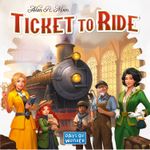
Ticket to Ride
A worldwide best seller set on a map of the United States, where you link city to city with train routes and build your own rail network. Collect matching train cards from your hand to claim a route and you score right away, and if you actually connect the two cities on a destination ticket you drew in secret, you score extra points. The rules are simple, so the whole family can learn it quickly.
Rules
Collect train cards to claim the routes between cities, and score your destination tickets by connecting their two cities with an unbroken path. A ticket you fail to complete costs you its points instead, so drawing more tickets is a gamble every time.
Components
| Component | Count | Notes |
|---|---|---|
| North America map board | 1 | The score track runs around the edge |
| Train cars | 45 per color | 5 colors — blue, red, green, yellow, and black |
| Train cards | 110 | 8 types × 12 cards + 14 locomotives |
| Destination tickets | 30 | Each shows two cities and a point value |
| Longest Continuous Path bonus card | 1 | 10 points |
| Score markers | 5 | Includes 1 summary card |
Locomotives are wild cards
A locomotive shows several colors mixed together and can stand in for any color when you claim a route. In exchange, there are limits on how you draw them (see «Drawing cards» below).
Setup
- 1Put the map board in the middle. Each player takes the 45 train cars of one color and a score marker, and puts the marker on the start space.
- 2Shuffle the train cards and deal 4 to each player.
- 3Put the rest of the train cards next to the board as a draw pile and turn the top 5 cards face up.
- 4Put the Longest Continuous Path bonus card face up next to the board.
- 5Shuffle the destination tickets and deal 3 to each player. Everyone looks at theirs and must keep at least 2; you may keep all 3 if you want. Discarded tickets go to the bottom of the ticket pile.
- 6Destination tickets stay secret until the end of the game.
The most traveled player goes first, and play continues clockwise.
Your turn — exactly one of three actions
- 1Draw train cards — take 2 cards.
- 2Claim a route — play a set of cards matching the route's color and length, then put your train cars on it. Score the points right away.
- 3Draw destination tickets — draw 3 and keep at least 1.
Drawing cards — locomotives are the one exception
Take a card from the 5 face-up cards, or take the top card of the draw pile blind. If you take a face-up card, replace it immediately and then draw your second card. But if you take a face-up locomotive, that is the only card you take that turn. And if the card that replaces your first pick is a locomotive, you may not take it.
A locomotive drawn blind from the draw pile counts as a normal card. You still get both cards that turn, which is a lucky break. If 3 of the 5 face-up cards are locomotives, discard all 5 and turn up 5 new cards.
There is no hand limit. When the draw pile runs out, shuffle the discards well to make a new pile. Cards are discarded in sets, so they need a thorough shuffle.
Claiming a route
- Play as many cards as the route has spaces. The cards must all be of the same type.
- A colored route can only be claimed with cards of that color. A gray route can be claimed with any single color.
- Discard the cards you played and put one of your train cars on each space of the route.
- You may claim any open route on the board. It does not have to connect to routes you already own.
- You may claim only one route per turn — that is, you connect only one pair of adjacent cities.
Double routes and the player count
Some cities are linked by two parallel routes. One player may not claim both routes between the same two cities. And in a 2 or 3 player game only one of the two routes is used — once somebody claims one side, the other side stays closed.
| Route length | Points |
|---|---|
| 1 space | 1 point |
| 2 spaces | 2 points |
| 3 spaces | 4 points |
| 4 spaces | 7 points |
| 5 spaces | 10 points |
| 6 spaces | 15 points |
Long routes pay far more per space. Six 1-space routes are worth 6 points, while one 6-space route is worth 15. Long routes take time, though, because you need six cards of the same color.
Destination tickets — the gamble of the game
- A ticket shows two cities and a point value. At the end of the game you add those points if the two cities are connected by an unbroken path of your own train cars.
- If you failed to connect them, you subtract the same points instead. That is what makes tickets scary.
- If you spend a turn drawing 3 tickets, you must keep at least 1. The rest go to the bottom of the pile.
- If fewer than 3 tickets are left in the pile, draw only as many as remain.
- You may hold any number of tickets, and they stay secret until final scoring.
End of the game and final scoring
Two or fewer train cars left triggers the last round
When a player has 0, 1, or 2 train cars left at the end of their turn, everyone — including that player — takes one more turn. Then the game ends.
- 1Route points are already on the score track. You may recount them to check.
- 2Reveal all destination tickets, adding the completed ones and subtracting the failed ones.
- 3The player with the Longest Continuous Path takes the bonus card and adds 10 points.
- The longest path is measured as the unbroken length of train cars of one color.
- It may loop around or pass through the same city more than once, but you may not count the same train car twice.
- If several players tie for the longest path, each of them scores 10 points.
- The highest total wins. On a tie, the player with more completed tickets wins; if still tied, the player holding the Longest Continuous Path card wins.
Commonly confused rules
Q. Can I claim a route over two turns?
No. You must fill the whole route in one turn. Putting 2 cars on a 3-space route and waiting is not allowed.
Q. If I take a face-up locomotive, do I only draw one card?
Yes. That ends your draw for the turn. A locomotive drawn blind from the pile counts as a normal card, though, so you still draw both cards.
Q. Can I only claim routes connected to my own network?
No. You may claim any open route on the board. Blocking another player's path is a legitimate move.
Q. Can I discard a ticket?
Only the ones you choose not to keep on the turn you drew them. Once you keep a ticket you hold it to the end, and it costs you points if you fail.
Q. Can two tickets use the same route?
Yes. One network can complete several tickets at once. Picking tickets that overlap is a basic strategy.
Q. Can I mix colors on a gray route?
No. You may choose any color, but every card you play must be the same color. Only locomotives can stand in for some of them.
Q. Can I claim both sides of a double route?
No. And in a 2 or 3 player game, once one side is claimed the other side is closed to everybody.
Q. Can another player's train cars count toward my longest path?
No. You only count the unbroken length of train cars of your own color.
History and editions
| Item | Detail |
|---|---|
| Designer | Alan R. Moon |
| Illustration | Julien Delval |
| Publisher | Days of Wonder, 2004 |
| Award | Spiel des Jahres 2004 |
| Backstory | October 2, 1900 — a one million dollar wager to connect the most cities in North America within seven days |
| Major edition | Released | Notes |
|---|---|---|
| Ticket to Ride: Europe | 2005 | A standalone game that adds ferries, tunnels, and stations |
| Ticket to Ride: Märklin / Nordic Countries / India, and others | 2006– | Standalone editions and expansions, each with its own map |
| Map Collection (Asia, India, France, Japan & Italy, and others) | 2011– | Map expansions that need base game components |
| Ticket to Ride: New York / London / Amsterdam | 2018– | Small 15-minute editions |
Sources
Official Days of Wonder rulebook (Ticket to Ride, English)Wiki cross-check — Wikipedia: Ticket to RideWiki cross-check — Namuwiki: Ticket to RideRule summaries are reference content written by us, not quotations from the official rulebook. Always check the official rulebook for exact rules. Diagrams are original schematics, not rulebook illustrations.
Spotted a mistake? Tell us in the comments below →
Last updated 2026-09-14
💡 Master tip
Claim the key routes where your destination tickets overlap first, and you can finish several tickets at once without wasting cards. A bottleneck route forces a long detour if an opponent takes it first, so if it overlaps with your destinations, grab it early even when you are short on cards.
Ready for something heavier
If this one has gotten too easy, try these — same feel, one step up in weight.
Tools you can request
Not built yet. Let us know if you want one — it goes on the list.
Destination ticket hit/miss scorer
Check connected route length and whether each ticket is completed
Comments
Share your thoughts, report a mistake, or request a tool. No sign-in needed — nicknames are not verified, so anyone can use the same one.
Loading…