Top 89
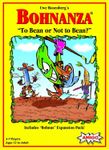
Bohnanza
A negotiation card game about planting and harvesting beans for money. Its radical rule that you can never reorder your hand means you must constantly haggle to get rid of beans you don't want — and that noisy, nonstop trading is the whole appeal of the game.
Rules
Never reorder your hand. Plant from the front of your hand into your fields, trade away beans you don't want, and harvest for bean dollars according to the exchange chart. The haggling itself is the whole game.
Components
| Bean type | Count |
|---|---|
| Garden Bean | 6 |
| Red Bean | 8 |
| Black-eyed Bean | 10 |
| Soy Bean | 12 |
| Green Bean | 14 |
| Stink Bean | 16 |
| Chili Bean | 18 |
| Blue Bean | 20 |
104 bean cards across 8 types, one bean field mat per player, and 2 starting player cards (one is a spare). For 3–5 players, ages 10 and up, about 45 minutes. Whoever has the most gold dollars when the game ends wins.
Setup
- 1With 3 players, use the side showing three bean fields; with 4–5 players, use the side showing two fields.
- 2Pick a starting player and give them the starting player card. It stays with them for the whole game.
- 3Shuffle all 104 cards and deal five to each player. Place the rest as a face-down draw pile.
Never reorder your hand
Cards stay exactly in the order you received them. Only the front card (visible to you) can be planted or traded right now — you may never sort your hand by bean type or for any other reason. This is the single most important rule in the game.
Your turn — four phases
- 1① Plant from your hand: you must plant the front card of your hand. You may optionally plant one more (the card now at the front) — at most two cards from your hand per turn.
- 2② Turn over and trade: reveal two cards from the draw pile. These belong to you — plant them or trade them to other players. Only the active player may trade, for as long as everyone wants to continue.
- 3③ Plant traded and turned-over cards: plant any cards you received in trade, plus any turned-over cards not traded away, in any order you like.
- 4④ Draw three cards: draw three cards one at a time from the draw pile and add them to the back of your hand in the order drawn. Play passes to the left.
Planting — one kind of bean per field
Each field can only hold one kind of bean at a time. You may plant the same bean in two different fields, but never two kinds in the same field. If you must plant a bean that doesn't match what's already in a field, you must harvest that field first to make room.
Trading rules
- Only the active player may trade with the other players. Non-active players cannot trade with each other.
- You may trade using cards anywhere in your hand; the active player can also use their two turned-over cards.
- Cards received in a trade cannot be traded again, and cards already planted in a field cannot be traded either.
- Any number of beans may be traded for any number of others (e.g. two for one). Only remove cards from your hand once both sides have agreed.
- Beans received in trade are placed beside your fields horizontally — not into your hand — until you plant them in phase 3.
- You may also simply give beans away, but the recipient must agree to accept them; if they refuse, you cannot give the cards.
Harvesting — any time
You may harvest a field at any time, even when it isn't your turn. Check the exchange chart (see Scoring below) for the number of cards in that field, turn that many cards to their dollar side onto your dollar pile, and put the rest face up on the discard pile. You must harvest the whole field — you cannot harvest only part of it.
The Bean Protection Rule
If one of your fields has only 1 bean card, you cannot harvest it as long as another field has more than one bean card. Clear your other fields first.
When the draw pile runs out, reshuffle the discard pile to form a new draw pile.
Bean exchange chart
Each bean has its own exchange rate — how many cards you need to earn 1 through 4 dollars. Rarer beans (fewer in the deck) pay off sooner but top out lower; common beans need more cards but pay a higher top amount.
| Bean type | $1 | $2 | $3 | $4 |
|---|---|---|---|---|
| Garden Bean (6) | 2 | 3 | — | — |
| Red Bean (8) | 2 | 3 | 4 | 5 |
| Black-eyed Bean (10) | 2 | 4 | 5 | 6 |
| Soy Bean (12) | 2 | 4 | 6 | 7 |
| Green Bean (14) | 3 | 5 | 6 | 7 |
| Stink Bean (16) | 3 | 5 | 7 | 8 |
| Chili Bean (18) | 3 | 6 | 8 | 9 |
| Blue Bean (20) | 4 | 6 | 8 | 10 |
Hand cards don't count
When the game ends, beans still in hand do not score. Only cards in your dollar pile, from fields you harvested, count toward your final total.
End and winning
The game ends the moment the draw pile runs out for the third time. If this happens during phase ② (turning over and trading), finish phases ② and ③ of that turn — even with only one card turned over instead of two — before the game ends.
- 1Everyone harvests all remaining fields and collects the appropriate bean dollars.
- 2Count the cards in each player's dollar pile (hand cards do not count).
- 3The player with the most dollars wins. In a tie, the tied player seated farthest from the starting player, going clockwise, wins.
Strategy tips
- Don't be afraid to lose value in a trade — giving away a bean you don't want for free still protects your fields.
- Remember what was at the front of each opponent's hand; it helps you judge whether to seek or avoid trading for it again.
- Since a field can only hold one kind of bean, harvest a field early if you expect to receive a very different bean soon.
- Rare high-paying beans (Blue Bean, Chili Bean) need more cards to pay off, so it's often better to hold out for a bigger harvest than to cash in too early.
Player count and expansions
The number of fields changes with player count — 3 players use 3 fields each, 4–5 players use 2 fields each. The deck itself is always all 104 cards, regardless of player count.
AMIGO has released over 20 themed expansions (a pirate island, a Western theme, a Mongol invasion, and more), most of which have not been localized into Korean. This guide covers the base game only; expansion rules were not checked.
Frequently asked questions
Q. Can I sort my hand by bean type?
No. You may never change the order you received your cards in. Only the front card can be planted or traded right now.
Q. Can two non-active players trade with each other?
No. Trading only happens between the active player and others. Non-active players cannot trade among themselves.
Q. Can I trade away a bean I just received in a trade?
No. Cards received in a trade cannot be traded again, and the same goes for cards already planted in a field.
Q. Can I plant two kinds of beans in one field?
No. Each field holds only one kind of bean. You must harvest a field before planting a different kind in it.
Q. Do beans left in my hand count at the end of the game?
No. Hand cards never score. Only cards in your dollar pile, from harvested fields, count.
Q. Can I always harvest a field with just one bean in it?
No. If another field has more than one bean card, the one-card field cannot be harvested (the Bean Protection Rule).
History and editions
Designed by Uwe Rosenberg, first published by AMIGO in 1997. Numerous themed expansions followed over the years, including La Isla Bohnita and High Bohn, building a lineup of more than 20 expansions today.
Korea Boardgames officially published a Korean edition in 2007. Most expansions have not been localized into Korean.
Sources
Official AMIGO English rulebook — full 2 pagesCross-checked against Wikipedia: Bohnanza (designer, release year, expansion timeline)Cross-checked against Namuwiki: Bohnanza (Korean release year, distributor, Korean bean names)Korea Boardgames — Bohnanza product page (confirms a licensed Korean edition)Rule summaries are reference content written by us, not quotations from the official rulebook. Always check the official rulebook for exact rules. Diagrams are original schematics, not rulebook illustrations.
Spotted a mistake? Tell us in the comments below →
Last updated 2026-10-10
💡 Master tip
Don't be afraid to come out behind in a trade — giving away a bean you don't want for free still protects your fields. Whoever remembers what's at the front of each opponent's hand holds the upper hand at the negotiating table.
Similar games
Ready for something heavier
If this one has gotten too easy, try these — same feel, one step up in weight.
Comments
Share your thoughts, report a mistake, or request a tool. No sign-in needed — nicknames are not verified, so anyone can use the same one.
Loading…