Top 60
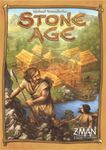
Stone Age
As a Stone Age chieftain, send your people out to the hunting grounds, forest, and quarry to gather resources, then spend them on Civilization cards and Building tiles in this worker-placement game. A moderate helping of luck from rolling dice for resources makes it the most commonly recommended entry point into the worker-placement genre.
Rules
Send your people out to the hunting grounds, forest, quarry, and river to roll dice for resources, then spend them on Civilization cards and buildings in this worker-placement game. Every round follows a fixed order — placement, then actions, then feeding your tribe — which is why it's so often recommended as a first worker-placement game.
Components
| Component | Count | Notes |
|---|---|---|
| Game board | 1 | Resource supply and placement locations |
| Player boards | 4 | Hold Tool and Building tiles and provide summaries |
| Wooden resources | 68 | 28 wood · 18 clay · 12 stone · 10 gold |
| Wooden figures | 40 | 4 colors × 10 each (5 starting + 5 in reserve) |
| Markers | 8 (two sizes) | 1 small agriculture-track marker and 1 large scoring-track marker per player |
| Food tokens | 53 | Sorted by value and stacked on the hunting grounds |
| Building tiles | 28 | Stacked in piles of 7, one pile per player |
| Tool tiles | 18 | Four value tiers: 1, 2, 3, and 4 |
| First player token | 1 | |
| Civilization cards | 36 | Green (set scoring) and sand-colored (multiplier scoring) |
| Dice | 7 | Used to gather food and resources |
| Leather dice cup | 1 |
Setup
- 1Place the board in the middle of the table.
- 2Sort the Food tokens by value and stack them on the hunting grounds.
- 3Place the 28 wood on the forest, 18 clay on the clay mound, 12 stone on the quarry, and 10 gold on the river.
- 4Sort the Tool tiles by value (1/2 and 3/4) onto the matching village spaces.
- 5Shuffle the Building tiles into piles of 7 and place as many piles as there are players (2 for two players, 3 for three, 4 for four). Reveal the top tile of each pile. Return any leftover piles to the box unseen.
- 6Shuffle the Civilization cards face down and reveal 4 from the rightmost space, regardless of player count, onto the 4 indicated spaces.
- 7Each player takes a player board, 5 figures of their color, and Food tokens totaling 12 (for example, a 10 and a 2).
- 8Each player places their small marker on space 0 of the agriculture track and their large marker on space 0 of the scoring track.
- 9The remaining 5 figures per color form a shared general supply beside the board. Place the 7 dice and the dice cup nearby as well.
- 10The youngest player takes the First player token and begins.
Round structure — 3 phases
Every round must follow this fixed order: Place figures → Resolve actions → Feed your tribe. The order can't be rearranged or skipped.
- 1Phase 1 (placement): Starting with the first player and going clockwise, each player places 1 or more figures on a single location of their choice. A player with unplaced figures may not pass.
- 2A player may never add more figures to a location where they already have figures this round. Continue until everyone has placed all their figures.
- 3Phase 2 (actions): Starting again with the first player and going clockwise, each player resolves every action tied to their own placed figures, in any order they choose. A figure returns to its player board as soon as its action resolves.
- 4Phase 3 (feeding): Once every player has resolved their actions, each player pays food equal to their total number of figures (see the feeding section for shortfalls).
- 5At the end of the round, pass the First player token to the next player clockwise and begin a new round.
Capacity differs by location
The tool maker and field each hold 1 figure, the hut requires 2 figures from the same player at once, the hunting grounds are unlimited, and the forest, clay mound, quarry, and river each hold up to 7 figures. Civilization cards and Building tiles hold 1 figure per space.
Gathering resources — dividing the dice
For each figure placed at the hunting grounds, forest, clay mound, quarry, or river, roll 1 die. Divide the sum of the dice by the location's fixed number (round down, discard the remainder) to find how many resources you gain.
| Location | Divide by | Resource gained |
|---|---|---|
| Hunting grounds | 2 | Food |
| Forest | 3 | Wood |
| Clay mound | 4 | Clay |
| Quarry | 5 | Stone |
| River | 6 | Gold |
Tools can boost the result
You may add as many of your own Tool tiles as you like (zero or more) to the sum before dividing. Each tool can be used only once per round, and you choose freely which gathering action to use it on first.
The tool maker — upgrading tools
Visiting the tool maker grants a new Tool tile or upgrades an existing one. A player may hold at most 3 Tool tiles; starting with the 4th visit, instead of adding a new tile, one existing tile is flipped up to the next value.
Used once, used whole
A Tool tile may be used only once per round and must be used for its full value (you cannot spend only part of a value-2 tile). A used tile is turned 90° to show it cannot be used again this round.
Acquiring Civilization cards and Buildings
A Civilization card is claimed by paying the resources shown above it (you choose which resource types — usually wood or clay; food is not a resource and cannot be used). Cards are kept face down on your player board. If you can't or don't pay, take back your figure and leave the card in place.
At the end of a round, remaining Civilization cards slide toward the vacated spaces, and new cards from the deck fill whatever spaces are left empty.
| Building category | Count | Cost | Points |
|---|---|---|---|
| Standard buildings | 17 | Fixed type and amount of resources | Fixed points printed on the tile |
| 2-type, 4-resource buildings | 8 | 4 resources split across exactly 2 types, your choice | Sum of the value of the resources paid |
| Free-choice buildings | 3 | 1 to 7 resources, any type and count | Sum of the value of the resources paid |
| Resource | Value (used for building points) |
|---|---|
| Wood | 3 per unit |
| Clay | 4 per unit |
| Stone | 5 per unit |
| Gold | 6 per unit |
Resource value equals its dice divisor
Example: 3 stone (5×3=15) plus 1 wood (3) scores 18 points. A resource's building value is the same number used to divide the dice sum for it — scarcer resources are worth more.
Taking a Building tile immediately moves your scoring marker forward by its points (computed as above for the variable-cost categories), and the next tile in that pile is flipped face up.
The hut and the field
- 1Hut: the player who placed 2 figures there takes 1 extra figure from the general supply and adds it permanently to their player board, usable every round from then on.
- 2Field: the figure returns to your player board and your agriculture marker advances 1 space. This track's current position is the food you gain each round during feeding.
Feeding your tribe
- 1First, take food equal to your agriculture track's current position from the supply.
- 2Then pay 1 food per figure for your total number of figures (leftover food carries over to future rounds).
- 3If you don't have enough food, pay all the food you have, then you may cover the rest with resources (1 resource = 1 food), your choice.
- 4If resources still don't cover it, or you choose not to use them, you immediately lose 10 points regardless of how much was missing (your score may go negative). Either way, you must use all the food and resources you're willing to spend.
A flat 10 points, not proportional
Being short 1 food or 5 food costs the same flat 10 points. Keeping your food supply stable matters more than the exact shortfall.
Final scoring
Green Civilization cards score by squaring the number of different types you hold. You don't need one single set — duplicate types left over form their own smaller set, scored the same way.
| Sand-colored card type | Multiplied by |
|---|---|
| Farmer | Your current position on the agriculture track |
| Tool Maker (card) | The total value of all your Tool tiles (not the count) |
| Builder | Your number of Building tiles |
| Shaman | Your total number of figures |
The tool maker location and the Tool Maker card are different things
The sand-colored "Tool Maker" card multiplies by the total value of your Tool tiles, not the number of tiles. Don't confuse it with the board location of the same name.
- 1Add the green card set scores and the sand card multiplier scores.
- 2Add 1 point for every leftover resource that isn't food.
- 3Since every point is recorded on the track as it's scored, only the green/sand card scores and the resource points need to be added at the end.
- 4Whoever has the highest score wins. In case of a tie, compare the sum of agriculture track position, total tool value, and total figures — the higher sum wins.
End of the game
- 1If there aren't enough Civilization cards left to fill all 4 spaces at the start of a round, the game ends immediately without starting that round.
- 2If any Building tile pile runs out, the current round is played to completion, including feeding, and then the game ends.
- 3Once either condition is met, move on to final scoring.
Strategy tips
- Since you pay food equal to your total figure count every round, raise the agriculture track with the field, or balance hunting-grounds visits, to stabilize food self-sufficiency within 3–4 rounds.
- Each tool can only be used once per round, so decide in advance whether food or a resource gets priority for that boost.
- Resource values run gold(6) > stone(5) > clay(4) > wood(3), so mixing pricier resources into 2-type and free-choice buildings scores more.
- Green cards reward avoiding duplicates, since squaring rewards distinct types — prioritize a new type over a repeat whenever you can.
- Gaining figures through the hut means more actions per round from then on, but also a bigger food bill every round after — weigh both sides.
2–3 player variant
With 2 or 3 players, only 2 of the 3 locations — tool maker, hut, and field — may be used each round. The remaining one stays vacant, and which one is vacant can change round to round.
| Player count | Forest, clay mound, quarry, and river |
|---|---|
| 3 players | Figures from only 2 different players may occupy each location at once |
| 2 players | Figures from only 1 player may occupy each location that round — effectively exclusive |
Expansions are outside this guide
Stone Age: The Expansion and the 10th Anniversary edition add further rules that differ from the base 2–4 player game covered here.
Frequently confused rules
Q. Can I split my figures across the same location in separate placements this round?
No. Once you have a figure at a location, you cannot add more there during the same round. A location that requires several figures at once, like the hut, needs them placed together from the start.
Q. What happens if the dice sum is smaller than the divisor?
You get zero resources. The remainder is discarded and never carries over to another round.
Q. Can I use only part of a tool's value?
No. A tool must be used for its entire value at once, and once used it cannot be used again that round.
Q. Does being short just 1 food cost less than being short 5?
No. The penalty is a flat 10 points regardless of how much food was missing.
Q. Must Civilization cards be paid with wood or clay specifically?
No. You may pay with any resource type you choose, in the amount shown. Food is not a resource and can never be used for cards or buildings.
Q. Do figures gained from the hut also need feeding?
Yes. A figure permanently gained through the hut needs 1 food during every feeding phase from then on, just like any other figure.
Q. Must green cards all form one single set to score?
No. Besides your largest set of distinct types, leftover duplicates can form smaller sets of their own, each squared and added separately.
History and editions
Stone Age was designed by Bernd Brunnhofer and first published by Hans im Glück in 2008. English Wikipedia also credits the pen name Michael Tummelhofer, though the official rulebook's cover prints the real name, Bernd Brunnhofer. It placed 2nd for the 2008 Deutscher Spiele Preis and was a 2008 Spiel des Jahres nominee (a nomination, not a win). The English edition is distributed by F2Z Entertainment (Z-Man Games).
Korea Boardgames imported and distributed the Korean edition starting in 2009. This guide covers only the base 2–4 player rules; the expansion and the 10th Anniversary edition's changes are out of scope.
Sources
Z-Man Games/Hans im Glück — Stone Age official Rules of PlayBoardGameGeek: Stone Age (34635)Wiki cross-check — English Wikipedia: Stone Age (board game)Wiki cross-check — Namuwiki: Stone Age (board game, Korean)Rule summaries are reference content written by us, not quotations from the official rulebook. Always check the official rulebook for exact rules. Diagrams are original schematics, not rulebook illustrations.
Spotted a mistake? Tell us in the comments below →
Last updated 2026-10-10
💡 Master tip
Your top priority is stabilizing food self-sufficiency (fields plus a minimum number of hunters) within 3 rounds. Later in the game, your green Civilization card sets grow by squaring, so collect non-overlapping types while counting them.
Ready for something heavier
If this one has gotten too easy, try these — same feel, one step up in weight.
Tools you can request
Not built yet. Let us know if you want one — it goes on the list.
Final Score Calculator
Automatically totals the squared Civilization card set scores together with the multiplier cards
Comments
Share your thoughts, report a mistake, or request a tool. No sign-in needed — nicknames are not verified, so anyone can use the same one.
Loading…