Top 74 · #15 of 52 in Family
Rummikub Classic
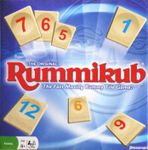
Rearrange tiles numbered 1 to 13 into runs (consecutive numbers in one color) or groups (the same number in different colors) and be the first to empty your rack — an official event at the world board game championship. What decides the game is using the jokers well and judging, in the moment, how to rebuild the sets you see on the table.
Rules
Build sets — runs of consecutive numbers in one color and groups of one number in different colors — and be the first to empty your rack. This guide covers the 30-point initial meld, manipulation of the table, and retrieving jokers, with diagrams.
Components
| Component | Count | Notes |
|---|---|---|
| Number tiles | 104 | 1 to 13 in four colors (red, blue, black, orange), two of each tile |
| Joker tiles | 2 | A joker can stand in for any tile |
| Racks | 4 | Rack holders included |
Playing with 5 or 6 (Rummikub XP)
XP is an expansion you add to the base set — it contains 52 tiles, 2 jokers, and 2 racks, which together make 156 tiles, 4 jokers, and 6 racks. The rules are the same.
Two kinds of sets — groups and runs
There are only two things you can put on the table: a group or a run. Knowing these two shapes exactly is almost all of Rummikub.
- Group — 3 or 4 tiles of the same number in different colors. There are only four colors, so a group holds at most 4 tiles.
- Run — 3 or more consecutive numbers in the same color. There is no limit on length.
- 1 is always the lowest number. You cannot attach a 1 after a 13.
Setup
- 1Turn all tiles face down and shuffle them well.
- 2Each player draws one tile; the highest number goes first. Return the drawn tiles and shuffle again.
- 3Each player takes 14 tiles and stands them on a rack. Stacking them in piles of 7 makes them easy to deal out.
- 4Leave the rest face down in the middle. This is the 'pool', and you draw from it when you cannot play.
Games and rounds
One 'game' ends as soon as a player empties their rack. Playing as many games as there are players makes one 'round' — 4 games with 4 players, 3 with 3, 2 with 2. Decide how many rounds you will play before you start.
What you do on your turn
- 1Build sets from the tiles on your rack and lay them down. Once you have made your initial meld, you may also rearrange the sets already on the table.
- 2If you have nothing to play, or choose not to play, draw 1 tile from the pool. Drawing ends your turn immediately.
You cannot play a tile you just drew
A tile drawn from the pool can be used from your next turn on, because drawing ends the turn.
Play passes to the left (clockwise).
The initial meld — 30 points
The first time you lay tiles down in a game, they must total at least 30 points in one turn. A tile is worth the number printed on it. You may lay down several sets at once to reach 30.
- The 30 points must come from tiles on your own rack. Tiles already on the table do not count.
- You may use a joker. It counts as the number of the tile it stands in for.
- Before you complete your initial meld you may not manipulate the table or retrieve a joker.
- On a turn when you cannot meld, draw 1 tile from the pool and pass.
Manipulation — rearranging the table
Once you have made your initial meld, you may move, split, and combine every tile on the table as if it were your own. This is where Rummikub gets interesting.
There is only one condition
When your turn ends, every set on the table must be valid (groups of 3 or 4, runs of 3 or more) and no tile may be left over. As long as that holds, you are free to do whatever you like in between.
Jokers
- There are only 2 jokers. A joker can be any number and color a set needs.
- You may retrieve a joker from the table by putting in the tile it stands for. That tile may come from your rack or from another set on the table.
- A joker in a group of 3 may be filled with either of the two missing colors.
- A joker you retrieve must be laid down in a new set on the same turn. You may not take it onto your rack.
- On the turn you retrieve a joker you must also play at least 1 tile from your own rack.
- You may not retrieve a joker before you have made your initial meld.
Holding a joker on your rack makes it easier to dump several tiles at the end, but if someone else calls 'Rummikub!' first you take the full 30-point penalty.
The one-minute limit and penalties
- A turn lasts 1 minute. If you go over, draw 1 tile from the pool and your turn ends.
- If you started manipulating the table and cannot finish within the minute, put every tile you touched back where it was and take back the tiles you played. Then draw 3 tiles from the pool as a penalty.
- Any tile whose original place cannot be found is shuffled back into the pool at random.
It is safer to work the whole move out in your head before you touch anything. A 3-tile penalty is big enough to decide the game.
End of the game and scoring
The game ends when a player empties their rack and calls 'Rummikub!'.
The game continues after the pool runs out
Play goes on even when there are no tiles left to draw. From then on, though, you must lay down at least 1 tile on your turn, and the game ends the moment a player cannot play a single tile.
- Each loser adds up the numbers left on their rack and takes that many minus points.
- A joker left on a rack counts as 30 points.
- The winner scores plus points equal to the sum of everyone else's minus points, so the scores of one game always add up to 0.
If nobody empties their rack
When the pool is gone and nobody can play, the player with the lowest total left wins that game. Everyone else takes minus points equal to the difference between their total and the winner's, and the winner scores plus points equal to the sum of those minus points.
After all the agreed games, each player adds up their plus and minus points, and the highest total wins.
Editions differ on who finally wins
The Korean edition rules decide it by total score as above. The English rulebook makes the player who won the most games the winner and only looks at points to break a tie. Agree on one before you start.
Commonly confused rules
Q. Can I use tiles from the table to reach the 30-point initial meld?
No. The 30 points must come only from tiles on your own rack. You may manipulate the table starting from the turn after you meld.
Q. Can I use a joker in my initial meld?
Yes. It counts as the number of the tile it stands in for. For example 11, joker, 13 counts the joker as 12, for 36 points.
Q. Can I play a tile the moment I draw it from the pool?
No. Drawing a tile ends your turn, so you can use it from your next turn on.
Q. Can I make a run of 12, 13, 1 by putting a 1 after the 13?
No. 1 is always the lowest number, so it can never follow a 13.
Q. Can a group contain two tiles of the same color?
No. A group needs the same number in colors that are all different. There are only four colors, so a group holds at most 4 tiles.
Q. Can I keep a joker I retrieved on my rack?
No. A retrieved joker must be laid down in a new set on the same turn, and on that turn you must also play at least 1 tile from your own rack.
Q. Can I take a joker from the table before I have melded?
No. Before your initial meld you may neither retrieve jokers nor manipulate the table.
Q. What happens if I cannot finish a manipulation within the minute?
Put every tile you touched back where it was, take back the tiles you played, and draw 3 tiles from the pool as a penalty. Then your turn ends.
Q. The pool ran out and nobody emptied their rack.
When no one can play any more, that game ends. The player with the lowest total left wins, and the others take minus points equal to the difference from the winner.
History and editions
| Item | Detail |
|---|---|
| Creator | Ephraim Hertzano |
| Origin | Israel in the 1950s — after moving there from Romania he made the sets by hand with his family and sold them door to door |
| Manufacturer | Lemada Light Industries (the company Hertzano founded, in Israel) |
| Award | Spiel des Jahres 1980 |
| Sales | More than 50 million copies worldwide |
| In Korea | The Korean edition rules are published and distributed locally (rummikub.co.kr) |
| Edition or variant | Detail |
|---|---|
| Rummikub (base) | 106 tiles, 2 to 4 players. This is the edition this guide covers |
| Classic · Select | Editions sold in Korea with different components. The racks and tile material differ, the rules are the same |
| XP | A 5 to 6 player expansion — adds 52 tiles, 2 jokers, and 2 racks to the base set |
| Twist | A variant with special jokers (mirror, color change, double). It has its own rule sheet |
| Xpress | A short variant played with dice |
| Okey | A tile game of the same family, widely played in Turkey |
There used to be several rule families
Sabra, American, and International rules were all in use at one time. Sets sold today generally carry only the Sabra rules, and this guide follows them. Tournament rules can differ somewhat from the rule sheet.
Sources
Official Rummikub rules, Korean editionOfficial Lemada Light Industries rulebook (Rummikub, English)Wiki cross-check — Wikipedia: RummikubRule summaries are reference content written by us, not quotations from the official rulebook. Always check the official rulebook for exact rules. Diagrams are original schematics, not rulebook illustrations.
Spotted a mistake? Tell us in the comments below →
Last updated 2026-09-06
💡 Master tip
Even after your initial meld, do not lay down all your tiles at once — watch the sets your opponents build, and when the table gets tangled, clear your rack in one big manipulation. Save the jokers where you can and play them at the end to complete the set that matters most.
Related games
Ready for something heavier
If this one has gotten too easy, try these — same feel, one step up in weight.
Tools you can request
Not built yet. Let us know if you want one — it goes on the list.
One-minute turn timer with sound
A warning tone 10 seconds before the end, plus an alert when the turn is over
30-point initial meld checker
Instantly totals the sets you plan to lay down for your initial meld
Comments
Share your thoughts, report a mistake, or request a tool. No sign-in needed — nicknames are not verified, so anyone can use the same one.
Loading…