Top 11
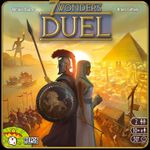
7 Wonders Duel
A lasting classic among two-player-only board games, in which you draft cards over three Ages and compete for a civilian, military, or scientific victory. Short playing time and deep reading of your opponent sit side by side, so it stays a steady recommendation for people who love two-player games.
Rules
A two-player-only take on “7 Wonders,” but you never pass a hand of cards. Instead you take one uncovered card at a time from the card structure. There are three ways to win, and two of them end the game on the spot, without waiting for Age III.
There are three ways to win
| Victory | Condition | When |
|---|---|---|
| Military supremacy | The Conflict pawn enters your opponent's capital space | Ends immediately |
| Scientific supremacy | You gather 6 different scientific symbols | Ends immediately |
| Civilian victory | No supremacy by the end of Age III, so compare victory points | After Age III ends |
This is the biggest difference from the original game. If your opponent is racing down the military or science track, you may never get to scoring at all. You will often be in a spot where stopping their instant win matters more than building your own score.
Contents
| Component | Count | Note |
|---|---|---|
| Game board | 1 | 9 zones · 19 spaces. The space at each end is that player's capital |
| Age cards | 23 Age I · 23 Age II · 20 Age III | Age III has no brown or grey cards |
| Guild cards | 7 | Only 3 are drawn and shuffled into Age III |
| Wonder cards | 12 | Split 4 each between the players |
| Military tokens | 4 | Trigger when the Conflict pawn enters a zone |
| Progress tokens | 10 | Only 5 go on the board at the start |
| Conflict pawn | 1 | Starts in the middle of the board |
| Coins | 31 | 14 value 1 · 10 value 3 · 7 value 6 |
Setup
- 1Place the board between the two players and put the Conflict pawn on the neutral space in the middle.
- 2Place the 4 Military tokens face up on their spaces.
- 3Shuffle the Progress tokens and place only 5, at random, face up on the board. Return the rest to the box.
- 4Each player takes 7 coins from the bank.
- 5Return 3 cards from each Age deck to the box without looking at them. Draw only 3 of the 7 Guild cards at random and shuffle them into the Age III deck.
Wonder selection — 1 · 2 · 1
Shuffle the 12 Wonders and lay out 4 face up. The first player takes 1, the second player takes 2, and the first player takes the last one. Then lay out 4 more and repeat in the same order, but starting with the second player. Each player ends up with 4 Wonders.
For a first game the rulebook suggests skipping Wonder selection and using the set it gives you. Player 1 takes the Pyramids, the Great Lighthouse, the Temple of Artemis, and the Statue of Zeus; Player 2 takes Circus Maximus, Piraeus, the Appian Way, and the Colossus.
A turn — take an uncovered card
Each Age lays out 20 cards in a set shape. Some are face up, some face down. The two players take alternating turns.
You may only take an “accessible” card
You may only choose a card that is not even partly covered by another card. Taking a card uncovers what was under it, so what you open up for your opponent is the calculation every turn.
| What you can do with the card you take | Detail |
|---|---|
| ① Construct a Building | Pay the cost and place it in your city |
| ② Discard for coins | Take 2 coins + 1 per yellow card in your city |
| ③ Construct a Wonder | Pay the Wonder's cost and slide the card face down under the Wonder |
- After you play a card, reveal any card that has become accessible.
- Some Wonders let you play again; you begin that turn after revealing the newly accessible cards.
- If a “play again” effect would give you a turn at the end of an Age, when the structure is empty, the effect is lost.
Trading — your opponent's production sets your prices
Cost = 2 + the number of that resource your opponent produces
You can always buy a missing resource from the bank. The price rises with the production of your opponent's brown and grey cards. The money goes to the bank, not to your opponent.
- There is no limit to how many resources you may buy on your turn.
- Resources from yellow cards and Wonders are not counted in trading costs.
- Some yellow cards fix the price of a given resource at 1 coin.
- Resources are not spent. Once you have them, you use them for the whole game.
- Free construction by chain: if an Age II or III card has a white symbol under its cost and you already built the Building that grants that symbol, you construct it for free.
Some cards ask for both coins and resources. Pay the card's coin cost to the bank, and cover the resources by producing or buying them. The two costs are separate.
Military — one shield is one space
- Each shield on a red card or a Wonder moves the Conflict pawn one space toward your opponent's capital. It applies immediately.
- The pawn moves back and forth. It comes back when your opponent adds shields.
- When the pawn enters a zone marked by dotted lines, that zone's Military token triggers. Your opponent loses 2 or 5 coins and the token goes to the box.
- If the pawn enters your opponent's capital space, you win at once by military supremacy.
Military points in a civilian victory
If the game reaches the end of Age III, you score 0 · 2 · 5 · or 10 points by where the pawn is. A small military lead is already points, so military is not a total waste even when it never reaches supremacy.
Science and Progress tokens
- There are 7 scientific symbols. They are on green cards and on some Progress tokens.
- Each time you gather a pair of identical symbols, you immediately take one of the Progress tokens on the board. That token is yours until the end of the game.
- Gather 6 different symbols and you win at once by scientific supremacy.
Pairs and six-of-a-kind pull in opposite directions
Progress tokens come from doubling up on the same symbol, while scientific supremacy needs you to spread across different symbols. Chasing both at once is hard, so every time you take a green card you have to decide which one you are after. If your opponent has 4 or 5 different symbols, you have to stop them, even by discarding the green card.
Only 7 Wonders get built in total
You hold 4 each, 8 in all, but only 7 are built in a game. The moment either player completes the 7th, the last unbuilt Wonder goes straight to the box.
“Making sure your opponent never builds the Wonder they are saving” is a real tactic. If you complete the 7th, their last Wonder disappears.
You pay the cost printed on the Wonder card. The cost of the Age card used to mark it does not matter.
End of an Age and final scoring
The weaker side chooses who starts the next Age
An Age ends when all 20 cards in the structure are gone. The player with the weaker military — the one whose side of the board the Conflict pawn is on — chooses who begins the next Age. If the pawn is exactly in the middle, the player who played the last card of the previous Age begins.
| Final scoring category | How it counts |
|---|---|
| Military | 0 · 2 · 5 · or 10 points by the Conflict pawn's position |
| Buildings | Victory points on blue · green · yellow · purple cards |
| Wonders | Victory points on the Wonders you completed |
| Progress tokens | Victory points printed on the tokens |
| Treasury | 1 point per 3 coins |
- On a tie, the player with more victory points from blue (civilian) cards wins.
- If that is tied as well, the players share the victory.
Rules people get wrong
Q. Can we mix these cards with the original game?
No. It is a completely different game. The card counts and contents differ, and play is not drafting.
Q. Can I take a covered card?
No. If it is covered even a little, you cannot take it. That is why you have to watch what taking a card opens up for your opponent.
Q. Do I buy resources from my opponent?
No. You buy from the bank. The price is set by your opponent's production, but the money never reaches them, which is unlike the original game.
Q. Do resources from yellow cards raise my opponent's prices?
No. Only brown and grey cards count toward trading costs.
Q. How many coins do I get for discarding a card?
2, plus 1 per yellow card in your city. Collecting yellow cards makes discarding strong.
Q. Can we build all 8 Wonders?
No. Only 7 get built and the last one goes to the box. Who builds the 7th matters.
Q. Do we score points if I gather 6 scientific symbols?
No. You win at once and the game ends. Military supremacy works the same way.
Q. Do three identical symbols give me two Progress tokens?
You take one each time a pair is completed. Three symbols is one pair, so one token. At four, a second pair is complete and you take another.
History and editions
| Item | Detail |
|---|---|
| Designers | Antoine Bauza · Bruno Cathala |
| Artwork | Miguel Coimbra |
| Published | Repos Production, 2015 |
| Reputation | The most widely recommended game for two players |
| Expansion | Released | Note |
|---|---|---|
| Pantheon | 2016 | Adds deity cards and a temple |
| Agora | 2020 | The Senate and conspiracy cards |
The original “7 Wonders” has an official two-player variant, but even its rulebook recommends 3 to 7 players first. If two players is your main setup, Duel is the better pick.
Sources
Official Repos Production rulebook (7 Wonders Duel, English)Wiki cross-check — Wikipedia: 7 Wonders DuelWiki cross-check — Namuwiki: 7 Wonders DuelRule summaries are reference content written by us, not quotations from the official rulebook. Always check the official rulebook for exact rules. Diagrams are original schematics, not rulebook illustrations.
Spotted a mistake? Tell us in the comments below →
Last updated 2026-09-08
💡 Master tip
Taking the color of card your opponent needs before they can, and always watching for a line toward an instant scientific win, both matter at the same time. Check how far the military track has moved each turn so your opponent cannot surprise you with an instant military win.
Related games
Similar games
Ready for something heavier
If this one has gotten too easy, try these — same feel, one step up in weight.
Tools you can request
Not built yet. Let us know if you want one — it goes on the list.
Automatic score calculator
Adds up civilian, military, science, commercial, and Wonder points at once
Comments
Share your thoughts, report a mistake, or request a tool. No sign-in needed — nicknames are not verified, so anyone can use the same one.
Loading…