Top 54
Patchwork
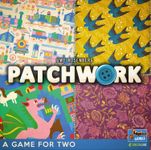
A two-player puzzle game where you buy a variety of fabric patch tiles to build a quilt with no gaps. Managing both time and buttons (currency) at once, the appeal lies in a timing contest to fill patches more efficiently than your opponent.
Rules
This two-player puzzle game does not alternate strict turns. Whoever's time token lags behind on the time track always acts next, buying fabric patches with buttons to fill a 9×9 personal quilt board without gaps.
Components
| Component | Count | Notes |
|---|---|---|
| Central time board | 1 | Double-sided — only the artwork differs, rules are the same |
| Quilt boards | 2 | One per player, 9×9 spaces |
| Time tokens | 2 | Lime green and yellow — pieces that move along the time board |
| Neutral token | 1 | Marks the 3 patches currently available to buy |
| Special tile | 1 | Awarded to whoever first fills a 7×7 square, worth 7 points |
| Special patches (leather patches) | 5 | Single-space patches — the only way to fill a lone empty space |
| Button tiles | 32+12+5+1 = 50 | Thirty-two 1-button, twelve 5-button, five 10-button, one 20-button tile |
| Regular patches | 33 | Varied shapes with a button cost, a time cost, and sometimes button icons |
Each patch is printed with a button cost (paid when bought), a time cost (spaces your time token advances when bought), and some patches also print button icons that pay out extra buttons whenever you later land on or pass a button income space.
Setup
- 1Each player takes a quilt board, a time token, and 5 buttons. Keep the rest of the buttons in a shared supply.
- 2Place the central time board in the middle and put both time tokens on the starting space.
- 3Arrange all 33 patches in a circle or oval around the time board.
- 4Find the smallest patch (2 spaces) and place the neutral token between it and the next patch clockwise.
- 5Set the special tile beside the board, then place the 5 special patches (leather patches) on the marked spaces of the time board.
- 6The player who most recently used a needle begins.
The two quilt boards are entirely separate. There is no rule about patches overlapping between players — each player fills only their own 9×9 board.
Turn order — no strict alternation
- 1Turns do not alternate. Whoever's time token is furthest behind on the time track acts next.
- 2If both time tokens sit on the same space, the one on top goes first.
- 3On your turn, choose exactly one of two actions: A. Advance and receive buttons, or B. Take and place a patch.
- 4After the action, the game again checks who is furthest behind to decide who goes next.
One player may take several turns in a row
If you advance far ahead, your opponent takes consecutive turns until they catch up. The farther you advance, the more consecutive turns you hand your opponent, so weigh the distance as well as the gain.
The two actions — advance / buy and place a patch
| Action | What happens | Reward / cost |
|---|---|---|
| A. Advance and receive buttons | Move your time token to the space directly in front of your opponent's token | Receive 1 button per space moved |
| B. Take and place a patch | Buy one of the 3 patches after the neutral token and place it on your board | Pay the printed buttons, then advance by the printed time cost |
- 1① Choose one of the 3 patches after the neutral token.
- 2② Move the neutral token to the space the chosen patch occupied.
- 3③ Pay the printed number of buttons to the supply.
- 4④ Turn the patch any way you like and place it on your quilt board. It may not overlap already-filled spaces.
- 5⑤ Advance your time token by the number of spaces printed on the patch.
Your time token moves every turn, regardless of which action you take. Both advancing and buying a patch always move your time token forward.
Filling the board and time-track events
Place bought patches without overlapping. Whenever a time token lands on or passes a marked space, resolve that space's event immediately.
| Marked space | Effect |
|---|---|
| Special-patch space | Take 1 special patch (a single space) and place it on your board at once. It is the only way to fill a lone empty space |
| Button-income space | Receive buttons equal to the button icons already printed on patches on your board |
First to complete a 7×7 area takes the special tile
Whoever first completely fills any 7×7 area of their quilt board takes the special tile (7 points). Only one tile exists, so completing a 7×7 area afterward earns nothing extra.
Scoring
- 1Count your remaining buttons.
- 2Add +7 if you hold the special tile.
- 3Subtract −2 for every empty space on your quilt board.
- 4The higher score wins. On a tie, whoever reached the final space of the time board first wins.
End of the game
The game ends once both time tokens reach the final space of the time track. If a token would move past the final space, it simply stops there. For action A, you receive buttons only for the spaces actually moved.
Strategy tips
- Patches with more button icons relative to their cost pay off more each time you later cross a button-income space.
- Advancing far ahead of your opponent hands them consecutive turns. Avoid advancing more than needed if your opponent is already far behind and you want to buy soon.
- Special patches cannot be bought directly, so plan your shapes in advance to avoid leaving single-space gaps only they can fill.
- Estimate early whether you can complete a 7×7 area so your opponent does not claim the 7-point bonus first.
Editions and expansions
| Name | Notes |
|---|---|
| Patchwork: Automa (2018) | A 24-card expansion enabling solo play |
| Patchwork Express (2018) | A faster variant with larger tiles and simplified rules |
| Patchwork DOODLE (2019) | A roll-and-write variant using dice |
| Themed limited editions | Numerous reskins such as Christmas, Halloween, Valentine's, Americana, and the Folklore series |
This guide covers the base two-player game
Automa, Express, and DOODLE change components and rules, so the numbers in this guide do not carry over directly. Korea Boardgames released the base game in Korea, and Asmodee Korea later took over distribution including a Folklore Korea limited edition, but no public official Korean rulebook text was obtained for this guide.
Frequently confused rules
Q. Can my patches overlap my opponent's quilt board?
There is no such rule to break. The two quilt boards are entirely separate; the only overlap rule concerns spaces already filled on your own board.
Q. Can I buy a special patch (leather patch) with buttons?
No. Special patches are received only by landing on or passing a marked time-track space. They cannot be purchased.
Q. Does "turn the patch any way you like" mean only rotation, or flipping too?
The rulebook only says you may turn it any way you like, without restricting it to one axis, so any orientation is allowed.
Q. What happens if I advance far ahead of my opponent?
Your opponent then takes consecutive turns until they catch up, since the player furthest behind always acts next.
Q. Does a button-income space trigger only if I land exactly on it?
No, it also triggers if your time token passes over it. Landing exactly on it or moving past it both resolve the event.
Q. What if my action A move would take my token past the final space?
The token simply stops on the final space, and you receive buttons only for the spaces you actually moved, not the calculated distance.
Q. If I also complete a 7×7 area later, do I get another bonus?
No. Only one special tile exists, and only the first player to complete a 7×7 area receives it. Completing one afterward earns nothing extra.
History and reception
Designed by Uwe Rosenberg and published in 2014 by Lookout GmbH and Mayfair Games, Patchwork received a 2015 Spiel des Jahres Recommended List mention. BGG lists it for two players, roughly 15–30 minutes, with an average weight around 1.6.
In Korea, Korea Boardgames released the base edition, and Asmodee Korea later took over distribution, including a Folklore Korea limited edition. Namuwiki carries a dedicated article using terms such as "personal board" and "shared track," but this guide's terminology follows the official English rulebook that was obtained.
Sources
Lookout GmbH / Mayfair Games — official English Patchwork rulebook (2014)BoardGameGeek: Patchwork (163412)Wiki cross-check — English Wikipedia: Patchwork (board game)Wiki cross-check — Namuwiki: Patchwork (board game, Korean)Rule summaries are reference content written by us, not quotations from the official rulebook. Always check the official rulebook for exact rules. Diagrams are original schematics, not rulebook illustrations.
Spotted a mistake? Tell us in the comments below →
Last updated 2026-10-10
💡 Master tip
Compare each patch's button icons against its button and time cost to pick efficient patches, and get ahead of your opponent on the time track to secure consecutive turns. Planning your routes by calculating button-income spaces and the special tile's position in advance is the key to a high score.
Ready for something heavier
If this one has gotten too easy, try these — same feel, one step up in weight.
Tools you can request
Not built yet. Let us know if you want one — it goes on the list.
Automatic empty-space penalty and button score calculator
Automatically counts empty spaces on the final quilt board
Comments
Share your thoughts, report a mistake, or request a tool. No sign-in needed — nicknames are not verified, so anyone can use the same one.
Loading…