Top 130
Othello
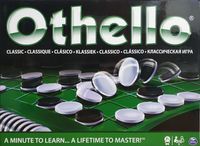
Outflank opposing discs horizontally, vertically or diagonally and flip every disc caught between your own. This entry covers the Korean Korea Boardgames/MegaHouse Othello Classic MGO-C04A8 edition with an 8×8 board and 64 double-sided discs.
👨👧👦 Played with our kids
Played with children aged 7 and 5.
Rules
Place a disc to outflank opposing discs in a horizontal, vertical or diagonal line, then flip every disc caught between your own. The rules are short, but corners and control of the opponent's choices decide the game.
Edition and components
This guide covers the Korean Othello Classic box marked model MGO-C04A8, distributed by Korea Boardgames under MegaHouse's Othello licence. The box specifies two players, age seven and up, and 30 minutes.
| Component | Quantity |
|---|---|
| Double-sided Othello discs | 64; each side is black or white |
| 8×8 game board | 1 |
| Board supports | 7 |
| Storage box | 1 |
The discs are double-sided
Black and White do not use separate sets. Each disc has one black side and one white side. Each player takes 32 discs and places them with their chosen colour face up.
Setup and objective
- 1One player takes Black and the other takes White. Each player takes 32 discs.
- 2Place two black and two white discs on the four central squares, with matching colours diagonally opposite.
- 3Black always moves first. When the game ends, the player with more discs showing their colour wins.
A legal move: outflank and flip
Before the move
Flip D4
After the move
- Place one disc on an empty square. In at least one direction, one or more uninterrupted opposing discs must lie between the new disc and an existing disc of your colour.
- A row may be horizontal, vertical or diagonal. You may not play on a square that flips no opposing disc.
- Flip every outflanked opposing disc to your colour. From the initial position, Black's legal moves are C4, D3, E6 and F5.
Before D4
Flip every row
After all three lines
Where flipping stops
Before A4
Flip B4 only
Direct outflank only
- You may not skip over your own disc to outflank an opposing disc beyond it.
- Only discs outflanked as a direct result of the newly placed disc flip. A flip never starts another chain of flips.
- Once a disc is placed, it can never move to another square.
- Every disc outflanked by the move must flip. A player may not flip only some of them or decline the flips.
Passing and ending the game
- 1If you have at least one legal move, you must play.
- 2If you have no legal move, your turn is forfeited and your opponent moves again. You rejoin as soon as a legal move becomes available.
- 3The game ends as soon as neither player can move. It may end before all 64 squares are filled.
- 4Count the discs showing each colour. The player with the majority wins.
Basic strategy from the booklet
A corner anchors the edge
Treat adjacent squares carefully
- The four corners are critical. A corner disc cannot be caught between opposing discs, so it can never be flipped.
- An early move next to an empty corner may let the opponent use that disc to take the corner. Look one reply ahead before approaching it.
- Early in the game, focus on reducing the opponent's legal moves instead of simply increasing your disc count. More exposed discs can create more outflanking lines for the opponent.
- Judge a move by how many replies it gives the opponent, not only by how many discs it flips now.
Beginner handicap
Agree on the handicap
The corner discs remain in place like ordinary played discs. Start with two corners, then adjust to three or four after seeing the result.
Othello and Reversi
Games in the Reversi family, which capture by outflanking and turning pieces, date to the nineteenth century. The trademarked modern Othello fixes the four-disc centre opening and gives each player 32 discs; MegaHouse's official history dates its Japanese launch to 29 April 1973.
The name Othello comes from Shakespeare's play. This Korean edition is a MegaHouse-licensed Othello product distributed domestically by Korea Boardgames.
History is separate from the rules
Sources disagree about some origin claims for Reversi and Othello. This guide records only the commercial launch date and fixed modern rules supported across the cited sources.
Frequently asked questions
Q. If a move outflanks in several directions, do I choose one?
No. Flip every outflanked opposing disc in every horizontal, vertical and diagonal row completed by the new disc.
Q. Can a flip create another chain of flips?
No. Only discs directly outflanked by the newly placed disc flip. You cannot jump over your own disc or continue flipping as a chain reaction.
Q. Does the game end as soon as one player has no move?
No. That player passes automatically and the opponent moves again. The game ends only when neither player can move.
Q. Must all 64 squares be filled?
No. If neither player can outflank an opposing disc, the game ends even with empty squares.
Q. Is flipping many discs early always good?
No. The Korean booklet recommends keeping your early disc count low enough to restrict the opponent's choices. Watch corners and the opponent's next legal moves first.
Sources
Official Korean rules — owner's Korea Boardgames/MegaHouse Othello Classic MGO-C04A8 booklet, pages 1–7 checked in fullWorld Othello Federation official English rules — setup, moves, passes and endingKorea Boardgames official product page — two players, age 7+, 30 minutes, genre and mechanismsMegaHouse official Othello site — product lineage and 1973 launch historyBGG 2389 — player count, age, time and weightWikipedia cross-check — Reversi/Othello history and edition differencesNamuwiki cross-check — no accessible article identifying this product editionRule summaries are reference content written by us, not quotations from the official rulebook. Always check the official rulebook for exact rules. Diagrams are original schematics, not rulebook illustrations.
Spotted a mistake? Tell us in the comments below →
Last updated 2026-09-16
💡 Master tip
Early on, restrict the opponent's legal moves instead of merely flipping many discs. Aim for stable corners without carelessly giving the opponent access through a corner-adjacent square.
Ready for something heavier
If this one has gotten too easy, try these — same feel, one step up in weight.
Comments
Share your thoughts, report a mistake, or request a tool. No sign-in needed — nicknames are not verified, so anyone can use the same one.
Loading…