Top 75
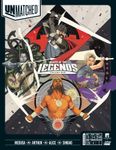
Unmatched: Battle of Legends
A dueling action game where legendary heroes such as King Arthur, Alice, Medusa, and Sinbad face off using asymmetric dedicated card decks and miniatures.
Rules
Four legendary heroes clash on the battlefield in this two-player miniatures dueling game. Each turn you pick 2 of 3 actions — maneuver, scheme, or attack — and attack/defense cards are revealed simultaneously to settle combat.
Components
| Component | Count | Notes |
|---|---|---|
| Double-sided board | 1 (2 battlefields: Marmoreal and Sarpedon) | A map of circular spaces linked by lines; starting spaces and zones differ by battlefield |
| Hero miniatures | 4 (King Arthur, Alice, Medusa, Sinbad) | The primary fighter that moves across the battlefield |
| Action cards | 30 per hero (120 total) | Each hero's own deck — attack, defense, scheme, and versatile (attack-or-defense) cards |
| Character cards | 4 | List each hero's move value, attack type (melee/ranged), special ability, and sidekick count |
| Sidekick tokens | 6 (1 Porter, 1 Merlin, 3 Harpies, 1 Jabberwock) | Fighters that assist the hero and move on the battlefield alongside them |
| Health dials | 7 (2+2+1+2, assembled) | Two punch-out discs riveted together; health cannot exceed the dial's highest number |
| Alice's size token | 1 | Unique to Alice — tracks her 'large' or 'small' state |
A hero with multiple sidekicks (Medusa's 3 Harpies) has each sidekick at 1 health unless a separate dial says otherwise. The character card instead lists the total sidekick count.
Setup
- 1Choose a battlefield (Marmoreal or Sarpedon). Team play with 3 or 4 players requires a battlefield with four starting spaces.
- 2Each player picks a hero and takes that hero's 30 action cards, character card, hero miniature, sidekick tokens, and health dials.
- 3Set the hero's and sidekick's health dials to the starting health printed on the character card (a sidekick without a dial has 1 health).
- 4Shuffle your own 30 action cards into a single face-down deck, then draw 5 cards as your starting hand.
- 5The younger player places their hero in space ①, then places their sidekicks in other spaces within the same zone as their hero. Make any decision your fighter requires at the start (such as Alice's size) now.
- 6The older player places their hero in space ②, placing sidekicks the same way.
- 7The younger player takes the first turn.
The 7-card hand limit does not apply to the starting hand
During a turn, going over 7 cards means discarding down at the end of the turn, but the initial 5-card starting hand is unaffected by that limit.
A turn — 2 actions
| Action | What happens | Notes |
|---|---|---|
| Maneuver | Draw the top card of your deck (mandatory), then optionally move your fighters up to their move value | You may discard 1 card from hand to add its BOOST value to your movement |
| Scheme | Play 1 scheme card from your hand face up and resolve its effect immediately | You must declare which fighter plays it; it cannot be played if that fighter is defeated |
| Attack | Declare a target, play attack/defense cards face down, then reveal simultaneously to resolve damage | Not available if you have no attack card in hand or no fighter has a valid target |
- 1On your turn you must take exactly 2 actions. You may pick two different actions, or the same action twice.
- 2You cannot skip an action — if your options are limited, you still choose from what remains available.
- 3At the end of your turn, if your hand exceeds 7 cards, discard down to 7. Then play passes to your opponent.
Maneuvering, zones, and deck exhaustion
- 1Choosing maneuver means you first draw the top card of your deck (mandatory). Moving your fighters afterward is optional.
- 2Movement is one adjacent space at a time. You may move through a space occupied by one of your own fighters (but not stop there); you cannot move through a space occupied by an opposing fighter at all.
- 3The battlefield's spaces are divided into zones by colored pattern. Spaces sharing the same pattern are the same zone, even on opposite sides of the board. Zones define the targeting range for ranged attacks and certain card effects.
- 4Boost: discard 1 card from your hand and add that card's BOOST value to your movement (or to whatever value an effect specifies). Even a card belonging to an already-defeated fighter may still be discarded to boost.
An empty deck is not reshuffled
If your deck is empty when you need to draw, the discard pile is not reshuffled — instead, every one of your fighters immediately takes 2 damage (exhaustion). This repeats every time you must draw again while exhausted.
Attack — simultaneous reveal and resolving combat
- 1Declare the attacking fighter and the target. Melee fighters may only target an adjacent space; ranged fighters may target an adjacent space, or any space in the same zone regardless of distance.
- 2The attacker plays 1 attack (or versatile) card that fighter is allowed to use, face down. The defender may, but is not required to, play a defense (or versatile) card face down.
- 3Reveal both cards simultaneously. Resolve any 'immediately' effects, then any 'during combat' effects (if both would resolve at the same time, the defender's effect goes first).
- 4The defender takes damage equal to the attack card's value minus the defense card's value (0 if none was played), and loses that much health. Then resolve any 'after combat' effects and discard both cards.
What it means to 'win the combat'
The attacker won if the attack card itself dealt at least 1 damage (effects don't count). The defender won if the attack itself dealt no damage (even if effects caused some). Certain 'after combat' effects key off this result.
Battle of Legends, Vol. 1 — the four heroes
| Hero | Sidekick | Confirmed from the official rules |
|---|---|---|
| Medusa | 3 Harpies (1 health each, no dial) | Move 3, starting health 16, ranged attacks. At the start of her turn, may deal 1 damage to an opposing fighter in Medusa's zone |
| Sinbad | 1 Porter (health 6) | Move 2, starting health 15. Melee vs. ranged was not shown in this rulebook and could not be confirmed |
| King Arthur | 1 Merlin | His special ability can apply a boost to other values, such as an attack. His cards include support effects like 'Noble Sacrifice' (an extra combat boost) and 'The Holy Grail' (after combat: if at 4 health or less but not defeated, set health to 8). Exact starting health and move were not confirmed |
| Alice | 1 Jabberwock | Sets a 'large' or 'small' size state at the start of the game; 'Drink Me' draws 2 cards and changes size. The Jabberwock's 'Jaws That Bite' deals 2 damage after combat to an adjacent fighter. Exact starting health and move were not confirmed |
King Arthur's and Alice's stats could not be confirmed here
The official rulebook obtained for this guide is a 2-page system overview, so Medusa's and Sinbad's numbers only happened to appear in component photos. King Arthur's and Alice's exact starting health, move value, and melee/ranged type are printed only on the physical character cards, so this guide does not guess at them.
Defeating fighters and winning
| Situation | Result |
|---|---|
| A fighter's (hero's or sidekick's) health reaches 0 | That fighter is defeated. A defeated sidekick's token is removed immediately |
| Your own hero is defeated | You lose immediately |
| Your opponent's hero is defeated | You win immediately |
The game continues as long as the hero survives, even if every sidekick has been defeated. Victory and defeat are decided only by whether the hero is still standing.
Strategy tips
- A card belonging to an already-defeated fighter is still fine to discard for a boost — if that fighter is gone, that card in your hand is useful for nothing else.
- You are never required to play a defense card. If nothing in hand is worth spending, declining defense to preserve your hand for a future attack is a legitimate choice.
- A ranged fighter can target anywhere in its own zone without needing adjacency, so check the battlefield's zone boundaries before planning your movement to keep your attack range wide.
- When your deck is running low, filling a turn with scheme or attack instead of a draw-mandatory maneuver can delay exhaustion damage.
- Nothing in this rulebook says you may freely inspect an opponent's discard pile, but tracking which effects and cards have already been played helps you narrow down what's left in their hand.
Player-count variants and other sets
| Player count | Rule |
|---|---|
| 2 players (base) | Each controls one hero; defeating the opponent's hero first wins |
| 4-player teams (2v2) | Teammates sit on the same side and may discuss cards and tactics, but each controls only their own hero and sidekicks. Heroes are placed in ①→②→③→④ order, and turns alternate the same way. Both heroes on the opposing team must be defeated to win |
| 3-player teams | One player controls both heroes and sidekicks for one team; everything else matches 4-player team play |
Heroes from other sets can be mixed in
The official rules state you "can mix and match fighters from any Unmatched set." The Restoration Games store confirms Battle of Legends, Vol. 2 and Vol. 3 exist in the same line (as of 2026-10-10), but their hero rosters and detailed rules were not cross-checked. This guide covers only Vol. 1's base 4 heroes (King Arthur, Alice, Medusa, and Sinbad).
Frequently confused rules
Q. Must the defender always play a defense card?
No. The defender may play a defense (or versatile) card or decline entirely. Declining counts as a defense value of 0, so the full attack value becomes damage.
Q. What if the attack and defense values are equal?
Damage is 0. Since the attack itself dealt no damage, the defender is considered to have won the combat under the rules' definition.
Q. Can a ranged attack hit anywhere on the battlefield?
No. A ranged fighter may only target an adjacent space or a space within its own zone. A target in a different zone, even if physically close, cannot be targeted unless also adjacent.
Q. Do all of a hero's sidekicks get their own health dial?
No. Unless a separate dial is provided (as with Medusa's 3 Harpies), each sidekick has exactly 1 health and is defeated the first time it takes any damage.
Q. When the deck runs out, is the discard pile reshuffled into a new deck?
No. With an empty deck, the discard pile stays as is, and your fighters immediately take 2 damage instead. This repeats every time you must draw again afterward.
Q. Can heroes from different Unmatched sets fight each other?
Yes, the official rules explicitly allow it. This guide only cross-checked Volume 1's base 4 heroes, though — other sets' stats and special abilities were not verified here.
History and editions
| Item | Detail |
|---|---|
| Designers | Noah Cohen, Rob Daviau, Justin D. Jacobson, Chris Leder, and Brian Neff (wiki cross-check). The rulebook credits this volume's restoration specifically to JR Honeycutt (core), with Rob Daviau and Justin D. Jacobson (additional) |
| Origin | Restored from 1987's Star Wars: Epic Duels (Milton Bradley, designed by Craig Van Ness and Rob Daviau); the rulebook credits its zone rules to Fantasy Flight Games' Tannhäuser (designed by William Grosselin and Didier Poli) |
| First revealed | Debuted at Gen Con in August 2019, reaching retail the same September (wiki cross-check) |
| Volume 1 contents | 4 heroes — King Arthur, Alice, Medusa, Sinbad — and 2 battlefields, Marmoreal and Sarpedon (wiki cross-check) |
| Publisher | Credited in the rulebook as a joint production of Restoration Games and Mondo Games (the rulebook notes 'Mondo and the Mondo Games logo is a trademark of Mondo Tees, LLC'). Wikipedia currently describes Restoration Games as the sole publisher |
| Korean release | Not confirmed — no Korean distributor or Korean rulebook was found (2026-10-10) |
English Wikipedia notes that, beyond Battle of Legends Vol. 1, the line has continued with further 4-hero sets, 3-hero sets (including Marvel and Witcher lines), 2-hero sets, and single-hero releases. This guide confirms only that these exist, without cross-checking their detailed rules. Namuwiki confirmed the game system's description (hero-specific card decks, figures, tokens, health dials, and battlefield boards), but no Korean distributor or release information could be found there.
Sources
Restoration Games — official English rules for Unmatched: Battle of Legends, Vol. 1 (two-page edition)Wiki cross-check — English Wikipedia: Unmatched (board game)Wiki cross-check — Namuwiki: Unmatched (Korean distribution not confirmed, 2026-10-10)Rule summaries are reference content written by us, not quotations from the official rulebook. Always check the official rulebook for exact rules. Diagrams are original schematics, not rulebook illustrations.
Spotted a mistake? Tell us in the comments below →
Last updated 2026-10-10
💡 Master tip
Don't just throw out every attack card. When your deck runs out, you'll take deck-exhaustion damage, so pacing your turns and maneuvering wisely is essential.
Ready for something heavier
If this one has gotten too easy, try these — same feel, one step up in weight.
Tools you can request
Not built yet. Let us know if you want one — it goes on the list.
Hero Health (HP) Dashboard
Manage health dials for the main hero and supporting heroes
Hero-Specific Counter Deck Card Guide
Reminders for key special cards of the opposing hero
Comments
Share your thoughts, report a mistake, or request a tool. No sign-in needed — nicknames are not verified, so anyone can use the same one.
Loading…