Top 115
Quoridor
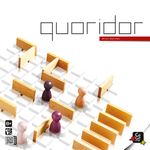
Move your pawn forward one square at a time to reach the opposite side first — but instead of moving, you can plant a fence each turn to block your opponent's path. An elegant maze-building mind game that fits in two rules, it is the flagship of Gigamic's abstract strategy line.
Rules
Move your pawn one square at a time toward the opposite side, or spend a turn planting a fence to slow your opponent down instead. No fence may ever cut off every path to an opponent's goal line.
Components
| Component | Count | Notes |
|---|---|---|
| Board | 1 | A square grid of 81 squares (9×9) |
| Pawns | 4 | One per color — two-player games use only 2 |
| Fences | 20 | 10 each in a two-player game, 5 each in a four-player game |
| Storage racks | 2 | Slot onto the sides of the board |
One name, one rule
Gigamic's official rulebook calls the walls fences. This guide uses the same term throughout.
Setup
- 1Two-player game: each player slots 10 fences into the storage rack beside the board.
- 2Each player places a pawn in the center square of their own base line (one edge of the board).
- 3Determine the starting player by any fair method.
Turn sequence
- 1On your turn, choose one of two actions — ① move your pawn one square, or ② place one fence.
- 2Once you have used all your fences, you may no longer place one and must move your pawn instead.
- 3After acting, your turn ends and play passes to the next player.
A placed fence cannot be moved or removed
Fences are permanent. On your turn you may only move or place a new fence — there is no rule for reclaiming or repositioning a fence already on the board.
Pawn movement — going around fences
A pawn moves one square at a time, orthogonally — up, down, left, or right. There is no ordinary diagonal move. A fence blocking one direction simply removes that move; you must go around it.
Placing fences — you may never seal every path
- 1A fence spans the length of 2 squares and slots exactly into the groove between them.
- 2You may place a fence to help your own progress, to slow your opponent, or both.
- 3However, you must always leave at least one path by which your opponent can still reach their goal line.
Check every remaining path, not just the obvious one
A fence is judged by whether any possible route for the opponent still exists after it is placed. Even a long detour keeps the fence legal.
Jumping — face to face, including diagonal jumps
When two pawns stand on adjacent squares with no fence between them, the player whose turn it is may jump over the opponent's pawn to the square directly behind it.
If a fence sits directly behind the opponent's pawn and blocks that landing square, you may instead jump diagonally to the square on either side of the opponent's pawn.
Four-player games allow only one pawn per jump
In a four-player game, you may never jump over more than one pawn in a single move. This situation cannot arise in a two-player game, since only two pawns are in play.
End and victory
The first player to reach any of the 9 squares on the row opposite their own base line wins immediately. The rulebook gives no fixed time limit, only noting an average game length of 10 to 20 minutes and that tournaments may assign each player a time budget.
Strategy tips
- Ten fences run out quickly. Close the distance by moving early, then save a fence for forcing a costly detour once your opponent has spent most of theirs.
- A fence that both advances your own route and slows your opponent is usually worth more than one that only blocks — look for spots that do both.
- Before placing a fence, trace every remaining path your opponent could still take. Because total blockades are illegal, a fence that only looks threatening is often wasted.
- Each turn, weigh whether moving or fencing saves more distance. If you are behind, a fence that forces a detour often helps more; if you are ahead, simply moving to protect your lead is often better.
Editions and variants
| Edition | What changes | Notes |
|---|---|---|
| Quoridor Mini | Same 9×9 board, rules identical to the base game | Only the physical size shrinks; fence racks are built into the board (stated in the official rulebook) |
| Quoridor Junior / Kid | 7×7 board, mouse-and-cheese theme, ages 4–6 and up | A separate product — a different board size and theme from the base game |
Four-player game
Each player takes 5 fences and starts at the center square of one of the four sides. Rules match the two-player game except that jumping over more than one pawn at once is forbidden.
Quoridor Junior's fence count is unconfirmed
Unconfirmed: the fence count and detailed rules for Quoridor Junior (the 7×7 edition) do not appear in the 9×9 official rulebook this guide checked. A Korean retail listing confirms only age, player count, and play time, and no rulebook PDF for it was found — this guide does not apply its 9×9 numbers to the Junior edition.
Frequently confused rules
Q. Can fences be used to completely trap an opponent?
No. Every fence placement must leave at least one path by which the opponent can still reach their goal line, however long that path is.
Q. Can a fence already on the board be moved elsewhere?
No. Once placed, a fence stays in that spot for the rest of the game.
Q. What happens once a player runs out of fences?
They may no longer place a fence and must move their pawn on every subsequent turn.
Q. When exactly is a diagonal jump allowed?
Only when a fence directly behind the opponent's pawn blocks the straight landing square. If that square is open, you must jump straight over.
Q. Can a pawn move diagonally on an ordinary turn?
No. Ordinary movement is one orthogonal square only. Diagonal movement is allowed solely as part of jumping over an opponent's pawn.
Q. Why does a four-player game give out fewer fences per player than a two-player game?
The same total of 20 fences is simply split among more players — 10 each for two players, 5 each for four. The overall supply of 20 fences never changes.
History and awards
Designed by Mirko Marchesi and published by France's Gigamic in 1997, Quoridor won a Mensa Select award that same year and, per English Wikipedia, was also named a 1998 Games Magazine Game of the Year. A Korean edition is distributed through Korea Boardgames, cross-checked against Namuwiki. The rules boil down to two lines — move or plant a fence — yet the resulting depth has made it a frequent gateway into abstract strategy games.
English Wikipedia lists several size variants — a smaller Pocket/Mini and larger Deluxe/Giant editions — but this guide covers only the base game, Mini, and Junior editions confirmed to be sold in Korea.
Sources
Gigamic official multilingual rulebook — includes Korean (KR, printed p.19) and English (GB, printed p.4) pagesGigamic official product page — QuoridorKorean retail cross-check — Quoridor Junior product page (imported by Korea Boardgames/Gigamic)Wiki cross-check — English Wikipedia: QuoridorWiki cross-check — Namuwiki: Quoridor (Korean)Rule summaries are reference content written by us, not quotations from the official rulebook. Always check the official rulebook for exact rules. Diagrams are original schematics, not rulebook illustrations.
Spotted a mistake? Tell us in the comments below →
Last updated 2026-10-10
💡 Master tip
Your 10 fences run out quickly. Keep pace with movement early on, then save a fence to force a decisive detour once your opponent has used up theirs. A fence that widens your own path is often worth more than one that only blocks your opponent.
Ready for something heavier
If this one has gotten too easy, try these — same feel, one step up in weight.
Comments
Share your thoughts, report a mistake, or request a tool. No sign-in needed — nicknames are not verified, so anyone can use the same one.
Loading…