Top 113
Backgammon
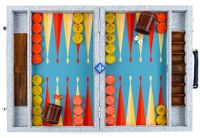
One of humanity's oldest board games, with roughly 5,000 years of history! Roll the dice and race your 15 checkers into your home board, then be the first to bear them all off in this racing puzzle. Luck and probability calculation mix beautifully, which is why it's still played at casinos and online tournaments worldwide.
Rules
Race all 15 of your checkers home and bear them off first in this roughly 5,000-year-old game. The heart of it is hitting your opponent's blots to send them to the bar, and the nerve game of the doubling cube.
Components
A two-player game. Each player takes one color, white or black.
| Component | Count | Notes |
|---|---|---|
| Checkers | 15 per color (30 total) | Each player moves their own 15 checkers around the 24-point board. |
| Board | 1 | 24 narrow triangles called points, split in half by a bar. |
| Dice | 2 (a pair per player, if available) | Each turn, roll 2 dice and move checkers by the numbers shown. |
| Doubling cube | 1 | A six-sided die marked 2, 4, 8, 16, 32, 64, showing the stake multiplier for the game. |
Setup and objective
- 1Each player takes 15 checkers and sets up the standard starting position. The doubling cube is placed in the middle with its 64 face up, marking the game as undoubled (value 1).
- 2Each player rolls one die. The player with the higher number moves first, using both numbers rolled by both players combined for that opening move (for example, if White rolls 5 and Black rolls 3, White plays using both the 5 and the 3). If the rolls tie, roll again.
- 3The goal is to move all 15 of your own checkers into your home board (points 1–6 for White, 19–24 for Black) and then be the first to bear all of them off the board.
Taking a turn — moving with the dice
Before the move — 2 white checkers on the 24-point
6 then 4 → 24→18→14
After the move — 1 remains on the 24-point, a new checker on the 14-point
- 1On your turn, roll 2 dice and move checkers by each number, either with two different checkers or one checker using both numbers in sequence. Checkers always move from your higher-numbered points toward your lower-numbered points.
- 2Rolling doubles (the same number on both dice) lets you move that number four times. For example, rolling 5-5 allows four separate moves of 5 spaces each.
- 3A checker may not land on a point held by 2 or more opposing checkers (a blocked point). It may land on an open point, a point you already occupy, or a point with a single opposing checker (a blot).
Play both numbers whenever legally possible
If both numbers can legally be played, you must play both. If only one of the two can be played, you must play that one; if either number could be played alone but not both together, you must play the larger number. If neither can be played, your turn is forfeited.
Hitting blots and the bar
A point held by only one checker is a blot. If an opponent's move lands exactly on that point, they hit it and send it to the bar.
Before the hit — a black blot on the 10-point
13→10 (using a 3)
After the hit — 10-point is white, the black checker is on the bar
- A checker on the bar must re-enter in the opponent's home board (the same region you started from) before you may move any other checker. Check which point matches the die you rolled.
- If you have more than one checker on the bar, enter as many as you can; if you cannot enter them all, the rest of your turn is forfeited. While any checker remains on the bar, no other checker may move.
- If an opponent occupies all six points of their home board with 2 or more checkers each, that is a closed board, and you cannot enter until they open at least one point.
Before entry — a black checker waits on the bar
Rolling a 4 → bar → 4-point
After entry — black enters on the 4-point
Bearing off
You may only begin bearing off once all 15 of your checkers are inside your home board. If even one checker is still outside it, or on the bar, you cannot start.
- 1If a die matches the number of a point that still has a checker, bear off that checker.
- 2If that point is empty and no higher-numbered point has a checker either, you may use that die to bear off from the current highest occupied point.
- 3If a checker is hit during bear-off, it must re-enter the board, and bearing off pauses until it is back home.
The doubling cube and scoring
The doubling cube sets the stake multiplier for the game. On your turn, before rolling the dice, whichever side holds the cube (at the start of the game, either side) may offer a double.
- The player offered a double may accept or decline. Declining ends the game immediately, and the player who declined loses at the cube value in effect at the time of the offer.
- Accepting doubles the cube value and passes the cube to the player who accepted; only that player may offer the next redouble.
- In match play, once a player is one point away from winning the match (match point), neither player may offer a double in the next game. This is the Crawford rule.
| Result | Condition | Multiplier (of the cube value) |
|---|---|---|
| Single game | The loser has already borne off at least one checker | × 1 |
| Gammon | The loser has borne off no checkers and still has all 15 on the board | × 2 |
| Backgammon | Gammon conditions, plus the loser still has a checker in the winner's home board or on the bar | × 3 |
Ending and winning
- 1Whoever bears off all 15 checkers first wins that game.
- 2A single money game decides the result in one game; match play plays to a target score (e.g. 7 points) to decide the overall winner.
- 3The final score is the cube value in effect for that game × the gammon/backgammon multiplier.
Basic strategy
- Avoid leaving single checkers exposed — stacking 2 or more on a point makes it yours and removes the risk of being hit there.
- Since both dice numbers must be used whenever legally possible, think ahead about which landing spots keep both numbers playable before you roll.
- During bear-off, make active use of the overshoot rule (using a high, empty die number to bear off from the highest point you still occupy).
- Offer the doubling cube when you have a clearly favorable position, and when receiving one, weigh the loss from declining against your chances if you accept.
Match formats and variants
On top of the standard rules, backgammon is played as a single money game or as match play (first to a target score across several games); match play also uses the Crawford rule.
- Acey-deucey: Players start with no checkers on the board and enter them one at a time, with rolling 1-2 granting a special bonus move.
- Hypergammon: A simplified variant using only 3 checkers per player, finishing much faster than standard backgammon.
- Nackgammon: A variant that uses a different starting arrangement than the standard setup. This guide does not cover its exact point placement.
- Russian backgammon: Both players move in the same direction toward a shared home board, changing the direction rule itself.
Why there is no Korean rulebook
Backgammon is not a game published by a single company — it is a traditional, publicly codified game. So instead of a Korean retail rulebook, this guide's Korean text is translated directly from the official USBGF English rules.
Frequently asked questions
Q. What happens if a double is declined?
The game ends immediately, and the player who declined loses at the cube value in effect when the double was offered. Accepting doubles the value and passes the cube to the player who accepted.
Q. Can I bear off before all my checkers are in my home board?
No. All 15 checkers must be inside your own home board's 6 points before you can start bearing off. Even one checker outside it, or on the bar, blocks bearing off.
Q. What happens if I have a checker on the bar and there's nowhere to enter?
If the opponent has closed all six points of their home board (2+ checkers on each), you cannot enter, and your whole turn is skipped until they open a point. While a checker remains on the bar, no other checker may move.
Q. If only one of my two dice numbers can be played, which do I use?
If both can legally be played, you must play both. If only one can be played, play that one. If either number alone could be played but not both together, you must play the larger number. If neither can be played, your turn is forfeited.
Q. Who moves first at the start of the game?
Each player rolls one die; whoever rolls higher moves first, using both players' numbers combined for that first move. Ties are re-rolled.
Q. Can anyone offer the doubling cube?
Before rolling your dice on your own turn, whichever side currently holds the cube may offer a double. At the very start, before anyone has doubled, either side may offer. Once a double is accepted, only the player now holding the cube may offer the next redouble.
History and today
Games in the 'tables' family, where players race checkers home, trace back roughly 1,600 years to Tabula, known from the era of Byzantine Emperor Zeno. The earliest specific reference to the name 'backgammon' is a 1647 letter, and the game developed out of the 16th-century game 'Irish'.
Francis Willoughby documented the rules around 1672 and Charles Cotton in 1674, and Edmond Hoyle's 1753 treatise helped popularize the game widely. By no later than 1850, the rules had settled into essentially their modern form, including the bar and the gammon/backgammon distinction.
The doubling cube, which decides the stakes, was introduced in the 1920s among gaming clubs on New York's Lower East Side, turning backgammon into a modern game of probability and expected value. The first world championship followed in Las Vegas in 1967, driving a surge in popularity.
Today, backgammon remains hugely popular across the Eastern Mediterranean — Egypt, Turkey, Cyprus and Greece among them — as part of coffeehouse culture, almost a national game in those regions. It remains less well known in Korea, though it is gradually being introduced through online communities.
A similar but distinct Korean tradition
Korea's traditional ssangnyuk game is also an old dice-driven checker race, but its rules are not the same as backgammon's. Both can be seen as distant relatives within the broader 'tables' family of race games.
Sources
USBGF official rules — Beginner's Guide to BackgammonWikipedia cross-check — BackgammonNamuwiki cross-check — Baekgaemeon, the Korean name for BackgammonRule summaries are reference content written by us, not quotations from the official rulebook. Always check the official rulebook for exact rules. Diagrams are original schematics, not rulebook illustrations.
Spotted a mistake? Tell us in the comments below →
Last updated 2026-10-10
💡 Master tip
Don't leave your checkers alone as single blots — keep stacking 2 or more together to make safe points as you advance. Near the opponent's home board, don't push forward recklessly; staying safely stacked while you watch for an opening reduces the risk of being hit.
Similar games
Ready for something heavier
If this one has gotten too easy, try these — same feel, one step up in weight.
Tools you can request
Not built yet. Let us know if you want one — it goes on the list.
Doubling cube stake multiplier calculator
2x/4x/8x/16x stake multiplier tracker
Dice combination move visualizer
Checker movement guide
Comments
Share your thoughts, report a mistake, or request a tool. No sign-in needed — nicknames are not verified, so anyone can use the same one.
Loading…