Top 64
Go / Weiqi
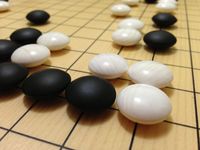
A two-player abstract-strategy mind sport of extraordinary depth, in which Black and White alternately place stones on a 19x19 grid to surround and form more territory than the other. Capturing fights interlock with the territory-building opening to create a depth that has kept this game alive for thousands of years.
Rules
A two-player abstract strategy game in which Black and White alternately place stones on the intersections of a 19-line grid, each trying to surround more territory than the other. Capturing fights and territory-building moves interlock to create the depth that has kept this game alive for thousands of years.
Components
| Component | Quantity | Notes |
|---|---|---|
| Board | 1 | A 19x19 grid with 361 intersections (per the Korea Baduk Association's 'How to Play' page) |
| Stones | 1 bowl each of black and white | Typically 181 black and 180 white stones, enough to fill all 361 intersections (exact spares vary by set) |
Every diagram in this guide uses a 9x9 board. The rules are identical regardless of board size, so this guide recommends learning the feel of liberties, captures and territory on a 9x9 board before moving to the full 19x19 board.
Stones sit on points, not squares
This guide's diagrams borrow a square-grid component to draw the board, but a real Go board is a point grid — stones are placed where the lines intersect. Each small square in a diagram stands for one intersection.
Setup
- 1Sit facing each other across an empty 9x9 board. Star points are just helpful landmarks; no special rule applies to them.
- 2One player takes the black stones, the other takes white. Black always moves first.
- 3When you move up to a full 19x19 board, apply the same rules to all 361 intersections.
Taking a turn
- 1Players alternate turns, each placing one stone of their own color on an empty intersection.
- 2Once placed, a stone can never be picked up and moved to another point.
- 3If you have no good place to play, you may pass instead of placing a stone.
- 4The game ends the moment both players pass in succession, moving to the counting procedure.
A pass is not a resignation
If one player passes and the other then plays a stone, the game continues normally. Only two passes in a row end the game.
Liberties and capture
A liberty is an empty intersection directly adjacent to a stone, horizontally or vertically — diagonals do not count. Stones of the same color connected horizontally or vertically share one combined pool of liberties.
Before the capture
White plays the last liberty
After the capture
A stone is removed the instant its liberties reach zero
The moment an opponent fills the last liberty of a stone or a connected group, that stone or group is removed from the board as a captured stone. Captured stones are later used to fill the opponent's territory when counting.
Forbidden moves — suicide and ko
| Forbidden move | Why | Exception |
|---|---|---|
| Suicide (self-capture) | Playing a stone that would leave it with zero liberties | Legal if that same move captures an opposing stone, creating a new liberty |
| Ko | Immediately recreating the exact position the opponent's last move produced | Legal once you have played elsewhere (a ko threat) first |
Before Black's capture
Black captures the single white stone
Right after Black's capture
Ko prevents an endless loop
If both sides kept recapturing the same single stone, the game would never end. The Korea Baduk Association's rules require a player to play elsewhere first before recapturing in a ko.
Life and death basics — living with two eyes
Turning the suicide rule around leads to an important conclusion: a group that completely owns two separate empty points (eyes) can never be captured. Playing into either eye would leave the opponent's own stone with zero liberties and nothing captured — a suicide move.
Two eyes — alive
One eye — dies
On a small board like 9x9, two eyes matter early
On a cramped board, territory can quickly be reduced to a single-eye shape. Always check whether your group holds two separated empty points.
Counting territory and komi
- 1Once the game ends (two passes in a row), remove any dead stones both players agree cannot survive, and add them to the captured-stone pile.
- 2Among the remaining empty intersections, count any point completely surrounded by only one color as that color's territory. A point either color can reach is dame and does not count as territory.
- 3Deduct captured stones from the opponent's territory, one point per captured stone (per the Korea Baduk Association's 'How to Play' page).
- 4Per Article 9 of the Korea Baduk Association's competition rules, Black deducts a 6.5-point komi from its territory count — compensation to White for not having the first move.
- 5After territory, captures and komi are all applied, the player with the higher total wins. Since komi is a half-point, there are no ties.
Seki counts as neither territory nor captures
A seki — a standoff where two groups share dame between them without either side daring to fill it — is excluded entirely from the territory count (Article 8 of the Korea Baduk Association's Rules of Baduk).
Ending the game and rare exceptions
- The game ends the moment both players pass in a row, moving straight to counting.
- If the players disagree on which stones are dead, they continue playing out the position until the capture is actually confirmed, then count.
- Extremely rare repeating shapes such as triple ko, eternal life, or cyclic ko are ruled a draw by repeated position under the Korea Baduk Association's rules (Article 9).
In practice, games are often decided before counting ever begins: a player who judges the position hopeless may simply stop playing and resign. This custom is not written as a separate numbered article in the Korea Baduk Association's 11-article Rules of Baduk, but it is widely used at the table.
Handicap games and regional rule differences
When two players have a large skill gap, a handicap game evens the odds.
- 1The weaker player takes Black and places an agreed number of handicap stones on star points before the game begins.
- 2In a handicap game, the two players usually agree that White moves first (per the Korea Baduk Association's 'How to Play' page).
- 3Handicap games commonly drop komi altogether or reduce it. The exact number and placement of handicap stones, and any komi adjustment, follow whatever tournament or club rules apply.
Unverified: a standard placement table by handicap count
The Korea Baduk Association source checked for this guide only confirms that White moves first in a handicap game. Check tournament rules or an instructor for the exact star-point placement used for each handicap count.
Komi varies by country
Per a Wikipedia cross-check, Japan and Korea use a 6.5-point komi, while Chinese rules use 7.5 points (or an equivalent stone-count adjustment). This guide follows the Korea Baduk Association's 6.5-point komi.
Etiquette at the board
- Offer the better seat to an elder or a stronger player.
- Hold a stone only with your right hand, pinching it lightly between your index and middle fingers. Avoid placing it loudly enough to click against the board.
- By convention, the first move of an even game goes in the upper-right corner, and the first move of a handicap game goes in the lower-right corner.
- Avoid unnecessary talk during play, and spectators should never offer advice on a move in progress.
- After the game, it's customary to say "well played" or "I learned a lot" to each other, then tidy the stones back into their bowls once counting is done.
Etiquette is part of Go culture too
The Korea Baduk Association describes this etiquette as part of Go's tradition as a 'way that values courtesy.' It carries no bearing on who wins, but it's a custom worth learning from your very first game.
Basic strategy
- Judge the position by territory size, not by how many stones you've captured — capturing many stones while holding little territory still loses.
- On a small board like 9x9, claiming space in the order corner, then side, then center is often stronger than fighting in one spot early.
- When one of your groups is down to two liberties or fewer, examine that situation first.
- Before every move, check both what it captures for you and whether your own group still keeps two separate eyes.
Frequently confused rules
Q. How are captured stones used when counting?
Per the Korea Baduk Association's 'How to Play' page, captured stones are deducted one for one from the opponent's territory during counting. Capturing more stones shrinks the opponent's territory count.
Q. Is a suicide move ever allowed?
Yes, if that same move captures an opposing stone and so gains a new liberty. What's forbidden is a move that captures nothing while leaving your own stone with zero liberties (Article 4).
Q. Why can't I immediately recapture in a ko?
Because immediate recapture would repeat the same single-stone exchange forever, and the game would never progress. The rules require playing elsewhere (a ko threat) before recapturing (Article 6).
Q. Do the rules differ between a 9x9 and a 19x19 board?
No. Liberties, captures, ko, suicide and territory counting all apply identically regardless of board size. A smaller board just has less territory, so games end faster.
Q. Why does Black give up points for komi?
Because moving first is an advantage. Article 9 of the Korea Baduk Association's competition rules compensates for that advantage by having Black deduct 6.5 points from its territory count in a standard game.
Q. Can a game end before counting even happens?
Yes, and it often does. A player who judges the position clearly lost may simply stop and resign. This is not written as a separate numbered article in the Korea Baduk Association's 11-article Rules of Baduk, but it is a common practice at the table.
History and today
Go is believed to have been invented in China more than 2,500 years ago and is often counted among the oldest board games still played today. Per a Wikipedia cross-check, the earliest surviving reference appears in the 4th-century-BCE text Zuo Zhuan, describing an event from 548 BCE.
The game reached the Korean peninsula by the Three Kingdoms period. Per a Namuwiki cross-check, the Samguk Yusa records that the Goguryeo monk Dorim played Go with King Gaero of Baekje, and Goguryeo-era relics found near Pyongyang are counted among the oldest domestic evidence of the game.
Modern Korean Go took shape when Jo Nam-cheol founded the Hanseong Gi-won (the forerunner of the Korea Baduk Association) in 1945, reorganizing domestic play around Japanese-style rules. Players such as Cho Hunhyun, Lee Chang-ho, and Lee Sedol went on to become world-class professionals.
In March 2016, 9-dan professional Lee Sedol played a five-game match against Google DeepMind's AlphaGo, which won 4 games to 1. This is counted as a landmark case of artificial intelligence defeating a top-ranked professional, and it greatly increased public interest in Go within Korea.
The professional qualification system is still active
Per a Namuwiki cross-check, the Korea Baduk Association selects roughly 120 trainees (yeon-gu-saeng) each year, ranked into tiers, and trainees must pass a professional qualification tournament to turn professional; women compete in a separate qualification tournament. Check the Korea Baduk Association's own notices for the current intake and system.
Sources
Korea Baduk Association official 'Rules of Baduk' — placing stones, liberties, forbidden moves, life/death, ko, territory and dame, seki, repeated positions, counting (Articles 1-11)Korea Baduk Association official 'Competition Rules' — 6.5-point komi (Article 9)Korea Baduk Association official 'How to Play' — 19x19 board, 361 points, Black moves first except in handicap gamesKorea Baduk Association official 'History of Baduk'Korea Baduk Association official 'Etiquette' — seating, how to hold a stone, where to play the first stone, greetingsNihon Ki-in official English rules — 'How to Play GO': intersections, liberties, territory, suicide, ko, opening through endgame, counting, handicap playWikipedia cross-check — Go (game)Namuwiki cross-check — Baduk, the Korean name for GoRule summaries are reference content written by us, not quotations from the official rulebook. Always check the official rulebook for exact rules. Diagrams are original schematics, not rulebook illustrations.
Spotted a mistake? Tell us in the comments below →
Last updated 2026-10-11
💡 Master tip
Don't get fixated on capturing stones. The player who completes the largest territory wins Go, not the player who captures the most stones. In the opening, claiming space broadly across the whole board usually matters more than a local fight.
Tools you can request
Not built yet. Let us know if you want one — it goes on the list.
Go territory and komi (6.5-point) auto-counter
Counts captured stones and territory size
Byo-yomi sound timer
30-second/45-second byo-yomi voice countdown
Comments
Share your thoughts, report a mistake, or request a tool. No sign-in needed — nicknames are not verified, so anyone can use the same one.
Loading…