Top 122
Shogi
Similar to chess or Korean janggi, but with a distinctive twist: captured enemy pieces switch sides and can be freely dropped back onto the board as your own. Because pieces never leave play for good, the tension stays high from the opening all the way to the endgame.
Rules
Like chess or Korean janggi, this is a 9x9 checkmate game for two — but its defining feature is the drop (mochigoma) rule: a captured piece switches sides and can be placed back on the board anywhere by its captor. Because pieces never leave the game for good, the tension never lets up until the very end.
Components
| Component | Quantity | Notes |
|---|---|---|
| Board | 1 | A 9x9 grid of squares, 81 squares total |
| Pieces | 40 (20 per side) | 1 king, 1 rook, 1 bishop, 2 golds, 2 silvers, 2 knights, 2 lances, 9 pawns = 20 per side (per the JSA's 'Shogi Basics' page 01) |
Pieces are pentagonal wedges of wood
Real shogi pieces are identical in color for both players — plain wooden pentagons. The pointed end simply faces toward the opponent, marking which side owns it. This guide's diagrams color pieces (orange for Sente, teal for Gote) purely to make the two sides easier to tell apart.
Initial setup
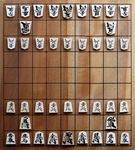
- 1Sit facing each other across an empty 9x9 board and arrange 20 pieces each across your own three rows, as shown.
- 2The player who moves first is called Sente, and the second player Gote. In casual play, players sometimes decide who goes first by tossing a handful of pawns and counting which side lands face-up more often — a custom called furigoma (per the JSA's 'Shogi Basics' page 06).
- 3Sente always moves first.
Taking a turn
- 1Players alternate turns. On your turn you either move one of your own pieces, or drop one piece from your hand (mochigoma) onto an empty square — never both in the same turn.
- 2If the destination square holds an opponent's piece, that piece is captured and joins your own hand. From that moment it belongs to the capturing side.
- 3You may not move onto a square already occupied by your own piece.
The opposing king is never actually captured
Per the JSA's 'Shogi Basics' page 04, shogi is defined as a game where capturing the opponent's king wins, but in practice the game ends the instant checkmate is confirmed — the final capturing move is never actually played out.
How each piece moves
| Piece | Normal movement | After promotion |
|---|---|---|
| King | One square in any of the 8 surrounding directions | Never promotes |
| Rook | Any distance along a rank or file (cannot jump over other pieces) | Promoted Rook (Dragon King) — rook's movement plus one square diagonally |
| Bishop | Any distance along a diagonal (cannot jump over other pieces) | Promoted Bishop (Dragon Horse) — bishop's movement plus one square orthogonally |
| Gold general | One square orthogonally or diagonally forward (6 directions; the two backward diagonals are excluded) | Never promotes |
| Silver general | One square forward, or one square diagonally forward or backward (not straight sideways or straight back) | Promoted Silver — moves exactly like a Gold general |
| Knight | Jumps to either of the two squares two ranks forward and one file to the side (jumps over anything in between) | Promoted Knight — moves exactly like a Gold general |
| Lance | Any distance straight forward (cannot jump over other pieces) | Promoted Lance — moves exactly like a Gold general |
| Pawn | One square straight forward only | Tokin (promoted pawn) — moves exactly like a Gold general |
Promotion rules
A piece may be flipped over to promote the moment it enters, moves within, or leaves the farthest three ranks (the enemy camp). Kings and gold generals never promote. Promotion is usually optional, and declining to promote is perfectly legal (per the JSA's 'Shogi Basics' page 02).
Before promotion
Entering the enemy camp and flipping the piece
After promotion
Declining promotion can leave a piece stranded
A pawn or lance left unpromoted on the farthest rank, or a knight left unpromoted on either of the farthest two ranks, has no square left to move to. In those situations, promotion is effectively forced.
Dropping captured pieces (mochigoma) and forbidden drops
Any piece you capture joins your hand (mochigoma). On a later turn, instead of moving, you may place one hand piece on any empty square, always in its unpromoted form. This is called a drop.
In hand
Dropped onto an empty square
After the drop
| Forbidden drop | Details |
|---|---|
| Two pawns on a file (nifu) | You may not drop an unpromoted pawn onto a file that already holds one of your unpromoted pawns. A promoted pawn (tokin) on that file does not count |
| Drop pawn checkmate (uchifuzume) | Dropping a pawn so that the very same move delivers checkmate is illegal. Giving check with a dropped pawn, or delivering checkmate by advancing a pawn already on the board, is legal |
| Dropping into a dead square | Dropping (or leaving unpromoted) a pawn or lance on the farthest rank, or a knight on either of the farthest two ranks, is illegal — none of these could ever move again |
A foul ends the game immediately
Per Article 10 of the JSA's competition rules, a player who commits a foul (nifu, uchifuzume, an illegal drop, ignoring check, moving twice in a row, and so on) loses on the spot and the game does not continue.
Checkmate, repetition and entering the king
Per the JSA's 'Shogi Basics' page 04, checkmate (tsumi) occurs when the king has no square to flee to, the checking piece cannot be captured, and no other piece can block — the game ends immediately. In practice, players conventionally resign before an actual checkmate is forced.
- Repetition (sennichite): Per Article 8 of the JSA's competition rules, if the exact same position — piece placement, both hands, and whose turn it is — occurs four times, the game is a draw and is replayed with sides swapped.
- Perpetual-check repetition: If that fourfold repetition was caused by one side giving check every single time, the checking side loses on the spot instead of drawing.
- Entering the king (nyugyoku): Per Article 9 of the JSA's competition rules, once a king has advanced deep into enemy territory and checkmate becomes effectively impossible, the game is scored instead — each rook or bishop is worth 5 points, and every other piece (gold, silver, knight, lance, pawn) is worth 1 point (the king itself scores nothing). If both sides reach 24 points or more, it's a draw and the game is replayed; if either side falls below 24, that side loses.
The declaration method within 500 moves
If the game has not exceeded 500 moves, a player who declares entering-king scoring wins outright with 31 points or more, or draws and replays with 24 to 30 points. Unverified: the exact procedure once a game passes 500 moves was not spelled out in the source checked for this guide, so it is omitted here.
Handicap games and differences from Korean janggi
When two players have a large skill gap, komaochi (piece-handicap games) even the odds. The stronger player removes some of their own pieces before play begins, and the weaker player takes Sente.
| Handicap | Pieces removed |
|---|---|
| Lance handicap | 1 lance |
| Bishop handicap | 1 bishop |
| Rook handicap | 1 rook |
| Rook-lance handicap | 1 rook + 1 lance |
| Two-piece handicap | 1 rook + 1 bishop |
| Four-piece / six-piece / eight-piece handicap | 4 / 6 / 8 pieces (the stronger player removes progressively more) |
| Feature | Shogi | Korean janggi (per a Namuwiki cross-check) |
|---|---|---|
| Captured pieces | Join the capturer's hand and can be dropped back onto the board | Removed from the game permanently — never reused |
| Promotion | Pieces flip to promote inside enemy territory | No promotion mechanic at all |
| Piece look and color | Same-colored pentagonal wooden pieces; the side they point toward shows ownership | Disc-shaped pieces in two colors/scripts (Han and Cho) to tell sides apart |
| Pawn/soldier movement | Straight forward only | Soldiers can move sideways from the very start (per Namuwiki) |
Basic strategy
- Because dropped pieces never run out, build a defensive formation (kakoi) of golds and silvers around your king early — otherwise a sudden drop attack can end the game fast.
- Pay attention to which pieces you hand over by trading. Avoid casually exchanging threatening pieces like rooks and bishops.
- Before dropping a pawn, always check whether that file already has one of your unpromoted pawns — nifu.
- Pawns, lances and knights eventually run out of room to advance, so decide whether to promote the instant one of them enters enemy territory.
Frequently confused rules
Q. Can I drop a captured piece back onto the board already promoted?
No. A dropped piece always returns to the board in its original, unpromoted form. It must re-enter enemy territory to be promoted again.
Q. Is it illegal to simply check the king with a dropped pawn?
No. The only foul is dropping a pawn so that the very same move delivers checkmate (uchifuzume). Checking with a dropped pawn, or delivering checkmate by advancing a pawn already on the board, is completely legal.
Q. Is promotion always mandatory?
Mostly it's optional. But if leaving a pawn or lance unpromoted on the farthest rank, or a knight unpromoted on either of the farthest two ranks, would strand it with no legal move, promotion is effectively forced in that case.
Q. Can a promoted pawn (tokin) share a file with an unpromoted pawn?
Yes. Nifu applies only between two unpromoted pawns on the same file. A tokin is no longer a pawn for this rule, so it doesn't trigger nifu.
Q. Does any repeated position automatically end in a draw?
No. The exact same position — piece placement, both hands, and whose turn it is — must occur four times for sennichite to apply. And if that repetition was caused by one side giving check every time, the result isn't a draw at all — the checking side loses.
Q. Does entering the king (nyugyoku) always end in a draw?
No. Points are scored at 5 per rook or bishop and 1 per other piece. Both sides reaching 24 or more points is a draw and replay, but if either side falls below 24, that side loses.
History and today
Per a Wikipedia cross-check, shogi's earliest ancestor, chaturanga, began in 6th-century India and reached Japan by way of China and the Korean peninsula. The modern form of the game — including the drop rule — was already in play by at least the 15th century, while records of an earlier ancestor without drops date back to 1210.
Today the Japan Shogi Association (JSA) governs professional titles and the official rules. Per a Namuwiki cross-check, Fujii Sota stood out as a talented player from his high-school years onward and is counted among the sport's leading modern representatives, competing across multiple title matches.
Per a Namuwiki cross-check, shogi remains a very niche hobby in Korea, where dedicated retailers are rare and players have relied on overseas purchases or direct imports. A JSA Seoul branch was established in 2015, creating a venue for exchange.
Shogi and janggi have taken different paths
Per a Namuwiki cross-check, Korean janggi is often seen as a pastime for older generations and its standing has been shrinking, while Japanese shogi is treated as a recognized mind sport. Even so, the same sources note that shogi's own player base in Japan has been declining alongside the population.
Sources
Japan Shogi Association (JSA, shogi.or.jp) official rules — piece setup, movement, piece characteristics, check and checkmate, fouls, practical play (knowledge/shogi 01-06)Japan Shogi Association official competition rules — fouls (Art. 10), repetition/sennichite (Art. 8), entering king/nyugyoku (Art. 9)BGG 2065 — player count, age, time and weight (BGG blocks automated fetches, but these match the catalog's existing figures)Wikipedia cross-check — ShogiNamuwiki cross-check — Syogi, the Korean name for ShogiNamuwiki cross-check — Janggi (Korean chess, for comparison)Rule summaries are reference content written by us, not quotations from the official rulebook. Always check the official rulebook for exact rules. Diagrams are original schematics, not rulebook illustrations.
Spotted a mistake? Tell us in the comments below →
Last updated 2026-10-11
💡 Master tip
Because of the drop rule, if you don't build a solid defensive formation (kakoi) around your king early, a sudden drop attack can capture your king almost immediately. Also be careful about which pieces you hand over through trades — avoid casually exchanging threatening pieces.
Tools you can request
Not built yet. Let us know if you want one — it goes on the list.
Legal drop-square checker for captured pieces
Flags the two-pawns-on-a-file (nifu) foul, which is normally forbidden
Shogi promotion movement guide
Shows how a piece's movement changes when it flips to its promoted side
Comments
Share your thoughts, report a mistake, or request a tool. No sign-in needed — nicknames are not verified, so anyone can use the same one.
Loading…