Top 87
Chess
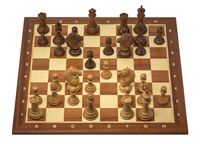
A traditional abstract strategy game in which you maneuver six piece types — king, queen, rook, bishop, knight, and pawn — across an 8x8 board, using each piece's distinctive movement to checkmate your opponent's king. Centuries of opening theory and endless tactical depth give this game its richness.
Rules
A two-player abstract strategy game played on an 8x8 board with six piece types — king, queen, rook, bishop, knight and pawn — where the goal is to checkmate the opponent's king. This guide covers only what you need to play your first game.
Components
A two-player game: one player takes the white pieces, the other the black pieces.
| Component | Count | Notes |
|---|---|---|
| Board | 1 | An 8x8 grid of 64 squares, alternating light and dark. |
| King | 1 per side (2 total) | The game ends the moment this piece is checkmated. |
| Queen | 1 per side (2 total) | Moves any distance along ranks, files and diagonals — the most powerful piece. |
| Rook | 2 per side (4 total) | Moves along ranks and files, and takes part in castling. |
| Bishop | 2 per side (4 total) | Moves diagonally only, staying on the same-coloured diagonals for the whole game. |
| Knight | 2 per side (4 total) | Moves in an L-shape and is the only piece that can jump over others. |
| Pawn | 8 per side (16 total) | Moves forward only and captures only diagonally forward. |
Tournament play often adds a chess clock. The basic rules work perfectly well without one.
Piece values are just a rule of thumb
There's no official points system in the rules, but when weighing a trade it's common to use the rough convention of queen 9, rook 5, bishop or knight 3, pawn 1 (the king is never captured, so it gets no point value). Actual value always depends on where a piece sits and the position on the board.
Setup and objective
- 1Place the board so that each player's near-right corner square is light.
- 2Arrange your 16 pieces across your own two ranks as shown. Both sides' setups mirror each other.
- 3White always moves first. The objective is to checkmate the opponent's king.
Taking a turn
- 1Players alternate turns, each moving one of their own pieces according to its rules (castling is the only exception, counting as a single move of two pieces).
- 2If the destination square holds an opponent's piece, that piece is captured and removed. You may never move onto a square you already occupy.
- 3There is no passing — as long as you have at least one legal move, you must make one.
Touch-move
If you touch a piece, you must move it (if it has a legal move). To adjust a piece's position without being bound to move it, say "j'adoube" or "I adjust" before touching it. This does not apply to a piece that has no legal move.
How each piece moves
| Piece | Movement | Notes |
|---|---|---|
| King | One square in any direction (orthogonal or diagonal) | Moves two squares only when castling |
| Queen | Any distance along a rank, file or diagonal | The most far-reaching piece |
| Rook | Any distance along a rank or file | Takes part in castling together with the king |
| Bishop | Any distance along a diagonal | Stays on the same-coloured diagonal it started on |
| Knight | An L-shape: two squares then one at a right angle | The only piece that can jump over other pieces |
| Pawn | One square forward (two on its first move), captures only one square diagonally forward | Subject to the separate en passant and promotion rules |
No sliding through pieces
The queen, rook and bishop cannot move past another piece blocking their path. The knight is the only piece that jumps over others.
Special moves — castling, en passant and promotion
Castling is the only move that shifts two pieces at once. The king moves two squares toward a rook, and that rook moves to the square the king just crossed.
Before castling — king on e1, rook on h1
Kingside castling
After castling — king on g1, rook on f1
- Castling is illegal if the king or that rook has ever moved before (even if it moved and returned to its original square).
- Castling is illegal if there is any piece between the king and the rook.
- Castling is illegal if the king is currently in check, or if the square it passes through or the square it lands on is attacked by an opposing piece.
En passant lets you capture an opponent's pawn that has just advanced two squares from its starting square to land beside yours, treating it as though it had moved only one square.
Right after White plays e2–e4
d4 pawn moves to e3
Black captures en passant, removing White's pawn
The chance lasts only one move
En passant is only legal on the move immediately following the two-square advance. If you let that turn pass, you can no longer capture that pawn en passant.
Promotion happens when a pawn reaches the farthest rank from its start: it must immediately become a queen, rook, bishop or knight of the same colour.
White's pawn on e7
e7 → e8 promotion
Promoted to a queen on e8
Notation basics
The board's vertical columns are called files, lettered a–h from White's left, and the horizontal rows are called ranks, numbered 1–8 starting from White's side. A square is named by its file then rank (e.g. e4).
| Notation | Meaning |
|---|---|
| e4 | A pawn moves to e4 |
| Nf3 | The knight (N) moves to f3 |
| O-O / O-O-O | Kingside / queenside castling |
| exd5 | A piece on the e-file captures on d5 |
| e8=Q | A pawn on e8 promotes to a queen |
| + / # | Check / checkmate |
A real game score reads like '1.e4 e5 2.Nf3 Nc6', alternating one move per side. The number marks the move count, with White's move and Black's move written side by side. A square name with no piece letter in front of it means a pawn move.
Check, checkmate and draws
- If your move puts the opponent's king where it could be captured next, that is check. The checked player must block it, move the king away, or capture the attacking piece.
- If there is no legal move that gets out of check, that is checkmate, and the game ends immediately — the checkmated side loses.
- If a player has no legal move at all but is not in check, that is stalemate, and the game is drawn. Even a clearly winning side only draws if it stalemates the opponent.
- If neither side can possibly checkmate the other with any sequence of legal moves, that is a dead position and the game is drawn.
- A draw may be claimed when the same position occurs for a third time, or when 50 moves pass for each side with no capture and no pawn move.
- The players may also agree to a draw at any time.
- In tournaments, results are scored as 1 point for a win, 0.5 for a draw and 0 for a loss, to compare standings across several games.
Basic strategy
- Don't leave your king stranded in the centre early on — castle early to tuck it away safely.
- Develop your bishops and knights quickly so they have room to act.
- Since the queen and rooks are blocked by anything in their path, check whether your own pieces are blocking each other's lines.
- The knight is the only piece that jumps over others, so its L-shaped move is especially useful in cramped positions.
Formats and variants
- Classical, rapid and blitz: the same rules played with a chess clock giving each side progressively less time. Running out of time (flag-fall) loses the game.
- Fischer Random (Chess960): the back rank pieces are shuffled randomly at the start, designed to reduce reliance on memorised opening theory. Castling conditions are adjusted to fit the resulting setup.
Frequently asked questions
Q. When is castling not allowed?
Castling is illegal if the king or that rook has moved before, if any piece sits between them, if the king is currently in check, or if the square the king passes through or lands on is attacked.
Q. Can en passant be played at any time?
No. It is only legal on the move immediately following the opponent's two-square pawn advance. If you let that turn pass, you can no longer capture that pawn en passant.
Q. Must a pawn promote to a queen?
No. You may choose a queen, rook, bishop or knight, regardless of which pieces have already been captured.
Q. What happens on stalemate?
If a player has no legal move and is not in check, the game is drawn. Even a side that was clearly winning only draws if it stalemates the opponent.
Q. What's the difference between check and checkmate?
In check, the king is attacked but the player still has a move that blocks it, moves the king away, or captures the attacker. In checkmate, no such move exists, and the game ends immediately.
Q. If I touch a piece, must I move it?
Yes — that's the touch-move rule. A piece with no legal move is the exception. To adjust a piece's position without this obligation, say 'j'adoube' before touching it.
Q. Besides checkmate, how else can the game end in a draw?
By stalemate, a dead position where neither side can checkmate the other, the same position occurring a third time, 50 moves passing for each side with no capture or pawn move, or by agreement.
History and today
The recorded history of chess begins with chaturanga in 7th-century India. The game travelled through Persia into the Arab world and then into Europe, changing along the way.
The queen's and bishop's modern, powerful moves, along with castling and en passant, were established in Europe by the end of the 15th century. The Staunton piece design later became the standard for competition, and the International Chess Federation (FIDE) now writes and maintains the official Laws of Chess.
Wilhelm Steinitz became the first universally recognised World Champion in 1886, and in 2024 Gukesh Dommaraju became champion at a remarkably young age. In 1997, the computer Deep Blue became the first machine to defeat a reigning World Champion, and chess engines have since surpassed human playing strength by a wide margin.
In Korea, chess has long been less well known than baduk (go) or janggi, but interest grew after the 2020 Netflix series 'The Queen's Gambit', alongside a rise in online play. The 2022 Hangzhou Asian Games was the first Asian Games to include chess as an official event.
Namuwiki attributes chess's long-standing low profile in Korea partly to baduk's much greater popularity and to janggi, a similar traditional game that was already well established there. Read together, that suggests Koreans simply had fewer opportunities to encounter chess.
Domestic rankings keep changing
As of a Namuwiki snapshot from August 2025, the Korea Chess Federation's top-ranked domestic player was IM Lee Jun-hyeok, with IM An Hong-jin recorded as the strongest Korean-born player. Rankings like these change over time, so check the Korea Chess Federation's own notices for the current standings.
Sources
FIDE official rules — Laws of Chess (effective 1 January 2023), handbook.fide.comKorea Chess Federation official 'How to Play' page — piece moves, castling, en passant, promotion, touch-moveWikipedia cross-check — ChessNamuwiki cross-check — Chess (Korean)Rule summaries are reference content written by us, not quotations from the official rulebook. Always check the official rulebook for exact rules. Diagrams are original schematics, not rulebook illustrations.
Spotted a mistake? Tell us in the comments below →
Last updated 2026-10-10
💡 Master tip
Whoever claims the four central squares first with central pawns and knights comes to dominate the movement paths of every piece on the board.
Similar games
Ready for something heavier
If this one has gotten too easy, try these — same feel, one step up in weight.
Tools you can request
Not built yet. Let us know if you want one — it goes on the list.
Chess clock timer
Official FIDE Fischer / basic time-control timer
Piece value calculator
Compares point values: queen (9), rook (5), bishop/knight (3), pawn (1)
Comments
Share your thoughts, report a mistake, or request a tool. No sign-in needed — nicknames are not verified, so anyone can use the same one.
Loading…