Top 134
Ubongo
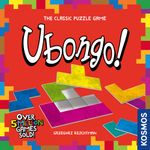
A real-time puzzle race where you cover the placement area of your own board exactly with tiles before the hourglass runs out and shout «Ubongo!». Its odd pull — your head racing and your mouth busy — makes it a standard family game.
Rules
A puzzle race: cover the placement area completely with a given set of tiles before the hourglass runs out. You play 9 rounds and win on the total value of the gems you collected. Solving fast is not enough — you also have to watch which gems are at stake.
Components
| Component | Count | Notes |
|---|---|---|
| Tiles | 12 × 4 sets | Each player uses one set of 12 |
| Puzzle boards | 36 | The two sides differ in difficulty, giving 432 puzzles |
| Die | 1 | Decides which set of tiles to use this round |
| Hourglass | 1 | The time limit |
| Game round track | 1 | Holds the reward gems and counts the rounds |
| Gems | 58 | 19 sapphires (blue) · 19 ambers (brown) · 10 rubies (red) · 10 emeralds (green) |
| Cloth bag | 1 | Holds the gems |
The gems are worth different amounts
Red 4 points · blue 3 points · green 2 points · brown 1 point. You win on total points, not on how many gems you have.
Setup
- 1Take the 36 puzzle boards out of the box. One side holds the easy tasks, which need 3 tiles, and the other the harder tasks, which need 4 tiles.
- 2Use the easy side for your first game. Turn the boards so the easy side is face down and stack them in the middle of the table. The tasks must stay hidden.
- 3Each player takes one set of 12 tiles, each set in its own color. With fewer than four players, put the unused sets back in the box.
- 4Put the game round track in the middle and take nine sapphires and nine ambers from the bag, fitting them into the holes of the track. These 18 gems are both the rewards and the round counter.
- 5Put the hourglass and the die on the table. All the other gems go into the bag.
How a round runs
- 1Each player takes a puzzle board from the stack, puts it in front of them, and turns it over so the easy side (3 tiles) is showing.
- 2The player whose turn it is rolls the die and flips the hourglass right away. The symbol rolled shows which set of tiles everyone has to use.
- 3Each player looks at the tiles drawn next to that symbol on their board and finds them in their own set of 12 as fast as they can.
- 4Fit those tiles exactly into the light-colored placement area of the board. The area must be covered completely and no tile may stick out. You may rotate and flip the tiles.
- 5Whoever finishes shouts "Ubongo!". Everyone else keeps working until the hourglass runs out.
- 6As soon as someone notices the hourglass has run out, they shout "Stop" and everyone stops immediately.
If nobody solved it, play a second-chance round
If the hourglass runs out and nobody has finished, flip the hourglass once more and keep working. If still nobody solves it, the round simply ends there.
Rewards — only first and second take from the track
| Place | From the game round track | From the bag |
|---|---|---|
| 1st | 1 sapphire (blue) | 1 at random |
| 2nd | 1 amber (brown) | 1 at random |
| 3rd | None | 1 at random |
| 4th | None | 1 at random |
| Did not finish | None | None |
Third and fourth place still draw a random gem from the bag, and a ruby (4 points) out of that draw can beat first place's blue (3 points) plus a random gem. Finishing at all earns you a draw, so it is better to keep solving even when you are slow.
End of the round and the next one
Exactly two gems must leave the track each round
At the end of a round the track has to hold one blue and one brown fewer than when the round started. If only one player finished, toss the leftover brown into the bag; if nobody finished, put both the blue and the brown into the bag.
- Used puzzle boards go on a shared discard pile.
- Each player takes a fresh puzzle board for the next round.
- The die and the hourglass pass to the player to the left of whoever rolled last.
End of the game and the winner
- The game ends after 9 rounds, that is, when no gems are left on the game round track.
- Each player adds up the value of the gems they collected. The highest score wins.
- On a tie, the tied players hold a playoff. Each takes a puzzle board and one of them rolls the die. The hourglass is not used, and the first to finish wins the whole game.
A scoring example
1 ruby + 1 sapphire + 3 emeralds + 3 ambers = 4 + 3 + (2×3) + (1×3) = 16 points.
Playing alone (official variant)
- Get a clock or a stopwatch.
- Either solve as many tasks as you can within 5, 10, or 20 minutes, or time how long it takes you to solve 5, 10, or 20 tasks.
- If a task has you stuck, set it aside and take a new board.
- Write your results down and try to beat them every time you play.
Rules people get wrong
Q. May I flip the tiles over?
Yes. Rotating and flipping are both allowed. The tiles just may not stick out of the placement area.
Q. May I use tiles other than the ones called for?
No. Only the tiles drawn next to the symbol the die rolled.
Q. Is first place always the best result?
Not always. First place gets a blue (3 points) plus a random gem while third place gets only a random gem, but that random gem may be a ruby (4 points). On average, though, first place is still better.
Q. If nobody solves it, is the round simply void?
You play one second-chance round. If nobody solves that either, the blue and brown for that round go back into the bag and play moves on.
Q. Can we mix the easy and the harder side?
The rulebook has you keep the same difficulty for the whole game. For a first game we recommend the easy side with 3 tiles.
Q. How do we count the 9 rounds?
You do not have to. The nine blues and nine browns on the game round track are the round counter.
History and editions
| Item | Detail |
|---|---|
| Designer | Grzegorz Rejchtman |
| Art | Bernd Wagenfeld, Karl Homes, Nicolas Neubauer |
| Publisher | Kosmos, 2003 · revised edition 2015 |
| What the name means | «Brain» in Swahili |
| Spin-off | Notes |
|---|---|
| Ubongo 3-D | You stack solid pieces into layers instead of covering a flat area |
| Ubongo Duel | For 2 players |
| Ubongo Junior / Mini | Shorter versions for children and for travel |
Sources
Official Kosmos / Thames & Kosmos rulebook (Ubongo, English)Wiki cross-check — Wikipedia: UbongoRule summaries are reference content written by us, not quotations from the official rulebook. Always check the official rulebook for exact rules. Diagrams are original schematics, not rulebook illustrations.
Spotted a mistake? Tell us in the comments below →
Last updated 2026-09-14
💡 Master tip
Settle where the biggest tile goes first, then fit the smaller ones around it. If you get stuck, turn the board 90 degrees — the same puzzle looks different.
Ready for something heavier
If this one has gotten too easy, try these — same feel, one step up in weight.
Comments
Share your thoughts, report a mistake, or request a tool. No sign-in needed — nicknames are not verified, so anyone can use the same one.
Loading…