Top 88
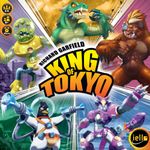
King of Tokyo
A dice game where you become a giant monster fighting to take over Tokyo. Like Yahtzee, you can reroll dice up to three times to choose between attacking, healing, gaining energy, or Victory Points, and the thrill comes from the high-risk structure where holding Tokyo means hitting everyone else while taking hits from everyone else in return.
Rules
Play a giant Monster, rolling dice up to three times to choose attack, heal, energy, or Victory Points — in this party dice game, holding Tokyo scores you points every turn but denies you healing, so you're always weighing whether to stay or run.
Components
| Component | Count | Notes |
|---|---|---|
| Monster boards | 6 | A Life Points dial (starts at 10) and a Victory Points dial (starts at 0) |
| Monster figures | 6 | Placed on the Tokyo board whenever that Monster is in Tokyo |
| Tokyo board | 1 | Tokyo City plus Tokyo Bay (Bay used only with 5 or 6 players) |
| Black dice | 6 | Each die has 6 different faces: 1, 2, 3, attack, heal, and energy |
| Green dice | 2 | Not used on a normal turn — only rolled when a Power card allows it |
| Power cards | about 66 (per the box contents) | Name, Energy cost, Keep/Discard type, and an effect |
| Status tokens | 28 (3 Smoke, 1 Mimic, 12 Shrink, 12 Poison) | Used alongside specific Power cards |
| Energy cubes | a shared pool | Gained from energy die faces; spent to buy Power cards |
What the status tokens are for
Poison and Shrink tokens mark a lingering effect that certain Power cards attach to an opponent. The token stays even if the card that placed it is later discarded, and it keeps working until removed by an attack (wound/smash) from outside Tokyo. Smoke and Mimic tokens mark other specific card effects the same way.
Setup
- 1Shuffle the Power card deck and reveal the top 3 cards face up next to the Tokyo board. Place the tokens nearby and form a shared pool with all the Energy cubes.
- 2Each player picks a Monster and takes its figure and Monster board. Set Life Points to 10 and Victory Points to 0.
- 3Place the Tokyo board in the middle, within easy reach of everyone. With 2 to 4 players, use only Tokyo City. With 5 or 6 players, use both Tokyo City and Tokyo Bay.
- 4Put the 6 black dice in the center and set the 2 green dice aside (only used when a Power card lets you roll them).
- 5Everyone rolls the 6 black dice; whoever shows the most attack faces goes first. On a tie, only the tied players roll again to break it.
No Monster starts the game inside Tokyo. The first player enters Tokyo City during their own Enter Tokyo step regardless of whether they rolled any attacks.
A turn — five steps
| Step | What happens |
|---|---|
| 1. Roll Dice | Roll the 6 black dice (plus green dice if a Power card allows) up to 3 times. |
| 2. Resolve Dice | Apply every face from your final roll, in any order you like, but all of them. |
| 3. Enter Tokyo | If Tokyo is empty, you move in (regardless of what you rolled). |
| 4. Buy Power Cards | Spend Energy on any of the 3 face-up cards you can afford. Spending 2 Energy also sweeps all 3 away and reveals new ones. |
| 5. End of Turn | Certain Power card effects trigger here, then pass the dice to the player on your left. |
- 1Your first roll uses all the dice.
- 2Set aside any faces you like, and reroll only the rest — up to two more times (three rolls total).
- 3On your third roll, you may change your mind and reroll dice you had set aside earlier, too.
- 4Once you stop rolling (or use all 3 rolls), move on to step 2, Resolve Dice, with that final result.
Reading the six die faces
Each black die has 6 different faces — the numbers 1, 2, and 3, plus attack, heal, and energy symbols. You may resolve them in any order, but you must resolve every face you rolled.
| Face rolled | Effect |
|---|---|
| 3 or more of the same number (1, 2, or 3) | Gain Victory Points equal to the number; each die beyond 3 of a kind adds 1 more |
| Attack | If you're in Tokyo, everyone outside loses 1 Life Point per attack; if you're outside, everyone inside Tokyo does |
| Heal | Only outside Tokyo: gain 1 Life Point per heal (capped at 10). No effect while in Tokyo |
| Energy | Regardless of location: gain 1 Energy cube per symbol, kept in your reserve |
Attacks are based on where you are, not who you are
Rolling attack while inside Tokyo wounds everyone outside; rolling it while outside wounds everyone inside Tokyo. Monsters sharing Tokyo (City and Bay both count) never wound each other.
Entering Tokyo and yielding
- 1If Tokyo is empty, the active player must enter Tokyo City.
- 2A Monster inside Tokyo who loses Life Points from another Monster's attack may immediately choose to stay or Yield.
- 3Yielding does not undo the damage already taken — the choice only affects what happens next.
- 4With 5 or 6 players, if Tokyo City is occupied but Tokyo Bay is empty, an entering Monster goes to the Bay instead (both City and Bay count as 'in Tokyo').
- 5Once the game drops to 4 or fewer players, a Monster in Tokyo Bay must leave immediately (moving into Tokyo City instead, if it's empty).
You can only Yield after taking attack damage
Losing Life Points from a Power card effect does not grant this choice. Only a dice attack from another Monster lets you decide whether to stay in Tokyo or leave.
Ways to gain Victory Points
| Source | Victory Points |
|---|---|
| 3 or more matching numbers (1, 2, or 3) | Equal to the number; +1 more per die beyond 3 of a kind |
| The moment you enter Tokyo | +1 |
| Starting your turn inside Tokyo | +2 |
| Certain Power card effects | As printed on the card |
End of the game
The game ends at the end of the turn in which a Monster reaches 20 Victory Points, or the moment only one Monster remains. Whoever reached 20 first, or is the last Monster standing, is crowned King of Tokyo.
You must survive the turn to win
If a Power card effect brings you to 20 Victory Points and 0 Life Points in the same turn, you are eliminated instead — reaching 20 only counts if you end that turn with at least 1 Life Point. If every Monster is eliminated at the same moment, no one wins.
Strategy tips
- Only 1 of a die's 6 faces is an attack. Count how many dice an opponent is rolling to estimate expected damage, and seriously consider leaving Tokyo once your Life Points drop to 4 or below.
- Healing only works outside Tokyo — the longer you hold Tokyo, the more points pile up, but you lose any way to recover health.
- Saving Energy lets you aim for pricier Power cards, but spending 2 Energy to sweep away 3 unappealing cards is rarely a bad trade.
- Extra dice beyond 3-of-a-kind add up fast, so on your second and third rolls, weigh keeping a number you've already matched against chasing something new.
- Rolling attacks while outside Tokyo hits everyone inside at once — a solid way to clear Tokyo and make room for your own turn there.
Editions and expansions
| Item | Notes |
|---|---|
| This guide covers | IELLO's 2016 edition base game — 2 to 6 players |
| Differences from the 2011 original | Designed by Richard Garfield and first published by IELLO in 2011. The 2016 edition swapped in new artwork and new Monster designs; the core rules did not change. |
| 2-player variant (optional rule) | Added in the 2023 reprint rules — instead of +1 VP for entering Tokyo, gain +1 Energy; instead of +2 VP for starting your turn in Tokyo, gain +1 Energy (everything else stays the same). |
| Power Up! (2012) | Expansion adding Evolution cards and a new Monster (Pandakai) |
| Halloween (2013), Monster Pack series (2017–2019) | Smaller expansions adding new Monsters |
| Dark Edition (2016) | A repackaging with different art, same rules |
| King of New York (2014) | A standalone game sharing the same core rules, set in New York with added elements like destroying buildings and fighting the army |
| King of Tokyo: Duel (2024), Origins (2024), King of Monster Island (2022) | Spin-offs with different rules — 2-player only, beginner-focused, and cooperative, respectively |
Expansions and spin-offs were only confirmed by name
The expansions and spin-offs above were confirmed only for existence and release year via wiki sources; their detailed rules were not cross-checked. This guide covers only the base game for 2 to 6 players.
Frequently confused rules
Q. Can I heal while I'm in Tokyo?
No. While you're in Tokyo (Bay included), rolling heal faces does not restore Life Points. Only certain Power cards that explicitly allow healing in Tokyo are an exception.
Q. When can I leave Tokyo?
Not whenever you like — only immediately after losing Life Points to another Monster's dice attack can you choose to Yield and leave. If you do, the attacking Monster must enter Tokyo.
Q. When is Tokyo Bay used?
Only with 5 or 6 players. A Monster that must enter Tokyo while City is occupied goes to the Bay instead; once the player count drops to 4 or fewer, any Monster in the Bay must leave Tokyo.
Q. Do I enter Tokyo even if I rolled no attacks at all?
Yes. Entering Tokyo depends only on whether Tokyo is empty, not on what you rolled that turn. Even the very first player enters Tokyo City regardless of their roll.
Q. Can Monsters sharing Tokyo attack each other?
No. Attacks are resolved based on your current location, so Monsters sharing Tokyo (City and Bay both count) never wound each other.
Q. Can Life Points go above 10?
No, not under the normal rules. Only specific Power cards that explicitly say otherwise are an exception.
Q. What happens if two Monsters are eliminated on the same turn?
If every remaining Monster is eliminated at the same moment, there is no winner — everyone loses.
History and editions
Designed by Richard Garfield, the game was first published by IELLO in 2011.
The 2016 edition replaced the Monster artwork and components with a full redesign; the core rules themselves did not change. The 2016 printing and the 2023 reprint rules checked for this guide carry the same ruleset, with one optional 2-player variant added in the 2023 version.
Expansions such as Power Up! (2012), Halloween (2013), and the Monster Pack series (2017–2019) have added new Monsters, and a standalone game sharing the same core rules, King of New York, was released in 2014 (its detailed rules were not cross-checked).
In Korea, Korea Boardgames officially distributes the Korean-language edition. No official Korean rulebook text could be obtained, so this guide is based on the English rules.
Sources
IELLO / 1jour-1jeu.com — official English rules for King of Tokyo (2016 edition)For reference — IELLO's official November 2023 reprint rules (used to cross-check the same ruleset)BoardGameGeek: King of Tokyo (70323)Wiki cross-check — English Wikipedia: King of TokyoWiki cross-check — Namuwiki: dedicated article URL not confirmed (2026-10-10)Rule summaries are reference content written by us, not quotations from the official rulebook. Always check the official rulebook for exact rules. Diagrams are original schematics, not rulebook illustrations.
Spotted a mistake? Tell us in the comments below →
Last updated 2026-10-10
💡 Master tip
Holding Tokyo for a long time is the fast track to Victory Points, but hanging on with 4 or less Life Points is a gamble. Count the expected damage from your remaining opponents (a 1-in-6 chance of an attack per die) to decide when to pull back.
Similar games
Ready for something heavier
If this one has gotten too easy, try these — same feel, one step up in weight.
Tools you can request
Not built yet. Let us know if you want one — it goes on the list.
Life/Victory Point/Energy tracker
Tracks each monster's Life Points, Victory Points, and Energy on one screen
Comments
Share your thoughts, report a mistake, or request a tool. No sign-in needed — nicknames are not verified, so anyone can use the same one.
Loading…