Top 92 · #16 of 19 in Co-op
Hanabi
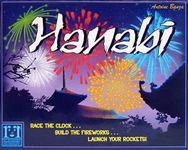
You're the only one who can't see your own cards—everyone else can! Work with your team, trading a limited number of hints, to build fireworks from 1 to 5 in order in this cooperative game.
Rules
You can see everyone's cards but your own. Teammates trade only color and number clues to build five fireworks in order from 1 to 5 in this cooperative card game, where saying less is often the whole strategy.
Components
| Component | Count | Notes |
|---|---|---|
| Hanabi cards | 60 total across 6 suits | Each suit: three 1's, two 2's, two 3's, two 4's, one 5 |
| Blue Clock tokens | 8 | Spent to give information; returned by discarding or completing a firework |
| Black Fuse tokens | 4 | One moves to the box lid for every misplayed card |
For 2 to 5 players, ages 8 and up, about 25 minutes. Every player is on one team; you win or lose together.
Setup
- 1Place the 8 Blue Clock tokens face up on the table.
- 2Stack the 4 Black Fuse tokens nearby with the longest fuse on top and the explosion on the bottom.
- 3Shuffle the 50 base cards into a face-down deck. The 6th multicolor suit is included for the advanced variant only — set it aside for the base game.
- 4Deal 5 cards each with 2 or 3 players, or 4 cards each with 4 or 5 players. Hold your cards so only the fronts face the other players.
- 5The game recommends starting with the most colorfully dressed player, then proceeding clockwise.
Never look at the fronts of your own cards
The rulebook is explicit: you must not look at the fronts of the cards dealt to you, whether while picking them up or at any later point. Without this restriction, the game does not work at all.
Turn structure
- 1On your turn, you must complete exactly one of the following three actions.
- 2① Give one piece of information — spend one Clock token to tell one other player about their color or value.
- 3② Discard a card — return a card from your hand to the discard pile, regain one Clock token, then draw a replacement.
- 4③ Play a card — place one card from your hand on the table. If it extends a firework, it succeeds; otherwise it is discarded and a Fuse token is spent.
Teammates may not comment or influence the active player
When it is a player's turn, no other player may comment on or try to influence that player's decision. Information can only be exchanged through action ①.
Giving information — point to every matching card
- 1Take one Clock token from the table and move it to the box lid, then choose one other player to inform.
- 2Choose only one type of information — either about one specific color or one specific value — and give only that type.
- 3Point clearly to every card the information applies to. If that player holds two or more cards of the named color (or value), you must point to all of them.
- 4If there are no Clock tokens left on the table, this action cannot be performed, and you must choose a different action instead.
You cannot give 'zero of something' as information
You may not say things like "you have zero red cards" because there is nothing to point to. Information can only be given about cards that are actually present and can be pointed at.
Playing a card and the Fuse tokens
| Outcome | Condition | Result |
|---|---|---|
| Success | The card is the missing 1 for that color's firework, or exactly one higher than its last card | Add it to that firework. Playing a 5 returns one Clock token |
| Failure | Any other case | Discard the card and move one Black Fuse token to the box lid |
There can be only one firework per color, and it must be built starting from 1 and rising through 2, 3, 4, and 5 in order. Whether the play succeeds or fails, draw one new card immediately afterward to refill your hand.
Scoring
At the end of the game, add up the highest card reached in each colored firework. A firework that stalled partway still contributes whatever value it reached.
| Points | Overall impression |
|---|---|
| 5 or less | Horrible, booed by the crowd... |
| 6 – 10 | Mediocre, just a hint of scattered applause... |
| 11 – 15 | Honorable attempt, but quickly forgotten... |
| 16 – 20 | Excellent, crowd pleasing. |
| 21 – 24 | Amazing, they will be talking about it for weeks! |
| 25 | Legendary, everyone left speechless, stars in their eyes! |
Ending the game
| Trigger | Result |
|---|---|
| The third Black Fuse token is added to the lid | The game ends immediately and is lost — the score is not counted |
| All 5 fireworks are completed before the deck runs out | The game ends immediately with a stunning victory, scored at 25 |
| A player takes the last card from the deck | Every player, including that one, plays one more turn each, then the game ends and is scored |
During the extra round after the last card is drawn, players do not draw replacement cards. Play continues with only the cards still in hand.
Advice from the rulebook
- After receiving information, you may rearrange your own hand — moving cards left, right, or further apart makes them easier to remember.
- You can look at the discard pile at any time. Tracking which numbers and colors have already appeared helps you reason about your own hand.
- Sometimes you must discard a card you know nothing about. Every value except 5 has duplicate copies, so discarding one does not necessarily close off that firework for good.
Table talk can vary by group
Strictly applied, the rules allow no communication outside the information action, but the rulebook itself notes that a group may agree to allow general remarks such as "I still don't know anything about my hand."
Variants and expansion modules
The four multicolor variants printed in the English small-box rulebook.
| Variant | Description |
|---|---|
| Variant 1 | Add the 6th suit and attempt all 6 fireworks |
| Variant 2 | As Variant 1, but the multicolor suit uses only one card of each value 1–5 |
| Variant 3 | Multicolor cards become wild — clues cannot name the multicolor suit, but a played card still builds the 6th firework |
| Variant 4 | Do not end on the round the last card is drawn; keep playing until the team wins or loses (the 25-point cap can be exceeded) |
The Korean «Hanabi: Giant Fireworks» edition splits the same idea into three separate expansion modules.
| Module | Description |
|---|---|
| ① Rainbow suit | Ten rainbow cards build a 6th firework in ascending order. Clues treat it like any other color, but no clue may name the rainbow color itself. Maximum score: 30 |
| ② Black suit | Ten black cards build a 6th firework, but it is built descending from 5 to 1. It has no color, so only value clues may be given. Each missing card subtracts 1 point from the total |
| ③ Dazzling fireworks | Completing any firework reveals one bonus tile instead of returning a Clock token, applying its effect at once (gain a Clock token, restore an error tile, give a free color or value clue, shuffle a discard back into the deck, or add a discarded card straight to a firework, among others) |
Expert rules
A further variant in the rulebook. Scoring is dropped entirely — the team simply wins by completing every firework or loses when all 3 error tiles are flipped. Play continues on the cards still in hand even after the deck runs out.
In Korea, Happy Baobab has released both «Hanabi» and «Hanabi: Giant Fireworks»; the edition currently sold is «Giant Fireworks», which bundles all three expansion modules. The modules can be combined freely, and using all three raises the game to 7 fireworks with a maximum score of 30.
Frequently asked questions
Q. Can I tell a teammate they have zero of a color or value?
No. Information such as "you have no green cards" has nothing to point to and is not allowed. A clue can only be given when there is at least one matching card to point at.
Q. If a teammate has two cards of the same color, can I point to just one?
No. Once you choose to give that color (or value) as information, you must point to every card of theirs that matches it.
Q. What happens if all the Clock tokens are gone?
You cannot give information at all. You must either discard a card or play one instead.
Q. After the third Fuse token flips, does everyone still get one more turn?
No. The game ends immediately as a loss the moment the third Fuse token is added. The extra round only happens when the draw deck runs out.
Q. Does the game end the instant the deck runs out?
No. The player who drew the last card, along with everyone else, takes one more turn each. Only then does the game end and get scored.
Q. What if I complete a firework but all 8 Clock tokens are already on the table?
You simply do not receive the bonus. The supply is capped at 8 tokens, so it cannot exceed that number.
History and editions
| Item | Detail |
|---|---|
| Designer · first release | Antoine Bauza · 2010 (Cocktail Games, French edition) |
| Major awards | 2013 Spiel des Jahres, 2013 Fairplay À la carte Award |
| Korean release | Happy Baobab — originally «Hanabi», later reissued as «Hanabi: Giant Fireworks» (2022) with three expansion modules added |
English Wikipedia lists Hanabi as a 2010 cooperative card game whose defining milestone is winning the 2013 Spiel des Jahres. The Namuwiki cross-check confirms Happy Baobab as the official Korean distributor and that the three Korean module names (Rainbow suit, Black suit, Dazzling fireworks) belong only to the «Giant Fireworks» edition.
Sources
Happy Baobab — official Korean rulebook for «Hanabi: Giant Fireworks» (PDF, 12 pages)R&R Games — official English rulebook for Hanabi (2013, PDF, 2 pages)Wiki cross-check — English Wikipedia: Hanabi (card game)Wiki cross-check — Namuwiki: Hanabi (board game, Korean)Rule summaries are reference content written by us, not quotations from the official rulebook. Always check the official rulebook for exact rules. Diagrams are original schematics, not rulebook illustrations.
Spotted a mistake? Tell us in the comments below →
Last updated 2026-10-10
💡 Master tip
Distinguish between a 'direct hint' that points to a card a teammate can play right now—like a 1 or the next card in sequence—and a 'protective hint' that flags an important card they should not discard.
Similar games
Ready for something heavier
If this one has gotten too easy, try these — same feel, one step up in weight.
Tools you can request
Not built yet. Let us know if you want one — it goes on the list.
Hint and Fuse Token Tracker
Track the remaining blue hint tokens and red fuse tokens
Final Fireworks Score Calculator
Shows your score out of a maximum of 25 points
Comments
Share your thoughts, report a mistake, or request a tool. No sign-in needed — nicknames are not verified, so anyone can use the same one.
Loading…