Top 147 · #42 of 60 in Family
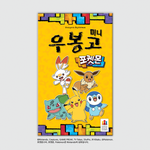
Ubongo Mini Pokémon
A real-time puzzle game where you fill the white squares on a card exactly with the pieces it shows. The first finisher shouts «Ubongo!» and counts slowly while the others keep solving. This is the Korean edition from Korea Boardgames, which dresses Ubongo Mini in Pokémon.
👨👧👦 Played with our kids
Played with children aged 6 and 4.
Rules
✓ Rulebooks cross-checked · verified with a physical copy
Sources checked
- Owner's physical Korean rule sheet, pages 1–4, box and contents checked (Korea Boardgames, KBG-CH04BZ6, 16 September 2026)
- BGG (Ubongo Mini, Korean edition version 701042)
- Original rulebook (Kosmos, German)
- Distribution in Korea — Korea Boardgames
- Cross-checked against English Wikipedia (Ubongo)
A 15-minute real-time puzzle game: fill the white squares on your card exactly with the pieces it shows. The first finisher shouts «Ubongo!» and counts slowly while everyone else keeps solving, and after 8 rounds the player with the most puzzle cards wins.
Contents and objective
Fill the white squares exactly with the puzzle pieces shown on your card. After 8 rounds, whoever has collected the most puzzle cards wins. 1–4 players, ages 7+, about 15 minutes.
| Component | Confirmed detail |
|---|---|
| Puzzle cards | Double-sided — the A side is solved with 3 pieces, the B side with 4. Total card count is ⚠️ unconfirmed (cards used per player count are listed below) |
| Puzzle pieces | Each player gets an identical set of 8 pieces. The number of sets in the box is ⚠️ unconfirmed |
| Rounds | 8, whatever the player count |
This is not the original Ubongo
There is no die, sand timer or gem. You solve with the pieces printed on your card, the first finisher counts aloud, and the winner is decided by puzzle cards collected.
Setup
- 1Choose a difficulty — A side (3 pieces) or B side (4 pieces) — and shuffle the cards with that side face down. Start with the A side.
- 2Use 16 cards for 2 players, 24 for 3 and 32 for 4. Put the rest away.
- 3Each player takes an identical set of 8 puzzle pieces.
Cards used (8 rounds in every case)
Unused cards go back in the box.
How a round works
- 1Each player takes one card from the deck and places it in front of them with the chosen side hidden.
- 2When the agreed player calls «Start!», everyone flips their card at the same time.
- 3Find the 3 (or 4) pieces shown on your card in your own set and fill the white squares. You may flip or rotate the pieces.
Gap or overhang = not finished · Abstract example, not a real card.
What counts as finished
If even one white square shows, or a piece extends beyond the white area, the puzzle is not finished.
«Ubongo!» and the count
| Side used | First finisher counts to |
|---|---|
| A side (3 pieces) | 20, slowly |
| B side (4 pieces) | 30, slowly |
- The first player to finish shouts «Ubongo!» and counts slowly to that number.
- Everyone else keeps solving meanwhile; when the count ends, all hands come off the pieces.
- Anyone who finished in time takes their own puzzle card.
- A card that was not finished goes to the player who finished first that round.
Why speed pays
The first finisher takes not only their own card but also the unfinished ones. Still, finishing within the count keeps your own card, so it is worth completing even when you are slower.
End and winner
After round 8, the player with the most puzzle cards wins. If several players share the most cards, they win together.
⚠️ Unconfirmed
The surviving record does not say what happens to the card when nobody finishes, how the starting player is chosen, or into how many stacks the cards are divided. Do not guess; follow the printed rule sheet.
Adjusting difficulty and solo play
- Learning: start on the 3-piece A side and move to the 4-piece B side once you are comfortable.
- Expert variant: remove the purple rectangle (Ditto) piece and solve with 7 pieces to even out skill differences.
- With children: you may agree beforehand on a longer count or a more generous time limit.
- Solo — time attack: see how many cards you can solve in 5, 10 or 15 minutes. You need a clock or timer.
- Solo — speed game: time how long it takes to solve 5, 15 or 20 cards.
Tips for playing with children
- If you are stuck, flip or rotate a piece. Flipping is allowed.
- When adults and children play together, children can use the A side and adults the B side to even out speed. This is a household suggestion, not an official rule; because cards from different sides are being compared, agree on it first.
Edition and verification scope
This guide rests on the owner's record of checking the physical Korean rule sheet of the Korea Boardgames edition (KBG-CH04BZ6). BGG lists this Korean edition as version 701042 of Ubongo Mini (28258).
| Item | Original Kosmos (German rulebook, 2007) | This Korean edition |
|---|---|---|
| Pieces | 28, coloured side only, no flipping | 8 per set, may be flipped or rotated |
| End | Card stacks run out | 8 rounds |
⚠️ Unconfirmed
A Namuwiki cross-check of designer and award history was not done this time. Nothing is stated until it is verified.
Frequently asked questions
Q. May I flip the pieces?
Yes. The Korean rule sheet states that pieces may be flipped or rotated. The original German rulebook forbids flipping, so do not mix them up.
Q. How many rounds are there?
Always 8, whatever the player count. That is why 2 players use 16 cards, 3 use 24 and 4 use 32.
Q. Can I play alone?
Yes. Try the time attack — how many cards in 5, 10 or 15 minutes — or the speed game — how long to solve 5, 15 or 20 cards. You need a clock.
Q. How does it differ from the original Ubongo?
The original uses a die, a sand timer and gems. This product solves with the pieces printed on the card, has the first finisher count aloud instead of a sand timer, and is decided by the number of puzzle cards collected.
Q. Does the first solver take the card?
Anyone who finishes in time takes their own card, and cards that were not finished go to the player who finished first that round.
Sources
Owner's physical Korean rule sheet, pages 1–4, box and contents checked (docs/owned-games.md; catalog rules_verified, 16 September 2026) — Korea Boardgames KBG-CH04BZ6 (no public rulebook URL; edition identified via the official distributor page)BGG — Ubongo Mini (Korean edition version 701042)Original Kosmos German rulebook (2007) — a different product, used only to note differencesCross-checked against Wikipedia: UbongoRule summaries are reference content written by us, not quotations from the official rulebook. Always check the official rulebook for exact rules. Diagrams are original schematics, not rulebook illustrations.
Spotted a mistake? Tell us in the comments below →
Last updated 2026-10-10
💡 Master tip
Start with the 3-piece A side, then move to the 4-piece B side once you are comfortable. Experts can remove the purple rectangle (Ditto) piece and solve with 7 to even out skill differences. When playing with children, you may agree beforehand on a longer count or time limit.
Similar games
Ready for something heavier
If this one has gotten too easy, try these — same feel, one step up in weight.
Comments
Share your thoughts, report a mistake, or request a tool. No sign-in needed — nicknames are not verified, so anyone can use the same one.
Loading…