Top 144 · #39 of 60 in Family
Topp die Torte!
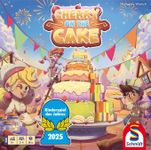
A visual puzzle game where players stack cake pieces in layers, lining up matching-color fillings. Designed by Wolfgang Warsch and published by Schmidt Spiele in 2024, it won the 2025 Kinderspiel des Jahres.
Rules
Build your cake layer by layer, matching color stripes and filling three jars of point chips, in this 2-4 player game of memory and judgment. The actual value of each chip stays secret until the very end.
Components
| Component | Count | Notes |
|---|---|---|
| Personal board | 4 | Shows 3 jars (bronze/silver/gold) and a trade jar |
| Starting piece (cake plate) | 4 | Back shows 3 sugar cubes and a scoring-marker icon |
| Cake layer tiles | 40 | Round tiles printed with 5 color stripes |
| Player figure | 4 | Double-sided design. Several players may pick the same side |
| Cake topper | 1 | Used by the winner to crown their cake at game end |
| Scoring track | 1 | A single shared track used by everyone |
| Point chips | 66 | 22 each bronze/silver/gold. The point value is hidden on the back; the front shows only a chef's-hat icon |
| Die | 1 | Rolled only as a bonus when you earn a gold chip |
| Sugar cubes | 102 | 18 each of blue/pink/green/purple/orange plus 12 golden wild cubes |
| Scoring markers | 4 | Matched to the icon on your starting piece |
Unverified: how many cubes each jar needs
The rulebook obtained says only that the number needed is shown as artwork printed on each jar, without ever spelling out the figures in running text. This guide explains that the jars need different amounts and are permanently tied to a bronze/silver/gold tier, but does not guess at the exact counts.
Setup
- 1Each player takes one personal board and one starting piece, placed to the left of the board.
- 2Take the 3 sugar cubes shown on the back of your starting piece and place one in each of your board's 3 jars.
- 3Check the ingredient icon at the bottom left of your starting piece, take the matching scoring marker, and place it on the start space of the scoring track (with the side not showing "20" face up).
- 4Choose a player figure and place it in front of you. Either side may be used, and several players may choose the same one.
- 5Set the cake topper aside; it is not used until the game ends.
- 6Shuffle the 40 cake layer tiles and deal 7 to each player. Reveal 2 of them face up on your board, and keep the remaining 5 face down as your personal draw stack.
- 7Shuffle the 66 point chips, sorted by tier, so the point-value side is hidden, and place them chef's-hat-side up next to the sugar cubes. Place the die beside them.
- 8Sort the sugar cubes by color in the middle of the table; place the 12 golden cubes next to the scoring track.
A round — 3 phases, over 7 rounds
Whoever most recently ate a piece of cake places first — not only in round 1, but in every round. Unlike most games, this turn order never rotates.
- 1① Choose a tile (everyone at once): look at your 2 revealed tiles and decide which to stack. You may rotate either one before deciding. Once decided, mark it with your figure — after that, neither tile may be rotated.
- 2② Place the tile (in the fixed order set above): place your chosen tile on top of your tower (on your starting piece in round 1). Align its edge marks flush with the tile below.
- 3③ Pass and draw (everyone at once): pass the tile you didn't choose to the player on your left, and reveal the tile you receive from your right beside your board. Then draw 1 more tile from the top of your own draw stack. You again have 2 revealed tiles for the next round.
Test-fitting is not allowed
Whether before or after choosing, you may never hold a tile up against your tower to check the fit. The decision must be made from memory and judgment alone.
The last (7th) round has no choice
Each draw stack holds only 5 tiles, so it runs out around round 6. In round 7, you are left with only 1 revealed tile, so there is nothing to choose — simply place it (you may still rotate it).
Connecting color stripes — the heart of the game
Each tile shows 5 color stripes — green, purple, orange, pink, and blue (the dough-colored gaps between them do not count as stripes). After placing a tile, check which stripes are connected through the tile you just placed and collect every sugar cube shown along that connection. Matching colors that overlap even slightly count as connected; colors that only touch corner-to-corner do not.
Connections can span several layers
A stripe can connect through more than just the tile directly below — it may run down through several earlier layers. As long as the newly placed tile is part of that connected run, you collect every sugar cube shown anywhere along it, not only those on the new tile.
Distributing cubes, filling jars, and point chips
- 1Distribute the sugar cubes you received among your 3 jars, in any order. A jar may never hold two cubes of the same color.
- 2A cube with nowhere to go (because that color is already in every jar) goes into the green trade jar instead.
- 3Only after distributing everything you received this round may you empty a full jar: return its cubes to the supply and take the point chip of that jar's fixed tier (bronze/silver/gold).
- 4If the trade jar holds 3 or more cubes, you may return 3 of them to the supply and take 1 cube of any other color to place in a jar (jar rules still apply).
- 5If you received neither a cube nor a star this round, you may take 1 consolation cube of any color into the trade jar.
Chips are kept secret
Collected point chips go face down beside your board, point value unseen. You may peek at your own chips whenever you like, but you never have to reveal them until the game ends — every chip's value is only revealed together at the final scoring.
Emptying the gold jar triggers a die roll
Whenever emptying your gold jar earns you a gold chip, you also roll the die and carry out its result. Results are: 1-2 colored cubes, 1 golden (wild) cube, your scoring marker advancing 1-2 spaces, or 1 bronze chip.
Stars — scored immediately
Some color-stripe segments carry a star. If the connection formed by the tile you just placed includes a star, advance your scoring marker on the shared track immediately, by that many spaces — unlike chip points, this scoring is public and instant.
For example, if the connection formed by your newly placed tile shows 1 star, move your marker forward 1 space. If your marker passes the start space (20) again, flip it over to show which lap you're on.
Game end and final scoring
The game ends the moment everyone has placed their 7th (final) tile, and final scoring runs in two phases.
- 1① Distribute golden cubes (clockwise, one player at a time): count how many golden-cube icons appear on your finished cake tower and take that many golden cubes from the supply.
- 2Golden cubes are wild, so you may place them freely in any jar, several in the same jar, and any overflow does not go to the trade jar. Collect a chip each time you empty a jar this way, and you may even refill an emptied jar with more golden cubes to empty it again.
- 3When your turn is done, return any unused golden cubes to the supply so the next player can use them.
- 4② Reveal chip points (clockwise, tier by tier, for everyone together): first everyone flips all their bronze chips to the point-value side and totals them, then in turn order each player advances their marker by that total. Repeat the same process with silver chips, then with gold chips.
- 5Whoever's marker is furthest ahead wins, and gets to crown their own cake with the cake topper as a reward.
Unverified: tie-breaking
The rulebook obtained does not state a tiebreaker for markers landing on the same space. Until further official material is found, the safest reading is to treat a tie as a shared win.
Strategy tips
- Connections can reach back several layers, so remembering the color layout from a few rounds ago improves the accuracy of your next choice.
- If one color keeps piling up in your trade jar, that color is probably already crowding your filled jars — look for other color connections instead.
- Filling the gold jar also brings a bonus die roll, so prioritizing connections that fill it is often worthwhile.
- Since chip points stay hidden until the end, how often you empty a jar is a more reliable strategy to track than which tier of chip you're chasing.
Editions and names in other languages
Starting with 6 or 8 tiles instead of 7 shortens or lengthens the game — an official variant stated in the rulebook.
"Topp die Torte!" (item no. 40659) is officially sold in English-speaking markets under the same item number as "Cherry On The Cake," with a confirmed Dutch edition "Kers op de taart" and a Czech/Slovak edition "Třešnička na dortu" — all are the same game under a localized name.
Do not confuse with a different product — Topp das Törtchen!
The similarly named "Topp das Törtchen!" (item no. 40683, about €14.99) is a separate, smaller product with its own item number. Its box size (13×18×4cm, 370g) and price already differ from this game (29.5×29.5×7.6cm, 1,340g, about €28), and its components are a card-and-pencil-and-scoresheet game, unlike this guide's personal board, point chips, and die. The two are listed as distinct item numbers (SSP40659 vs SSP40683) by Pegasus, the German distributor.
Frequently confused rules
Q. Can I hold a tile up against my tower to test the fit before choosing?
No. Whether before or after choosing, neither tile may be tested against the tower. The choice must be made from memory and judgment alone.
Q. Does the first player change each round?
No. Whoever most recently ate a piece of cake places first in round 1 and in every round after that.
Q. Do I only collect cubes from the tile I just placed?
No. As long as the tile you just placed is part of a connected run, you collect every sugar cube shown anywhere along that run, however many layers it spans.
Q. Do I know a chip's point value as soon as I take it?
No. Collected chips go face down and unseen; every chip's value is revealed together only at the end of the game.
Q. Must golden cubes go to the trade jar if they don't fit?
No. Golden cubes are wild — place them freely in any jar, several in the same jar, and any overflow never goes to the trade jar.
Q. Can I roll the die whenever I want?
No. You only roll it as a bonus when emptying a jar earns you a gold-tier chip.
Designer and awards
Designer Wolfgang Warsch is a German game designer known for The Mind and The Quacks of Quedlinburg. The rulebook credits illustration to Michel Verdu (some award-announcement pages instead spell it Michael Verdu — this guide follows the rulebook's own credit).
The game was published by Schmidt Spiele in 2024, and Spiel des Jahres e.V. officially announced it as the Kinderspiel des Jahres 2025 winner. That same year, the overall Spiel des Jahres went to Bomb Busters, and the Kennerspiel des Jahres (for more experienced players) went to Endeavor: Deep Sea.
As of 2026-10-11, no dedicated article for this game was found on English Wikipedia or Namuwiki (English Wikipedia surfaced only the general Spiel des Jahres article).
Sources
Schmidt Spiele official German rulebook (item no. 40659, "Topp die Torte!" / "Cherry On The Cake") — official site downloadSchmidt Spiele official product page — Cherry On The Cake (English listing, same item no. 40659)Pegasus (German distributor) product page — Topp die Torte! (SSP40659, €27.99)Pegasus product page — Topp das Törtchen! (SSP40683, €14.99) — a separate product with its own item numberSpiel des Jahres e.V. — official Kinderspiel des Jahres 2025 winner announcementSpiel des Jahres e.V. — official game page for Topp die TorteWiki cross-check — English Wikipedia search: no dedicated article found, only the general Spiel des Jahres article (checked 2026-10-11)Wiki cross-check — Namuwiki search: no dedicated article found (checked 2026-10-11)Rule summaries are reference content written by us, not quotations from the official rulebook. Always check the official rulebook for exact rules. Diagrams are original schematics, not rulebook illustrations.
Spotted a mistake? Tell us in the comments below →
Last updated 2026-10-11
💡 Master tip
Rather than chasing one big color block, it is safer to steadily fill and empty your bottles for score chips by reliably connecting smaller colors. Remembering the color layout of the previous piece also improves your accuracy when placing the next piece by feel.
Ready for something heavier
If this one has gotten too easy, try these — same feel, one step up in weight.
Comments
Share your thoughts, report a mistake, or request a tool. No sign-in needed — nicknames are not verified, so anyone can use the same one.
Loading…