Top 6 · #4 of 40 in Strategy
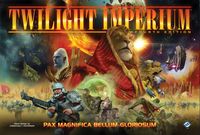
Twilight Imperium: Fourth Edition
An epic 4X board game in which players fight over the throne of a galactic empire through diplomacy, trade, politics, and interstellar war. One game runs 4 to 8 hours, and negotiation and betrayal between players are what decide the winner.
Rules
A 4X epic in which three to six players fight over the throne of a galactic empire for four to eight hours. You build a new galaxy out of hex system tiles every game, pick strategy cards that set turn order and give you powers, and the first player to score 10 victory points wins on the spot.
What you are doing, and what this guide covers
Each player runs an alien faction, expanding across the galaxy, negotiating, and fighting. Winning does not mean wiping everyone out — it means filling objective cards to reach 10 victory points first. War is only one of the tools you use to get there.
What this guide covers
The official rules come in two books: a 24-page Learn to Play and a 32-page Rules Reference. This guide carries only as much as you need to start your first game — for detailed rulings (ability timing, faction-specific rules, anomaly exceptions) go to the alphabetical Rules Reference. If the two books disagree, the Rules Reference takes precedence.
| Item | Detail |
|---|---|
| Players | 3-6 (base game) |
| Play time | 4-8 hours, longer with more players |
| Victory | The game ends the moment someone reaches 10 victory points |
| Longer game | By agreement you can use the 14-space side of the victory point track |
| Dice | Eight ten-sided dice (D10). "Combat 7" means you need a 7 or higher to hit |
Components
| Component | Count | Notes |
|---|---|---|
| System tiles | 51 | Sorted by the back: green = home system, blue = contains planets, red = anomaly or no planets |
| Faction sheets | 17 | Unit attributes and faction abilities |
| Command sheets | 6 | Tactic, fleet and strategy pools, trade good area, quick reference |
| Plastic units | 354 | 6 colors × 59 units |
| Strategy cards | 8 | 1 Leadership through 8 Imperial |
| Planet cards | 59 | Resource, influence and trait |
| Objective cards | 40 | Stage I public, stage II public, secret |
| Action cards | 80 | Hand limit of seven |
| Agenda cards | 50 | Laws and directives |
| Promissory notes | 41 | Bargaining chips you hand to other players |
| Technology cards | 122 | Plus 62 unit upgrade technology cards |
| Command tokens | 272 | 16 per player |
| Control tokens | 289 | 17 per player |
| Trade good and commodity tokens | 48 | Double-sided — a commodity flips into a trade good when it changes hands |
| Infantry and fighter tokens | 49 each | Stand-ins for plastic pieces |
| Ten-sided dice | 8 | Used for combat, bombardment and space cannon rolls |
| Victory point track, speaker token, custodians token | 1 each | The custodians token starts on Mecatol Rex |
| Faction-specific tokens | 5 | 2 Creuss alpha/beta wormholes, 2 Nekro assimilator X/Y, 1 Naalu "0" |
| The 59 units in one color | Count |
|---|---|
| Infantry | 12 |
| Fighters | 10 |
| Destroyers | 8 |
| Cruisers | 8 |
| PDS units | 6 |
| Dreadnoughts | 5 |
| Carriers | 4 |
| Space docks | 3 |
| War suns | 2 |
| Flagship | 1 |
Running out of infantry, fighters, trade goods or control tokens does not stop the game. The rules let you substitute a coin or a bead for those. Every other unit and token is capped at what came in the box.
You build a new galaxy every game
There is no fixed board. You lay hex system tiles into three rings around Mecatol Rex, and each player's home system attaches to the third ring. The same faction plays differently every time because the map is never the same.
| Players | Tiles dealt to each player | Notes |
|---|---|---|
| Three | 6 blue, 2 red | — |
| Four | 5 blue, 3 red | — |
| Five | 4 blue, 2 red | Before tiles are placed, the speaker draws one extra red tile and places it faceup adjacent to Mecatol Rex |
| Six | 3 blue, 2 red | — |
- 1Separate the tiles by the color of their backs into a blue pile and a red pile. Green home systems are not separated this way.
- 2Shuffle each pile facedown and deal tiles according to the player count.
- 3Each player puts their home system roughly where it will connect, near their seat.
- 4Starting with the speaker and going clockwise, each player places one tile faceup, filling ring 1 around Mecatol Rex first. After the last player places a second tile, placement reverses and runs counterclockwise back to the speaker, who places two tiles, and then reverses again.
- 5Each ring must be fully built before any tile goes into the next ring.
- 6Anomaly tiles cannot be placed next to each other, and neither can tiles with the same type of wormhole — unless there is no other option.
- 7Once all dealt tiles are down, attach the home systems to the rest of the galaxy.
| Anomaly | Effect |
|---|---|
| Asteroid field | Ships cannot move through or into it |
| Nebula | A ship can move into it only if it is the active system, and cannot move through it. A ship starting its move in a nebula has move 1, and the defender in a nebula applies +1 to combat rolls |
| Supernova | Ships cannot move through or into it |
| Gravity rift | A ship moving out of or through one applies +1 to its move value, then rolls one die after moving: on a 1-3 that ship is destroyed |
Wormholes ignore distance
Systems containing matching wormholes (alpha, beta, delta) are treated as adjacent. That counts for movement and for deciding who is a neighbor for transactions. A tile on the far side of the table suddenly becomes next door, which is why tile placement gets tense.
Setup
There is a shortcut for your first game
Learn to Play has a separate first-game setup. The speaker deals a random faction from just six — the Xxcha Kingdom, the Federation of Sol, the Emirates of Hacan, the Barony of Letnev, the Sardakk N'orr and the Universities of Jol-Nar — and the galaxy is copied from the preset map for your player count on pages 22-23. Promissory notes are left out. The steps below are the "complete setup" you use from your second game on.
- 1Randomly determine the speaker. Whoever holds the speaker token chooses a strategy card first.
- 2Each player chooses a faction sheet.
- 3Take your faction components: 1 home system tile, 17 control tokens, 16 command tokens, 2 faction technology cards, 1 faction promissory note.
- 4Choose a color and take its components: 59 plastic units, 1 command sheet, 25 technology cards, 4 promissory notes. Combine your faction and color technology cards into one deck, and do the same with promissory notes.
- 5Take the planet cards for the planets in your home system and place them faceup in front of you.
- 6Create the game board (see the previous section).
- 7Place the custodians token on Mecatol Rex.
- 8Shuffle the action, agenda, stage I objective, stage II objective and secret objective decks separately.
- 9Create supply piles of trade good, fighter and infantry tokens.
- 10Place all eight strategy cards faceup within reach of the speaker.
- 11Take the starting technologies and starting units listed on the back of your faction sheet, putting the units in your home system. Split your command tokens three into the tactic pool, three into the fleet pool, two into the strategy pool.
- 12Prepare objectives: each player draws two secret objectives and keeps one; each player puts a control token on "0" of the victory point track; the speaker deals five facedown stage I objectives and five facedown stage II objectives in two rows and reveals the first two stage I objectives.
Five players start unbalanced, so there is a correction
In the five-player map three players are at a slight disadvantage because of where their home systems sit. After the board is built, the player closest to two others receives four trade goods, the two players on either side of them receive two each, and the remaining two players, who are not within two tiles of another player, receive none.
A round is four phases
- 1Strategy phase — starting with the speaker and going clockwise, each player takes one strategy card. The speaker then puts one trade good on every card nobody chose, and whoever picks that card in a later round gains those trade goods.
- 2Action phase — turns run from the lowest chosen card number upward (initiative order), and each turn is one action. The phase ends when everyone has passed.
- 3Status phase — work through the eight steps below in order.
- 4Agenda phase — added once the custodians token is gone. Vote on two agendas, ready your planets, then start the next round.
| The eight status phase steps | What happens |
|---|---|
| 1. Score objectives | In initiative order, each player may score up to one public and one secret objective that can be fulfilled in the status phase |
| 2. Reveal public objective | The speaker flips one facedown objective faceup. No stage II objective is revealed until every stage I objective is |
| 3. Draw action cards | Each player draws one |
| 4. Remove command tokens | Every player returns all of their command tokens from the board to their reinforcements |
| 5. Gain and redistribute command tokens | Each player gains two and may redistribute every token on their command sheet among the three pools |
| 6. Ready cards | Flip all exhausted cards faceup — planets, technologies and strategy cards too |
| 7. Repair units | Stand up any units laid on their side by Sustain Damage |
| 8. Return strategy cards | Return them to the common play area. If the custodians token has been removed, continue to the agenda phase; otherwise start a new round |
Check your fleets at step 5
If you shrink your fleet pool when redistributing, some system may now hold more ships than you are allowed, and you must choose and destroy the excess. Redistribution is usually simultaneous, but a timing conflict is resolved in initiative order.
The eight strategy cards — turn order and power in one
A strategy card does two jobs at once. Its number sets initiative order for the round, and the card itself has a primary ability only its owner uses and a secondary ability everyone else may use. Riding along on other people's cards is half of this game's economy.
| Card | Primary ability (owner only) | Secondary ability (everyone else) |
|---|---|---|
| 1 Leadership | Gain three command tokens, then spend any amount of influence to gain one more per three influence | One token per three influence. This is the one secondary ability that costs no strategy token |
| 2 Diplomacy | Choose a system other than Mecatol Rex that contains a planet you control; every other player places a command token from their reinforcements in that system (which locks them out of activating it). Then ready your exhausted planets in that system | Spend 1 strategy token to ready up to two exhausted planets you control |
| 3 Politics | Choose a player who is not the speaker and give them the speaker token (you may choose yourself if you are not the speaker). Draw two action cards, then look secretly at the top two agenda cards and put each back on the top or the bottom | Spend 1 strategy token to draw two action cards |
| 4 Construction | Place one PDS or one space dock on a planet you control, then place one more PDS on a planet you control. Neither needs a command token in the system | Place 1 strategy token in any system (if you already have one there, the token goes back to your reinforcements instead), then place one PDS or space dock on a planet you control in that system |
| 5 Trade | Gain three trade goods and replenish your commodities. Then choose any number of other players: they use the secondary ability without spending a token, and they cannot refuse | Spend 1 strategy token to replenish commodities |
| 6 Warfare | Remove one of your command tokens from the board and gain it into any pool, then redistribute all the tokens on your command sheet | Spend 1 strategy token to use the Production ability of one unit in your home system (no token is placed there) |
| 7 Technology | Research one technology, then spend six resources to research one more | Spend 1 strategy token and four resources to research one technology |
| 8 Imperial | Immediately score one public objective you fulfill. Then gain one victory point if you control Mecatol Rex, or draw a secret objective if you do not | Spend 1 strategy token to draw one secret objective |
How to read initiative order
Only cards that were actually chosen count; unchosen numbers are ignored. In a three- or four-player game each player takes two cards, and initiative is set by their lower-numbered card. In those games a player also cannot pass until both cards are exhausted.
The action phase — one thing at a time
On your turn you perform one action. Then the turn passes, and once everyone has had a turn, initiative order starts over. The phase keeps looping until every player has passed.
| Action | What it does |
|---|---|
| Tactical action | Spend one token from your tactic pool to activate a system. Movement, combat, invasion and production all happen here |
| Strategic action | Resolve the primary ability of your strategy card. Then every other player gets a chance at the secondary ability, and finally you exhaust the card |
| Component action | Resolve an ability headed "Action" on an action card, technology card or faction sheet. You cannot use it unless you can resolve it completely |
You cannot pass before your strategic action
This single line keeps the whole game turning. Because everyone must take their strategic action, every player gets one chance at every other player's secondary ability. Once you pass you cannot act again that phase, but you may still resolve other players' secondary abilities.
- If everyone else has passed, the remaining player can take several consecutive actions.
- A player who cannot perform an action must pass.
- When all players have passed, play moves to the status phase.
Trading is not an action
Neighbors — players with a unit or a controlled planet in the same system or in adjacent systems — may trade at any point during your turn, even in the middle of a combat. One transaction per neighbor per turn. You may exchange trade goods, commodities and up to one promissory note, and the two sides do not have to be equal.
The tactical action — five steps
- 1Activation — take a command token from your tactic pool and place it on a system. That is the active system. You cannot activate a system that already contains one of your own tokens; other players' tokens do not stop you.
- 2Movement — bring ships in from any number of systems. Once ships have moved, Space Cannon Offense fires.
- 3Space combat — if two players have ships in the active system, they fight.
- 4Invasion — bombardment, then committing ground forces, Space Cannon Defense, ground combat and establishing control.
- 5Production — use the Production ability of your units in the active system. You may do this even if you moved nothing and invaded nothing.
- A ship must end its movement in the active system.
- The number of systems a ship enters cannot exceed its move value. Cruisers and destroyers move 2; carriers and dreadnoughts move 1.
- You may move through a system holding your own command token, but you cannot start a move there. Activating a system also pins down what is in it.
- Ships with a capacity value pick up infantry and fighters along the way. They cannot pick up from a system holding one of their own command tokens (the active system excepted), and they can only drop off in the active system.
- The number of non-fighter ships you may have in a system equals the tokens in your fleet pool. Fighters are exempt from that, and count against capacity instead.
Space cannon is not combat
Right after movement, every player with units in the active system may use Space Cannon — you do not have to be the active player, or even be in the coming combat. A PDS with Space Cannon 6 rolls one die, hits on a 6 or higher, and the target player must choose and destroy one of their ships in the active system. Fleets routinely melt here before combat even begins.
| The five invasion steps | What happens |
|---|---|
| 1. Bombardment | Units with Bombardment fire at ground forces only. A planet containing a unit with Planetary Shield cannot be bombarded |
| 2. Commit ground forces | Move your infantry from the space area down onto planets. If you commit none, skip straight to the production step |
| 3. Space cannon defense | PDS units on an invaded planet fire at the ground forces coming down |
| 4. Ground combat | If both sides have ground forces on a planet, fight rounds until one side is gone |
| 5. Establish control | You gain each invaded planet that still holds one of your ground forces. Take its planet card exhausted, and any other player's structures there are destroyed immediately |
Mecatol Rex alone is locked
While the custodians token sits there, you cannot commit ground forces to Mecatol Rex. Immediately before landing you must spend six influence to remove the token, and you must then commit at least one ground force. Whoever removes it gains one victory point, and the agenda phase is added from that round on. If you cannot spend the influence, you cannot land at all.
Combat and units — the dice are D10
Every unit has a combat value, and you roll a ten-sided die: a result equal to or greater than that value is one hit. Because the player who was hit chooses which of their own units dies, screening with cheap fighters is the basic tactic.
| One round of space combat | What happens |
|---|---|
| 1. Anti-fighter barrage | First round only. Hits from this ability can only be assigned to fighters |
| 2. Announce retreats | The defender goes first. If the defender announces, the attacker may not announce that round. The retreat happens at the end of the round |
| 3. Roll dice | One die per ship (or one per burst icon). The attacker rolls everything first |
| 4. Assign hits | The player who was hit chooses ships to destroy, and may first cancel hits with Sustain Damage |
| 5. Retreat | If you announced, move all your ships to an adjacent system that contains your units or a planet you control and no other player's ships |
| Unit (faction sheet defaults) | Cost | Combat | Move | Capacity | Abilities |
|---|---|---|---|---|---|
| Carrier I | 3 | 9 | 1 | 4 | — |
| Cruiser I | 2 | 7 | 2 | — | — |
| Destroyer I | 1 | 9 | 2 | — | Anti-Fighter Barrage 9 (x2) |
| Dreadnought I | 4 | 5 | 1 | 1 | Sustain Damage, Bombardment 5 |
| Fighter I | 1 for two | 9 | — | — | Counts against capacity |
| Infantry I | 1 for two | 8 | — | — | Only ever on planets or in transport |
| PDS | — | — | — | — | Planetary Shield, Space Cannon 6 |
| Space dock | — | — | — | — | Production = that planet's resource value plus 2; up to three fighters there ignore capacity |
| War sun | — | — | — | — | Cannot be produced until you own its unit upgrade technology |
| Flagship | — | — | — | — | Attributes and abilities differ by faction |
Those are the faction sheet defaults. Some factions have different numbers on a same-named unit — the Federation of Sol's carrier has capacity 6 and its infantry has combat 7. Your own faction sheet always wins, and a unit upgrade card overrides the sheet once you gain it.
- Bombardment hits ground forces only, Anti-Fighter Barrage hits fighters only, and Space Cannon hits ships on offense and committed ground forces on defense.
- "Bombardment 5" means one die; "Space Cannon 5 (x3)" means three dice.
- Effects that reroll or modify combat rolls do not affect bombardment, anti-fighter barrage or space cannon rolls.
- Sustain Damage cannot cancel an effect that destroys a unit outright, and cannot be used against a hit the unit was never eligible to take, such as anti-fighter barrage.
- Blockade — if your space dock is in a system holding another player's ships and none of yours, it cannot produce ships. It can still produce ground forces.
Resources, influence and technology — what one planet card is for
A planet card shows resources in a yellow border at the upper left and influence in a blue border at the lower right. Exhausting the card lets you spend only one of the two. That choice is the decision you make most often in this game.
| What you are paying for | What you spend |
|---|---|
| Producing units | Resources |
| Researching technology (Technology's extra research and secondary) | Resources |
| Gaining command tokens (Leadership) | Influence — one per three |
| Removing the custodians token | Influence, six of it |
| Voting on an agenda | Influence — you cast votes equal to the combined influence of the planets you exhaust |
| Trade goods | Spendable in place of one resource or one influence. But never to cast votes |
Commodities and trade goods are two sides of one token
You cannot spend your own commodities. The moment you give one to another player it flips into a trade good, and the receiver spends it like a resource or influence. That is why replenishing with the Trade strategy card and swapping commodities is good for both sides. You can never hold more commodities than the value printed on your faction sheet.
- Technology cards show prerequisites as a column of colored symbols at the lower left. You must already own that many technologies of the matching color.
- There are four technology colors: biotic (green), warfare (red), propulsion (blue) and cybernetic (yellow).
- Unit upgrades have no color, so they never satisfy anyone's prerequisites. They go faceup on your faction sheet over the unit they share a name with.
- Some planets have a technology specialty. Exhaust such a planet while researching to ignore one prerequisite of the matching color. You cannot exhaust the same planet for its specialty and for its resources.
Objectives and victory points — ten ends it
| Objective type | Detail |
|---|---|
| Stage I public | Five are dealt facedown at setup and two are revealed. One more is revealed each status phase |
| Stage II public | Five cards, worth more, and not revealed until every stage I objective is |
| Secret | You start with one. You can only score your own, and you may never hold more than three scored and unscored combined |
- Each card states when it can be scored — status phase or action phase — just under its title.
- In a status phase you may score one public and one secret objective at most.
- In the action phase there is no overall limit, but only one objective per combat. You may score one during the space combat and one during the ground combat of the same tactical action.
- Each objective can be scored only once per game.
- Victory points also come from elsewhere: one point for removing the custodians token, one from the Imperial card while you control Mecatol Rex, and some agendas and promissory notes.
Lose your home and the public objectives close
You cannot score a public objective unless you control every planet in your home system. Secret objectives have no such restriction. This is the rule that stops you from racing outward with your back exposed.
The agenda phase — the galactic council votes
Once the custodians token is off Mecatol Rex, an agenda phase is added to the end of every round starting with that round. You resolve two agendas, then everyone readies their planets.
- 1Reveal agenda — the speaker draws one agenda card and reads it aloud, including every possible outcome.
- 2Vote — starting with the player to the left of the speaker and going clockwise, each player exhausts planets and casts votes equal to their combined influence. The speaker votes last.
- 3Resolve outcome — tally the votes and resolve the outcome with the most. On a tie the speaker decides.
- 4Repeat all of that for a second agenda.
- 5Ready planets — every player readies their exhausted planet cards, and the next round begins with the strategy phase.
| Agenda type | Result |
|---|---|
| Law | If "For" wins, or the law requires an election, it becomes a permanent part of the game. If "Against" wins, resolve that text and discard the card |
| Directive | Resolve the winning outcome once and discard the card immediately |
- When you exhaust a planet to vote, you must cast its full amount of votes. You cannot split it.
- You may abstain simply by casting no votes.
- On an "elect player" agenda you may vote for yourself. On an "elect planet" agenda the planet must be controlled by some player.
- During each vote step you may transact once with each other player even if you are not neighbors. This is where votes get bought.
- An effect that asks you to predict an outcome must be declared after the agenda is revealed but before anyone has voted.
How the game ends
- Reaching 10 victory points (or 14 on the other side of the track) wins immediately and ends the game.
- If two players would reach 10 in the same status phase, the one earlier in initiative order wins, because they had the chance to score first.
- Imperium Rex — if the speaker must reveal a public objective and there are none left, the game ends at once and the player with the most victory points wins. Ties go to whoever is earliest in initiative order.
- Elimination — a player is out when all three are true at once: no ground forces on the board, no unit with Production, and no controlled planets.
Advice that falls straight out of the rules
- Never let your strategy pool hit zero. Almost every secondary ability costs one strategy token, and with none you watch everyone else profit from cards you could have ridden (Leadership's secondary is the one exception).
- Your tactic pool is literally "how many things you can do this round." Only two tokens come in each status phase, so without Leadership — yours or someone else's secondary — your turns shrink round by round.
- Activating is both an attack and a lock. Opponents cannot activate a system holding your command token, but neither can you move ships out of it. Spend those placements carefully.
- Mecatol Rex is not free. It costs six influence, and taking it opens the agenda phase so everyone starts voting on the game itself. One victory point, plus a second from the Imperial card, is what you are buying.
- Read the public objectives before you decide where to expand. Two stage I objectives are face up from the start. Shaping your expansion around a known requirement beats expanding first and hoping an objective fits.
- Do not strip your home system. Lose one planet there and public objectives stop scoring for you.
- Fighters are armor. Because the defender chooses which units die, a screen of cheap fighters keeps your dreadnoughts and cruisers alive.
Player counts and expansions
| Item | Detail |
|---|---|
| Three and four players | Each player takes two strategy cards. Initiative uses the lower number, and you cannot pass until both cards are exhausted |
| Four players | All eight cards get chosen, so no trade goods are placed on leftovers |
| Five players | The speaker adds one extra red tile before placement, and the trade good correction of +4 / +2 / +2 applies afterward |
| 14-space track | The other side of the victory point track. By agreement the game runs to 14 points — and runs longer |
| First-game setup | A random faction out of six, the preset map for your player count, and no promissory notes |
| Expansion or supplement | Detail |
|---|---|
| Prophecy of Kings (2020) | Adds seven factions plus leaders, relics and mechs, and raises the ceiling to eight players |
| Thunder's Edge (2025) | The most recent expansion |
| Twilight Codex | FFG's web-distributed official supplements, released in several volumes, carrying rules adjustments and replacement cards |
This guide covers the base game. Adding an expansion changes setup and how the strategy cards play — Prophecy of Kings in particular alters the player ceiling and the objective mix. Use each expansion's own official documents for its rules.
Rules people get wrong
Q. Do I spend the command tokens in my fleet pool?
No. Fleet pool tokens are not spent, they are parked there. Their number is the maximum non-fighter ships you may have in any one system. Only the tactic pool (tactical actions) and the strategy pool (other players' secondary abilities) are spent. Fighters do not count against the fleet limit; they count against capacity instead.
Q. Can I pass without taking my strategic action?
No. You cannot pass until your strategy card is exhausted, and in three- and four-player games until both of them are. That rule is what guarantees every player a shot at every secondary ability. A player who has already passed may still resolve other players' secondary abilities.
Q. Can I vote with trade goods?
No. A trade good can be spent in place of one resource or one influence, but never to cast votes in the agenda phase. Votes come only from the influence of planet cards you exhaust.
Q. Can I just land on Mecatol Rex?
You may move ships into that system freely, but while the custodians token is there you cannot commit ground forces to the planet. Immediately before committing you must spend six influence to remove the token, and you must then commit at least one ground force. Whoever removes it gains one victory point, and the agenda phase is added from that round on.
Q. I meet an objective, so why did I not score?
Check two things. First, you must fulfill the requirement at the timing printed on the card — status phase or action phase; having met it earlier does not count. Second, a public objective requires you to control every planet in your home system. Secret objectives have no such restriction.
Q. Does only the combatant get to use Space Cannon?
No. Right after movement, any player with a Space Cannon unit in the active system may fire, including the active player. During an invasion, PDS units on the invaded planet fire again at the incoming ground forces. Neither of these is a combat roll, so effects that reroll combat dice do not apply.
Q. Why can I not build a war sun?
The war sun row on your faction sheet is blank because it cannot be produced until you own its unit upgrade technology. Some flagships carry their own conditions too, so read your faction sheet.
History and editions
The series began in 1997, with a second edition in 2000, a third in 2005, and the fourth edition launched at Gen Con in August 2017. Each edition rebuilt the rules structure rather than just refreshing the art, so the fourth edition reads less like a revision of the third than like a new game.
- Design — Christian T. Petersen created the series, and the fourth edition also credits Dane Beltrami and Corey Konieczka.
- Publisher — Fantasy Flight Games, now part of Asmodee.
- Factions number 17 in the base game, 25 with Prophecy of Kings and 30 with Thunder's Edge.
- FFG splits the rules into two books: a Learn to Play for teaching and a Rules Reference organized alphabetically for rulings. The fourth edition's reference runs 32 pages across 89 entries plus an index.
- In Korea the fourth edition was published by Korea Boardgames and is commonly called "Yeomyeong-ui Jeguk", or simply by its English name.
This game eats a whole day. The four-to-eight-hour figure assumes everyone knows the rules; a first game adds an hour or two for teaching and setup. Budgeting roughly an hour to an hour and a half per player is the safer plan.
Sources
Official FFG rulebook — Learn to Play (2020 printing)Official FFG rulebook — Rules Reference (takes precedence on details)BGG — Twilight Imperium: Fourth EditionCross-checked against Wikipedia: Twilight ImperiumCross-checked against Namuwiki: Twilight Imperium (Korean)Rule summaries are reference content written by us, not quotations from the official rulebook. Always check the official rulebook for exact rules. Diagrams are original schematics, not rulebook illustrations.
Spotted a mistake? Tell us in the comments below →
Last updated 2026-09-14
💡 Master tip
Early on, expand and build your resource base, use the order in which strategy cards are picked to get in the way of other players' plans, and stay flexible enough to turn toward whatever the objective cards ask for. Taking Mecatol Rex and voting on agendas can flip the whole flow of the game, so approach both carefully.
Similar games
Tools you can request
Not built yet. Let us know if you want one — it goes on the list.
Counts include public tool requests only, excluding repeats from the same browser. These are not signed-in people counts: other devices or cleared cookies can be counted again.
Agenda vote and victory point dashboard
Voting power calculator and strategy tile tracker
Comments
Share your thoughts, report a mistake, or request a tool. No sign-in needed — nicknames are not verified, so anyone can use the same one.
Loading…